Recombinant Escherichia coli Peptide release factor RF3 (prfC)

Code CSB-EP358978ENV
Abbreviation Recombinant E.coli prfC protein
MSDS
Size $224
Order now
Image
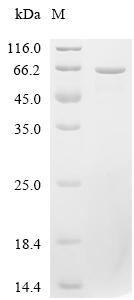
  • (Tris-Glycine gel) Discontinuous SDS-PAGE (reduced) with 5% enrichment gel and 15% separation gel.
Have Questions? Leave a Message or Start an on-line Chat

Product Details

Purity
Greater than 85% as determined by SDS-PAGE.
Target Names
prfC
Uniprot No.
Research Area
Others
Species
Escherichia coli (strain K12)
Source
E.coli
Expression Region
2-529aa
Target Protein Sequence
TLSPYLQEVAKRRTFAIISHPDAGKTTITEKVLLFGQAIQTAGTVKGRGSNQHAKSDWMEMEKQRGISITTSVMQFPYHDCLVNLLDTPGHEDFSEDTYRTLTAVDCCLMVIDAAKGVEDRTRKLMEVTRLRDTPILTFMNKLDRDIRDPMELLDEVENELKIGCAPITWPIGCGKLFKGVYHLYKDETYLYQSGKGHTIQEVRIVKGLNNPDLDAAVGEDLAQQLRDELELVKGASNEFDKELFLAGEITPVFFGTALGNFGVDHMLDGLVEWAPAPMPRQTDTRTVEASEDKFTGFVFKIQANMDPKHRDRVAFMRVVSGKYEKGMKLRQVRTAKDVVISDALTFMAGDRSHVEEAYPGDILGLHNHGTIQIGDTFTQGEMMKFTGIPNFAPELFRRIRLKDPLKQKQLLKGLVQLSEEGAVQVFRPISNNDLIVGAVGVLQFDVVVARLKSEYNVEAVYESVNVATARWVECADAKKFEEFKRKNESQLALDGGDNLAYIATSMVNLRLAQERYPDVQFHQTREH
Note: The complete sequence may include tag sequence, target protein sequence, linker sequence and extra sequence that is translated with the protein sequence for the purpose(s) of secretion, stability, solubility, etc.
If the exact amino acid sequence of this recombinant protein is critical to your application, please explicitly request the full and complete sequence of this protein before ordering.
Mol. Weight
66.4 kDa
Protein Length
Full Length of Mature Protein
Tag Info
C-terminal 6xHis-tagged
Form
Liquid or Lyophilized powder
Note: We will preferentially ship the format that we have in stock, however, if you have any special requirement for the format, please remark your requirement when placing the order, we will prepare according to your demand.
Buffer
If the delivery form is liquid, the default storage buffer is Tris/PBS-based buffer, 5%-50% glycerol. If the delivery form is lyophilized powder, the buffer before lyophilization is Tris/PBS-based buffer, 6% Trehalose, pH 8.130.
Reconstitution
We recommend that this vial be briefly centrifuged prior to opening to bring the contents to the bottom. Please reconstitute protein in deionized sterile water to a concentration of 0.1-1.0 mg/mL.We recommend to add 5-50% of glycerol (final concentration) and aliquot for long-term storage at -20℃/-80℃. Our default final concentration of glycerol is 50%. Customers could use it as reference.
Troubleshooting and FAQs
Storage Condition
Store at -20°C/-80°C upon receipt, aliquoting is necessary for mutiple use. Avoid repeated freeze-thaw cycles.
Shelf Life
The shelf life is related to many factors, storage state, buffer ingredients, storage temperature and the stability of the protein itself.
Generally, the shelf life of liquid form is 6 months at -20°C/-80°C. The shelf life of lyophilized form is 12 months at -20°C/-80°C.
Lead Time
Basically, we can dispatch the products out in 3-7 working days after receiving your orders. Delivery time may differ from different purchasing way or location, please kindly consult your local distributors for specific delivery time.
Datasheet & COA
Please contact us to get it.
Customer Reviews and Q&A

 Customer Reviews

There are currently no reviews for this product.

Submit a Review here

Target Background

Function
Increases the formation of ribosomal termination complexes and stimulates activities of RF-1 and RF-2. It binds guanine nucleotides and has strong preference for UGA stop codons. It may interact directly with the ribosome. The stimulation of RF-1 and RF-2 is significantly reduced by GTP and GDP, but not by GMP.
Gene References into Functions
  1. Data show that peptide chain release factor RF-3 (RF3) hydrolyzes GTP and dissociates from the ribosome before peptide chain release factor RF-1 (RF1)dissociation. PMID: 27779391
  2. Together, these data define a more precise role for RF3 in translation termination and provide insights into the function of this family of translational GTPases PMID: 24667215
  3. Ordering of critical elements of switch loop I and the P loop, which help to form the GTPase catalytic site, are caused by interactions between the G domain of RF3. PMID: 22187675
  4. Data suggest how RF3, by stabilizing the hybrid state of the ribosome, facilitates the dissociation of class I release factors. PMID: 21903932
  5. Study examines the role of RF3 in the bacterial cell and show that the deletion of this gene sensitizes cells to other perturbations that reduce the overall fidelity of protein synthesis. PMID: 22000017
  6. Data show a novel class of RF3 mutations specifically defective in the tRNA drop-off reaction, and these mutations suggest differential molecular pathways closely related to the guanine nucleotide modes of RF3. PMID: 20043913
  7. The data show that RF3*GTP binding induces large conformational changes in the ribosome, which break the interactions of the class I RF with both the decoding center and the GTPase-associated center leading to the release of the class I RF. PMID: 17540173

Show More

Hide All

Subcellular Location
Cytoplasm.
Protein Families
TRAFAC class translation factor GTPase superfamily, Classic translation factor GTPase family, PrfC subfamily
Database Links
icon of phone
Call us
301-363-4651 (Available 9 a.m. to 5 p.m. CST from Monday to Friday)
icon of address
Address
7505 Fannin St., Ste 610, Room 7 (CUBIO Innovation Center), Houston, TX 77054, USA
icon of social media
Join us with

Subscribe newsletter

Leave a message

* To protect against spam, please pass the CAPTCHA test below.
CAPTCHA verification
© 2007-2026 CUSABIO TECHNOLOGY LLC All rights reserved. 鄂ICP备15011166号-1
Place an order now

I. Product details

*
*
*
*

II. Contact details

*
*

III. Ship To

*
*
*
*
*
*
*

IV. Bill To

*
*
*
*
*
*
*
*



