Recombinant Escherichia coli Ribosome-recycling factor (frr)

Code CSB-EP014941ENV
Abbreviation Recombinant E.coli frr protein
MSDS
Size $256
Order now
Image
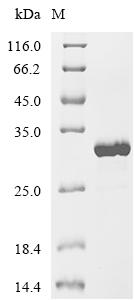
  • (Tris-Glycine gel) Discontinuous SDS-PAGE (reduced) with 5% enrichment gel and 15% separation gel.
Have Questions? Leave a Message or Start an on-line Chat

Product Details

Purity
Greater than 90% as determined by SDS-PAGE.
Target Names
frr
Uniprot No.
Research Area
Others
Alternative Names
Ribosome-releasing factor
Species
Escherichia coli (strain K12)
Source
E.coli
Expression Region
1-185aa
Target Protein Sequence
MISDIRKDAEVRMDKCVEAFKTQISKIRTGRASPSLLDGIVVEYYGTPTPLRQLASVTVEDSRTLKINVFDRSMSPAVEKAIMASDLGLNPNSAGSDIRVPLPPLTEERRKDLTKIVRGEAEQARVAVRNVRRDANDKVKALLKDKEISEDDDRRSQDDVQKLTDAAIKKIEAALADKEAELMQF
Note: The complete sequence may include tag sequence, target protein sequence, linker sequence and extra sequence that is translated with the protein sequence for the purpose(s) of secretion, stability, solubility, etc.
If the exact amino acid sequence of this recombinant protein is critical to your application, please explicitly request the full and complete sequence of this protein before ordering.
Mol. Weight
27.6 kDa
Protein Length
Full Length
Tag Info
C-terminal 6xHis-tagged
Form
Liquid or Lyophilized powder
Note: We will preferentially ship the format that we have in stock, however, if you have any special requirement for the format, please remark your requirement when placing the order, we will prepare according to your demand.
Buffer
If the delivery form is liquid, the default storage buffer is Tris/PBS-based buffer, 5%-50% glycerol. If the delivery form is lyophilized powder, the buffer before lyophilization is Tris/PBS-based buffer, 6% Trehalose, pH 8.133.
Reconstitution
We recommend that this vial be briefly centrifuged prior to opening to bring the contents to the bottom. Please reconstitute protein in deionized sterile water to a concentration of 0.1-1.0 mg/mL.We recommend to add 5-50% of glycerol (final concentration) and aliquot for long-term storage at -20℃/-80℃. Our default final concentration of glycerol is 50%. Customers could use it as reference.
Troubleshooting and FAQs
Storage Condition
Store at -20°C/-80°C upon receipt, aliquoting is necessary for mutiple use. Avoid repeated freeze-thaw cycles.
Shelf Life
The shelf life is related to many factors, storage state, buffer ingredients, storage temperature and the stability of the protein itself.
Generally, the shelf life of liquid form is 6 months at -20°C/-80°C. The shelf life of lyophilized form is 12 months at -20°C/-80°C.
Lead Time
Basically, we can dispatch the products out in 3-7 working days after receiving your orders. Delivery time may differ from different purchasing way or location, please kindly consult your local distributors for specific delivery time.
Datasheet & COA
Please contact us to get it.
Customer Reviews and Q&A

 Customer Reviews

There are currently no reviews for this product.

Submit a Review here

Target Background

Function
Responsible for the release of ribosomes from messenger RNA at the termination of protein biosynthesis. May increase the efficiency of translation by recycling ribosomes from one round of translation to another.
Gene References into Functions
  1. Ribosome recycling after peptide chain termination is a special case of the general RRF and EF-G function, which happens whenever fMet-tRNA is not available for triggering 70S scanning. PMID: 27261258
  2. Data show that monosomes produced in ribosome recycling factor-deficient cells are able to translate synthetic homopolymer but not natural mRNA with leader and canonical initiation signal. PMID: 15522083
  3. data enable a model to be proposed for the dual action of EF-G and RRF during ribosome recycling PMID: 15616575
  4. domain II of RRF plays a crucial role in the concerted action of RRF and EF-G for the post-termination complex disassembly, and the specific interaction between RRF and EF-G on ribosomes mainly depends on the interaction between domain II of RRF and EF-G PMID: 16262604
  5. V117D mutation does not perturb the efficient interdomain interaction, which results in cooperative unfolding of the RRF protein. PMID: 16684502
  6. RRF is capable of spontaneously moving from its initial binding site on the 70S ribosome to a site exclusively on the large 50S ribosomal subunit. PMID: 17643374
  7. The disruption of bridge B2a upon RRF binding to the ribosome seen in the present structures reveals one of the key roles that RRF plays in ribosome recycling, the dissociation of 70S ribosomes into subunits. PMID: 18234219

Show More

Hide All

Subcellular Location
Cytoplasm.
Protein Families
RRF family
Database Links
icon of phone
Call us
301-363-4651 (Available 9 a.m. to 5 p.m. CST from Monday to Friday)
icon of address
Address
7505 Fannin St., Ste 610, Room 7 (CUBIO Innovation Center), Houston, TX 77054, USA
icon of social media
Join us with

Subscribe newsletter

Leave a message

* To protect against spam, please pass the CAPTCHA test below.
CAPTCHA verification
© 2007-2026 CUSABIO TECHNOLOGY LLC All rights reserved. 鄂ICP备15011166号-1
Place an order now

I. Product details

*
*
*
*

II. Contact details

*
*

III. Ship To

*
*
*
*
*
*
*

IV. Bill To

*
*
*
*
*
*
*
*



