Recombinant Human Acylglycerol kinase, mitochondrial (AGK)

Code CSB-MP706634HU
Abbreviation Recombinant Human AGK protein
MSDS
Size $138
Order now
Image
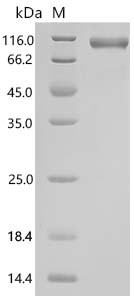
  • (Tris-Glycine gel) Discontinuous SDS-PAGE (reduced) with 5% enrichment gel and 15% separation gel.
Have Questions? Leave a Message or Start an on-line Chat

Product Details

Purity
Greater than 95% as determined by SDS-PAGE.
Activity
Not Test
Target Names
AGK
Uniprot No.
Research Area
Cancer
Alternative Names
Multiple substrate lipid kinase
Species
Homo sapiens (Human)
Source
Mammalian cell
Expression Region
1-422aa
Target Protein Sequence
MTVFFKTLRNHWKKTTAGLCLLTWGGHWLYGKHCDNLLRRAACQEAQVFGNQLIPPNAQVKKATVFLNPAACKGKARTLFEKNAAPILHLSGMDVTIVKTDYEGQAKKLLELMENTDVIIVAGGDGTLQEVVTGVLRRTDEATFSKIPIGFIPLGETSSLSHTLFAESGNKVQHITDATLAIVKGETVPLDVLQIKGEKEQPVFAMTGLRWGSFRDAGVKVSKYWYLGPLKIKAAHFFSTLKEWPQTHQASISYTGPTERPPNEPEETPVQRPSLYRRILRRLASYWAQPQDALSQEVSPEVWKDVQLSTIELSITTRNNQLDPTSKEDFLNICIEPDTISKGDFITIGSRKVRNPKLHVEGTECLQASQCTLLIPEGAGGSFSIDSEEYEAMPVEVKLLPRKLQFFCDPRKREQMLTSPTQ
Note: The complete sequence may include tag sequence, target protein sequence, linker sequence and extra sequence that is translated with the protein sequence for the purpose(s) of secretion, stability, solubility, etc.
If the exact amino acid sequence of this recombinant protein is critical to your application, please explicitly request the full and complete sequence of this protein before ordering.
Mol. Weight
51.0 kDa
Protein Length
Full Length
Tag Info
N-terminal 10xHis-tagged and C-terminal Myc-tagged
Form
Liquid or Lyophilized powder
Note: We will preferentially ship the format that we have in stock, however, if you have any special requirement for the format, please remark your requirement when placing the order, we will prepare according to your demand.
Buffer
If the delivery form is liquid, the default storage buffer is Tris/PBS-based buffer, 5%-50% glycerol. If the delivery form is lyophilized powder, the buffer before lyophilization is Tris/PBS-based buffer, 6% Trehalose, pH 8.0.
Reconstitution
We recommend that this vial be briefly centrifuged prior to opening to bring the contents to the bottom. Please reconstitute protein in deionized sterile water to a concentration of 0.1-1.0 mg/mL.We recommend to add 5-50% of glycerol (final concentration) and aliquot for long-term storage at -20℃/-80℃. Our default final concentration of glycerol is 50%. Customers could use it as reference.
Troubleshooting and FAQs
Storage Condition
Store at -20°C/-80°C upon receipt, aliquoting is necessary for mutiple use. Avoid repeated freeze-thaw cycles.
Shelf Life
The shelf life is related to many factors, storage state, buffer ingredients, storage temperature and the stability of the protein itself.
Generally, the shelf life of liquid form is 6 months at -20°C/-80°C. The shelf life of lyophilized form is 12 months at -20°C/-80°C.
Lead Time
Basically, we can dispatch the products out in 3-7 working days after receiving your orders. Delivery time may differ from different purchasing way or location, please kindly consult your local distributors for specific delivery time.
Notes
Repeated freezing and thawing is not recommended. Store working aliquots at 4°C for up to one week.
Datasheet & COA
Please contact us to get it.
Customer Reviews and Q&A

 Customer Reviews

There are currently no reviews for this product.

Submit a Review here

Target Background

Function
Lipid kinase that can phosphorylate both monoacylglycerol and diacylglycerol to form lysophosphatidic acid (LPA) and phosphatidic acid (PA), respectively. Does not phosphorylate sphingosine. Phosphorylates ceramide. Phosphorylates 1,2-dioleoylglycerol more rapidly than 2,3-dioleoylglycerol. Independently of its lipid kinase activity, acts as a component of the TIM22 complex. The TIM22 complex mediates the import and insertion of multi-pass transmembrane proteins into the mitochondrial inner membrane by forming a twin-pore translocase that uses the membrane potential as the external driving force. In the TIM22 complex, required for the import of a subset of metabolite carriers into mitochondria, such as ANT1/SLC25A4 and SLC25A24, while it is not required for the import of TIMM23. Overexpression increases the formation and secretion of LPA, resulting in transactivation of EGFR and activation of the downstream MAPK signaling pathway, leading to increased cell growth.
Gene References into Functions
  1. The dual function of AGK as lipid kinase and constituent of the TIM22 complex reveals that disturbances in both phospholipid metabolism and mitochondrial protein biogenesis contribute to the pathogenesis of Sengers syndrome. PMID: 28712724
  2. Identify AGK as a bona fide subunit of TIM22 providing an exciting and unexpected link between mitochondrial protein import and Sengers syndrome. PMID: 28712726
  3. Acylglycerol kinase functions as an oncogene and an unfavorable prognostic marker for human gliomas. PMID: 27574811
  4. We showed that AGK was over-expressed in cervical cancer cell lines and clinical tissues, and over-expression of AGK was associated with poor survival outcomes of early-stage CSCC patients. AGK can be used as an independent prognostic marker for early-stage CSCC. PMID: 26662108
  5. Data suggest that acylglycerol kinase (AGK) has potential as a prognostic factor for overall survival in nasopharyngeal carcinoma (NPC). PMID: 26443540
  6. AGK promotes the proliferation and cell cycle progression of oral squamous cell carcinoma. PMID: 25872568
  7. miR-194 could reduce the phosphoinositide 3-kinase (PI3K)/AKT/FoxO3a signaling pathway by suppressing acylglycerol kinase (AGK) directly. PMID: 25960215
  8. findings provide new evidence that AGK plays an important role in promoting angiogenesis and providing resistance to apoptosis in hepatocellular carcinoma PMID: 25474138
  9. compare our findings to those in 21 previously reported AGK mutation-positive Sengers patients, confirming that Sengers syndrome is a clinically recognisable disorder of mitochondrial energy metabolism PMID: 25208612
  10. AGK promotes cell proliferation and tumorigenicity in breast cancer via suppression of the FOXO1. PMID: 24886245
  11. Our findings suggest that ATX-AGK-LPA signaling axis might be an important player in the development and progression of diabetic retinopathy. PMID: 22864860
  12. AGK expression was significantly correlated with JAK2/STAT3 hyperactivation in esophageal squamous cell carcinoma, as well as in lung and breast cancer. PMID: 23676499
  13. study reports 2 families with Sengers syndrome and mutations in the acylglycerol kinase gene; 1 proband had abnormal mitochondria with citrate synthase crystals, associated with high citrate synthase activity; these pedigrees confirm that mutation of AGK is responsible for the severe neonatal presentation of Sengers syndrome PMID: 23266196
  14. This is the first mutation in AGK gene to be implicated in the development of isolated cataract. PMID: 22415731
  15. The loss of AGK led to a decrease of the adenine nucleotide translocator in the inner mitochondrial membrane in muscle. PMID: 22284826
  16. Recessive mutations in AGK cause mitochondrial DNA depletion PMID: 22277967
  17. Lack of the AGK causes Sengers syndrome PMID: 22284826
  18. identification and characterization of a novel lipid kinase that phosphorylates multiple substrates, MuLK PMID: 15252046
  19. The chiral specificity of diacylglycerol kinase alpha, zeta & epsilon mimics the substrate specificity, with MuLK being the least selective and the epsilon isoform of diacylglycerol kinase exhibiting the greatest selectivity. PMID: 18004883
  20. High Expression of acylglycerol kinase is associated with development and progression of prostate cancer. PMID: 19549252

Show More

Hide All

Involvement in disease
Mitochondrial DNA depletion syndrome 10 (MTDPS10); Cataract 38 (CTRCT38)
Subcellular Location
Mitochondrion inner membrane; Peripheral membrane protein. Mitochondrion intermembrane space.
Protein Families
AGK family
Tissue Specificity
Highly expressed in muscle, heart, kidney and brain.
Database Links

HGNC: 21869

OMIM: 212350

KEGG: hsa:55750

STRING: 9606.ENSP00000347581

UniGene: Hs.743318

icon of phone
Call us
301-363-4651 (Available 9 a.m. to 5 p.m. CST from Monday to Friday)
icon of address
Address
7505 Fannin St., Ste 610, Room 7 (CUBIO Innovation Center), Houston, TX 77054, USA
icon of social media
Join us with

Subscribe newsletter

Leave a message

* To protect against spam, please pass the CAPTCHA test below.
CAPTCHA verification
© 2007-2026 CUSABIO TECHNOLOGY LLC All rights reserved. 鄂ICP备15011166号-1
Place an order now

I. Product details

*
*
*
*

II. Contact details

*
*

III. Ship To

*
*
*
*
*
*
*

IV. Bill To

*
*
*
*
*
*
*
*



