Recombinant Mouse IgG receptor FcRn large subunit p51 (Fcgrt), partial

In Stock
Code CSB-EP717217MO
Abbreviation Recombinant Mouse Fcgrt protein, partial
MSDS
Size $256
Order now
Image
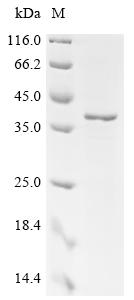
  • (Tris-Glycine gel) Discontinuous SDS-PAGE (reduced) with 5% enrichment gel and 15% separation gel.
Have Questions? Leave a Message or Start an on-line Chat

Product Details

Purity
Greater than 85% as determined by SDS-PAGE.
Activity
Not Test
Target Names
Uniprot No.
Research Area
Cancer
Alternative Names
FcRn;IgG Fc fragment receptor transporter alpha chain;Neonatal Fc receptor
Species
Mus musculus (Mouse)
Source
E.coli
Expression Region
22-297aa
Target Protein Sequence
SETRPPLMYHLTAVSNPSTGLPSFWATGWLGPQQYLTYNSLRQEADPCGAWMWENQVSWYWEKETTDLKSKEQLFLEALKTLEKILNGTYTLQGLLGCELASDNSSVPTAVFALNGEEFMKFNPRIGNWTGEWPETEIVANLWMKQPDAARKESEFLLNSCPERLLGHLERGRRNLEWKEPPSMRLKARPGNSGSSVLTCAAFSFYPPELKFRFLRNGLASGSGNCSTGPNGDGSFHAWSLLEVKRGDEHHYQCQVEHEGLAQPLTVDLDSSARSS
Note: The complete sequence may include tag sequence, target protein sequence, linker sequence and extra sequence that is translated with the protein sequence for the purpose(s) of secretion, stability, solubility, etc.
If the exact amino acid sequence of this recombinant protein is critical to your application, please explicitly request the full and complete sequence of this protein before ordering.
Mol. Weight
37.9
Protein Length
Partial
Tag Info
C-terminal 6xHis-tagged
Form
Liquid or Lyophilized powder
Note: We will preferentially ship the format that we have in stock, however, if you have any special requirement for the format, please remark your requirement when placing the order, we will prepare according to your demand.
Buffer
If the delivery form is liquid, the default storage buffer is Tris/PBS-based buffer, 5%-50% glycerol. If the delivery form is lyophilized powder, the buffer before lyophilization is Tris/PBS-based buffer, 6% Trehalose.
Reconstitution
We recommend that this vial be briefly centrifuged prior to opening to bring the contents to the bottom. Please reconstitute protein in deionized sterile water to a concentration of 0.1-1.0 mg/mL.We recommend to add 5-50% of glycerol (final concentration) and aliquot for long-term storage at -20°C/-80°C. Our default final concentration of glycerol is 50%. Customers could use it as reference.
Troubleshooting and FAQs
Storage Condition
Store at -20°C/-80°C upon receipt, aliquoting is necessary for mutiple use. Avoid repeated freeze-thaw cycles.
Shelf Life
The shelf life is related to many factors, storage state, buffer ingredients, storage temperature and the stability of the protein itself.
Generally, the shelf life of liquid form is 6 months at -20°C/-80°C. The shelf life of lyophilized form is 12 months at -20°C/-80°C.
Lead Time
3-7 business days
Notes
Repeated freezing and thawing is not recommended. Store working aliquots at 4°C for up to one week.
Datasheet & COA
Please contact us to get it.
Customer Reviews and Q&A

 Customer Reviews

There are currently no reviews for this product.

Submit a Review here

Target Background

Function
Cell surface receptor that transfers passive humoral immunity from the mother to the newborn. Binds to the Fc region of monomeric immunoglobulin gamma and mediates its selective uptake from milk. IgG in the milk is bound at the apical surface of the intestinal epithelium. The resultant FcRn-IgG complexes are transcytosed across the intestinal epithelium and IgG is released from FcRn into blood or tissue fluids. Throughout life, contributes to effective humoral immunity by recycling IgG and extending its half-life in the circulation. Mechanistically, monomeric IgG binding to FcRn in acidic endosomes of endothelial and hematopoietic cells recycles IgG to the cell surface where it is released into the circulation. In addition of IgG, regulates homeostasis of the other most abundant circulating protein albumin/ALB.
Gene References into Functions
  1. The main function of hepatic FcRn is to direct albumin into the circulation, thereby also increasing hepatocyte sensitivity to toxicity. PMID: 28330995
  2. Preproinsulin fused to Fc administered to pregnant mice efficiently accumulated in fetuses through the placental neonatal Fc receptor and protected them from subsequent diabetes development. PMID: 25918233
  3. The neonatal Fc receptor (FcRn) binds independently to both sites of the IgG homodimer with identical affinity. PMID: 25658443
  4. Characterization and screening of IgG binding to the neonatal Fc receptor. PMID: 24802048
  5. Fc receptor promotes formation of subepithelial immune complexes and subsequent glomerular pathology leading to proteinuria PMID: 24357670
  6. Abundant intracellular IgG in enterocytes and endoderm lacking FcRn. PMID: 23923029
  7. Extending serum half-life of albumin by engineering neonatal Fc receptor (FcRn) binding. PMID: 24652290
  8. FcRn thus has a primary role within mucosal tissues in activating local immune responses that are critical for priming efficient anti-tumor immunosurveillance PMID: 24290911
  9. Neonatal Fc receptor for IgG uptake mediates intestinal absorption of IgG(1) anti-IgE/IgE immune complexes. PMID: 23181795
  10. AMG 386 clearance in FcRn-knockout mice was 18-fold faster at the 3-mg/kg dose. PMID: 22189693
  11. an increase in lymphoid follicles and Helicobacter bacterial load in knock-out mice PMID: 22089027
  12. Data show that FcRn traps antigen and protects it from degradation within an acidic loading compartment in association with the rapid recruitment of key components of the phagosome-to-cytosol cross-presentation machinery. PMID: 21628593
  13. Findings reveal that FcRn expression has a different effect on Ag processing and presentation of ICs to CD4(+) T cells in the endosomal versus phagosomal compartments of Ms versus DCs. PMID: 21402891
  14. These studies demonstrate that FcRn-mediated transport is a mechanism by which IgG can act locally in the female genital tract in immune surveillance and in host defense against sexually transmitted diseases. PMID: 21368166
  15. Fetal, but not maternal, FcRn is required for induction of Fetal and neonatal immune thrombocytopenia. PMID: 20647570
  16. No binding of albumin was observed at physiological pH to neonatal Fc receptor. At acidic pH, a 100-fold difference in binding affinity was observed. PMID: 20018855
  17. Mouse FcRn is promiscuous in its antibody binding specificity, interacting with IgG from human, mouse, rabbit, guinea pig, bovine, sheep and rat. PMID: 11717196
  18. Direct evidence is provided that FcRn is responsible for both perinatal IgG transport and IgG homeostatic function. PMID: 12646614
  19. FcRn promotes humorally mediated autoimmune disease. PMID: 15124024
  20. sequence analysis of promoter indicates that availability of specific TFs may contribute to the regulation of Fcgrt expression PMID: 15627500
  21. the amount of albumin saved from degradation by FcRn-mediated recycling is the same as that produced by the liver PMID: 16210471
  22. report a therapeutic strategy to beneficially alter the pharmacokinetics of IgG antibodies via pharmacological inhibition of the neonatal Fc receptor (FcRn) using high-dose IgG therapy PMID: 17717602
  23. Mice lacking FcRn accumulated IgG in the glomerular basement membrane as they aged, and tracer studies showed delayed clearance of IgG from the kidneys of FcRn-deficient mice PMID: 18198272
  24. FcRn maintains levels of pathogenic autoantibodies and thereby promotes tissue injury in experimental epidermolysis bullosa acquisita. PMID: 18542899
  25. A previously undescribed role for FcRn in mediating the presentation of antigens by dendritic cells when antigens are present as a complex with antibody, is shown. PMID: 18599440
  26. The intracellular trafficking pathway and functions of FcRn may be altered by the association of major histocompatibility (MHC) class II invariant chain (Ii) during physiological and inflammatory conditions. PMID: 18684948
  27. Results indicate that FcRn-dependent internalization of IgG may be important not only in cells taking up IgG from an extracellular acidic space, but also in endothelial cells participating in homeostatic regulation of circulating IgG levels. PMID: 18843053
  28. FcRn is responsible for virtually all immunoglobulin G transport from mother to fetus during gestation. PMID: 19234152
  29. renal FcRn reclaims albumin, thereby maintaining the serum concentration of albumin, but facilitates the loss of IgG from plasma protein pools PMID: 19661163

Show More

Hide All

Subcellular Location
Cell membrane; Single-pass type I membrane protein. Endosome membrane.
Protein Families
Immunoglobulin superfamily
Tissue Specificity
Intestinal epithelium of suckling rodents. Expressed in neonatal intestine and fetal yolk sac.
Database Links
icon of phone
Call us
301-363-4651 (Available 9 a.m. to 5 p.m. CST from Monday to Friday)
icon of address
Address
7505 Fannin St., Ste 610, Room 7 (CUBIO Innovation Center), Houston, TX 77054, USA
icon of social media
Join us with

Subscribe newsletter

Leave a message

* To protect against spam, please pass the CAPTCHA test below.
CAPTCHA verification
© 2007-2026 CUSABIO TECHNOLOGY LLC All rights reserved. 鄂ICP备15011166号-1
Place an order now

I. Product details

*
*
*
*

II. Contact details

*
*

III. Ship To

*
*
*
*
*
*
*

IV. Bill To

*
*
*
*
*
*
*
*



