
Call us
301-363-4651 (Available 9 a.m. to 5 p.m. CST from Monday to Friday)

| Code | CSB-RA797631A0HU |
| Size | US$210 |
| Order now | |
| Image |
|
| Have Questions? | Leave a Message or Start an on-line Chat |
| Application | Recommended Dilution |
|---|---|
| IF | 1:20-1:200 |
ADAM17, also known as TNF-alpha-converting enzyme (TACE), serves as a critical membrane-bound metalloproteinase responsible for the proteolytic release of numerous cell surface proteins, including TNF-alpha, EGF receptor ligands, and various adhesion molecules. This sheddase activity positions ADAM17 at the intersection of inflammatory signaling, tumor microenvironment regulation, and cellular communication pathways, making it an essential target for researchers investigating cancer progression, neurological disorders, metabolic dysfunction, and stem cell biology.
This recombinant monoclonal antibody, clone 5A1, offers the reproducibility and consistency that demanding experimental workflows require. Because the antibody sequence is defined and produced recombinantly in rabbit host cells, researchers can expect uniform performance across experiments and between lots, eliminating the variability often encountered with traditional hybridoma-derived antibodies. The affinity-chromatography purification ensures high specificity for the target epitope, which was generated against a synthetic peptide derived from human ADAM17.
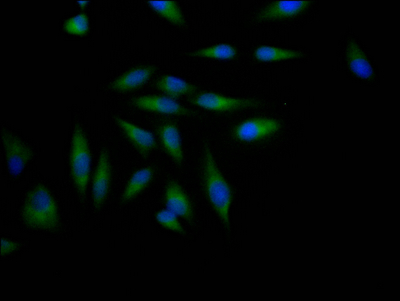
Validation studies demonstrate effective performance in immunofluorescence applications, with successful staining observed in HeLa cells at dilutions ranging from 1:20 to 1:200. In these experiments, cells were fixed with formaldehyde, permeabilized with Triton X-100, and blocked with normal goat serum before overnight primary antibody incubation, yielding clear signal detection when paired with FITC-conjugated secondary antibodies. The antibody is also suitable for ELISA-based detection methods, providing flexibility for both imaging and quantitative approaches.
Whether investigating TNF-alpha shedding mechanisms, characterizing ADAM17 expression patterns in cancer models, or exploring its role in signal transduction pathways, this antibody delivers the reliability needed for meaningful experimental outcomes in human cell systems.
There are currently no reviews for this product.





