
Call us
301-363-4651 (Available 9 a.m. to 5 p.m. CST from Monday to Friday)

| Code | CSB-RA180846A0HU |
| Size | US$210 |
| Order now | |
| Image |
|
| Have Questions? | Leave a Message or Start an on-line Chat |
| Application | Recommended Dilution |
|---|---|
| WB | 1:500-1:5000 |
| IHC | 1:50-1:200 |
ATF5 is a member of the ATF/CREB family of basic leucine zipper transcription factors that plays critical roles in cellular stress responses, differentiation, and survival signaling. This transcription factor has garnered significant research interest due to its involvement in neural development, adipocyte differentiation, and notably its overexpression in various cancer types, where it appears to promote cell survival under stress conditions. Understanding ATF5 regulation and expression patterns provides valuable insights into both normal cellular physiology and disease mechanisms.
This recombinant monoclonal antibody, generated from clone 9D8, offers the consistency and reliability that demanding research applications require. Because the antibody sequence is defined and produced recombinantly in rabbit host cells, researchers benefit from lot-to-lot reproducibility that ensures experimental results remain comparable across extended studies. The affinity-chromatography purification yields a high-quality reagent suitable for quantitative work.
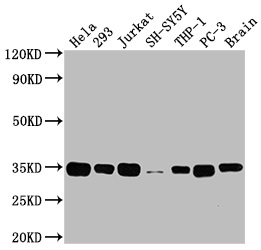
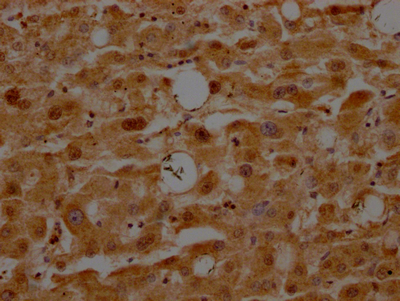
Validation studies demonstrate robust performance across multiple experimental platforms. In western blot applications, the antibody successfully detects ATF5 in a diverse panel of human cell lines including HeLa, 293, Jurkat, SH-SY5Y, THP-1, and PC-3, as well as rat brain tissue, confirming cross-species reactivity between human and rat samples. The observed band at approximately 35 kDa runs slightly higher than the predicted 31 kDa molecular weight, which likely reflects post-translational modifications such as phosphorylation events known to regulate ATF5 activity. For immunohistochemistry, the antibody has been validated in paraffin-embedded human liver tissue using standard antigen retrieval protocols.
This antibody serves researchers investigating epigenetics, nuclear signaling pathways, stress response mechanisms, and cancer biology where ATF5 dysregulation may contribute to disease progression.
There are currently no reviews for this product.





