
Call us
301-363-4651 (Available 9 a.m. to 5 p.m. CST from Monday to Friday)

| Code | CSB-RA986010A0HU |
| Size | US$210 |
| Order now | |
| Image |
|
| Have Questions? | Leave a Message or Start an on-line Chat |
| Application | Recommended Dilution |
|---|---|
| IHC | 1:50-1:200 |
| FC | 1:50-1:200 |
BRMS1 (Breast cancer metastasis-suppressor 1) plays a critical role in regulating cancer metastasis by modulating gene expression and signaling pathways that control cell migration and invasion. Originally identified as a suppressor of metastasis in breast cancer models, BRMS1 has since been implicated in the progression of multiple tumor types, making it a valuable target for researchers investigating metastatic mechanisms, tumor suppressor networks, and potential therapeutic strategies.
This recombinant monoclonal antibody, clone 5D3, offers the consistency and reproducibility that demanding research applications require. Generated against a synthetic peptide derived from human BRMS1, the antibody is produced using recombinant technology, ensuring sequence-defined specificity and eliminating the lot-to-lot variability often encountered with traditional hybridoma-derived antibodies. This reliability is particularly valuable for longitudinal studies or multi-site collaborations where experimental consistency is essential.
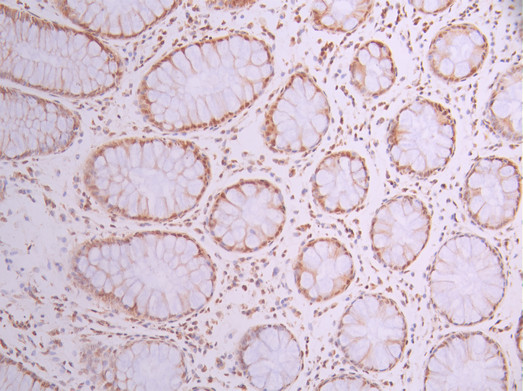
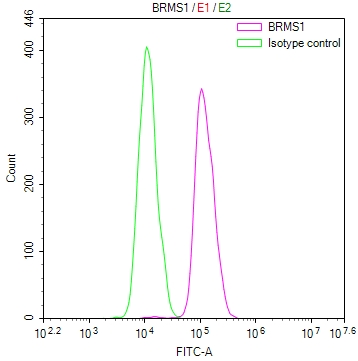
The antibody has been validated for immunohistochemistry and flow cytometry applications, providing flexibility across different experimental workflows. IHC validation in paraffin-embedded human small intestine tissue demonstrates clear staining at dilutions of 1:50 to 1:200, with antigen retrieval performed using citrate buffer at pH 6.0. Flow cytometry validation using HepG2 cells confirms the antibody's utility for intracellular detection in fixed and permeabilized samples, showing distinct signal separation from isotype control at 1:50 to 1:200 dilutions.
Supplied in a stabilized liquid format with glycerol for long-term storage at -20°C or -80°C, this affinity-purified rabbit IgG antibody is well-suited for researchers studying metastasis suppression, chromatin remodeling complexes, or BRMS1's broader roles in cancer biology and gene regulation.
There are currently no reviews for this product.





