C4BPB Recombinant Monoclonal Antibody

Code CSB-RA220182A0HU
Size US$210
Order now
Image
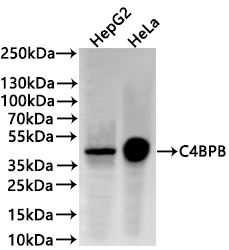
  • Western Blot
    Positive WB detected in: HepG2 whole cell lysate(30µg), HeLa whole cell lysate(30µg)
    All lanes: C4BPB antibody at 1:1000
    Secondary
    Goat polyclonal to rabbit IgG at 1/40000 dilution
    Predicted band size: 28 kDa
    Observed band size: 45 kDa
    Exposure time:1min
Have Questions? Leave a Message or Start an on-line Chat

Product Details

Uniprot No.
Target Names
Alternative Names
C4b-binding protein beta chain, C4BPB
Species Reactivity
Human
Immunogen
A synthesized peptide from human C4BPB protein
Immunogen Species
Homo sapiens (Human)
Conjugate
Non-conjugated
Clonality
Monoclonal
Isotype
Rabbit IgG
Clone No.
12H3
Purification Method
Affinity-chromatography
Concentration
It differs from different batches. Please contact us to confirm it.
Buffer
Rabbit IgG in 10mM phosphate buffered saline , pH 7.4, 150mM sodium chloride, 0.05% BSA, 0.02% sodium azide and 50% glycerol.
Form
Liquid
Tested Applications
ELISA, WB
Recommended Dilution
Application Recommended Dilution
WB 1:500-1:2000
Troubleshooting and FAQs
Storage
Upon receipt, store at -20°C or -80°C. Avoid repeated freeze.
Lead Time
Basically, we can dispatch the products out in 1-3 working days after receiving your orders. Delivery time maybe differs from different purchasing way or location, please kindly consult your local distributors for specific delivery time.
Description

C4BPB encodes the beta chain of C4b-binding protein, a key regulator of the classical complement pathway that plays an essential role in modulating inflammatory responses and immune homeostasis. This protein forms a complex with protein S and influences coagulation processes, making it a significant target for researchers investigating complement biology, thrombotic disorders, and autoimmune conditions.

This recombinant monoclonal antibody, clone 12H3, offers the reproducibility and consistency that demanding experimental workflows require. Because the antibody sequence is defined and production occurs in a controlled recombinant system, researchers can expect uniform performance across different lots, eliminating the variability often encountered with traditional hybridoma-derived antibodies. The rabbit host origin combined with monoclonal specificity provides high-affinity binding to human C4BPB, generated against a synthetic peptide immunogen.

Validation studies confirm reliable performance in Western blot applications, with successful detection demonstrated in HepG2 and HeLa whole cell lysates at dilutions ranging from 1:500 to 1:2000. Notably, while the predicted molecular weight of C4BPB is 28 kDa, the observed band migrates at approximately 45 kDa. This size difference is consistent with extensive post-translational modifications, particularly glycosylation, which is characteristic of secreted complement regulatory proteins and reflects the native, biologically relevant form of the protein. The antibody is also validated for ELISA, providing flexibility for quantitative detection approaches.

Supplied in a glycerol-containing buffer optimized for long-term storage stability, this affinity-purified antibody serves researchers exploring complement regulation, coagulation pathway interactions, and inflammatory disease mechanisms where C4BPB function is implicated.

Usage
For Research Use Only. Not for use in diagnostic or therapeutic procedures.

Customer Reviews and Q&A

 Customer Reviews

There are currently no reviews for this product.

Submit a Review here

Target Background

Function
Controls the classical pathway of complement activation. It binds as a cofactor to C3b/C4b inactivator (C3bINA), which then hydrolyzes the complement fragment C4b. It also accelerates the degradation of the C4bC2a complex (C3 convertase) by dissociating the complement fragment C2a. It also interacts with anticoagulant protein S and with serum amyloid P component. The beta chain binds protein S.
Gene References into Functions
  1. SAA, PROZ, and C4BPB may serve as new potential biomarkers for TB PMID: 28278182
  2. Binding of complement inhibitor C4b-binding protein to a highly virulent Streptococcus pyogenes M1 strain is mediated by protein H and enhances adhesion to and invasion of endothelial cells. PMID: 24064215
  3. crystallographic data on the structure of CD11c/CD18 and prediction of the secondary structure of the C4BP oligomerization domain, we show that epitopes bound by KIM185 in these proteins are unlikely to share any major structural similarity. PMID: 21856004
  4. C4BP alpha7beta0 subunit [C4BP alpha7beta0 isoform lacking the beta-chain] induces a semimature, tolerogenic state on human monocyte-derived dendritic cells activated by a proinflammatory stimulus. PMID: 23390292
  5. Since FI requires cofactors for its activity we also investigated the binding of purified cofactors C4BP and FH and found acquisition of both proteins, which retained their activity in FI mediated degradation of C3b and C4b. PMID: 22514678
  6. Results demonstrate that successful secretion of complement regulatory protein C4b-binding protein beta-chains depends on intracellular complex formation with vitamin K-dependent protein S, but not on the alpha-chains. PMID: 20693287
  7. Localized via protein S to the surface of apoptotic cells, C4BP is able to interact with complement protein C4b, thus retaining its physiological role in regulation of complement on the apoptotic cell surface. PMID: 12193728
  8. C4BP is composed of seven alpha-chains and a unique beta-chain, each chain comprising repeating complement control protein (CCP) modules, the results suggest that the role of CCP2 in protein S binding is to orient and stabilize CCP1 PMID: 12492479
  9. C4b-binding protein binds to necrotic cells and DNA, limiting DNA release and inhibiting complement activation. PMID: 15967823
  10. analysis of structural basis for C4b-binding protein interaction with streptococcal M protein PMID: 16330538
  11. review of multiple functional roles of the complex of protein S and cd4-binding protein beta chain, such as binding to apoptotoic cells, phagocytosis PMID: 17597997
  12. C4BP levels are increased in patients suffering from primary Sjogren's syndrome PMID: 19284503

Show More

Hide All

Subcellular Location
Secreted.
Database Links

HGNC: 1328

OMIM: 120831

KEGG: hsa:725

STRING: 9606.ENSP00000243611

UniGene: Hs.99886

icon of phone
Call us
301-363-4651 (Available 9 a.m. to 5 p.m. CST from Monday to Friday)

icon of address
Address
No. 269, Shendun 5th Road, Donghu Hi-Tech Development Area, Hubei Province, 430206, P.R.China
icon of social media
Join us with

Subscribe newsletter

Leave a message

* To protect against spam, please pass the CAPTCHA test below.
CAPTCHA verification
© 2007-2026 CUSABIO TECHNOLOGY LLC All rights reserved. 鄂ICP备15011166号-1
Place an order now

I. Product details

*
*
*
*

II. Contact details

*
*

III. Ship To

*
*
*
*
*
*
*

IV. Bill To

*
*
*
*
*
*
*
*


