
Call us
301-363-4651 (Available 9 a.m. to 5 p.m. CST from Monday to Friday)

| Code | CSB-RA910400A0HU |
| Size | US$210 |
| Order now | |
| Image |
|
| Have Questions? | Leave a Message or Start an on-line Chat |
| Application | Recommended Dilution |
|---|---|
| WB | 1:500-1:2000 |
| IHC | 1:50-1:200 |
CDC40, also known as pre-mRNA-processing factor 17, plays an essential role in the spliceosome machinery that governs pre-mRNA splicing. As a component of the catalytic step II spliceosome, CDC40 participates in the precise removal of introns from nascent transcripts, making it a protein of significant interest for researchers investigating RNA processing, cell cycle regulation, and the molecular mechanisms underlying splicing-related diseases.
This recombinant monoclonal antibody, generated from clone 10C12, offers the reproducibility and consistency that demanding experimental workflows require. Because recombinant antibodies are produced from defined genetic sequences rather than traditional hybridoma methods, researchers benefit from lot-to-lot uniformity that supports reliable data across extended studies and multi-site collaborations. The rabbit IgG format and affinity-chromatography purification ensure high specificity for CDC40 detection.
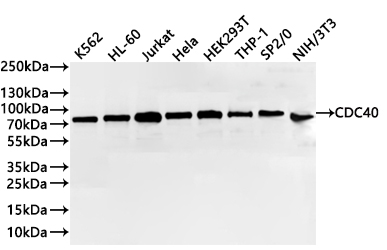
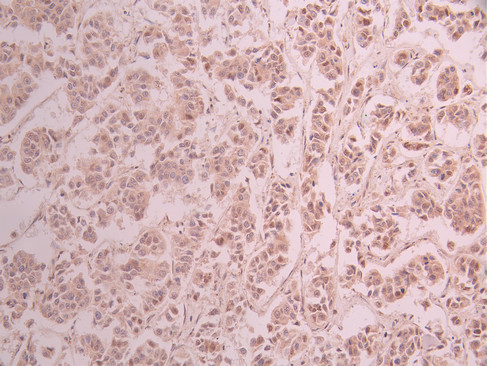
Validation studies demonstrate robust performance across multiple applications. In western blot analysis, this antibody successfully detects CDC40 in a broad panel of human cell lines including K562, HL-60, Jurkat, HeLa, HEK293T, and THP-1, as well as mouse cell lines SP2/0 and NIH/3T3, confirming cross-species reactivity between human and mouse samples. The observed band at approximately 74 kDa runs slightly higher than the predicted 66 kDa molecular weight, a shift commonly attributable to post-translational modifications such as glycosylation. For tissue-based studies, immunohistochemistry validation in paraffin-embedded human breast cancer tissue demonstrates clear staining with appropriate signal intensity.
This antibody serves researchers exploring spliceosome biology, cell division mechanisms, and cancer-associated splicing alterations, providing a dependable tool for both cell-based and tissue investigations.
There are currently no reviews for this product.





