
Call us
301-363-4651 (Available 9 a.m. to 5 p.m. CST from Monday to Friday)

| Code | CSB-RA137096A0HU |
| Size | US$210 |
| Order now | |
| Image |
|
| Have Questions? | Leave a Message or Start an on-line Chat |
| Application | Recommended Dilution |
|---|---|
| WB | 1:500-1:2000 |
| IHC | 1:50-1:200 |
| FC | 1:50-1:200 |
Dihydropyrimidine dehydrogenase (DPYD) serves as the initial and rate-limiting enzyme in the pyrimidine catabolic pathway, catalyzing the reduction of uracil and thymine. This enzyme has gained substantial research attention due to its critical role in fluoropyrimidine drug metabolism, where DPYD deficiency can lead to severe toxicity in patients receiving 5-fluorouracil-based chemotherapy. Understanding DPYD expression and activity is therefore essential for pharmacogenomics research, cancer biology, and drug metabolism studies.
This recombinant monoclonal antibody, developed from clone 7C8 in rabbit host, offers the reproducibility and consistency that demanding research applications require. Because the antibody sequence is defined and produced recombinantly, researchers can expect uniform performance across experiments and over time, eliminating the lot-to-lot variability that can complicate long-term studies or multi-site collaborations.
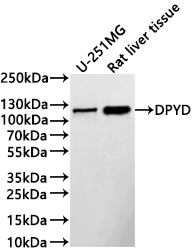
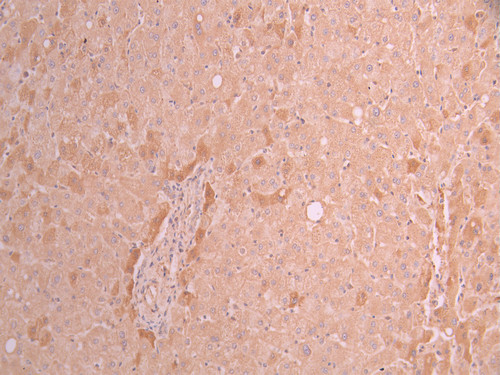
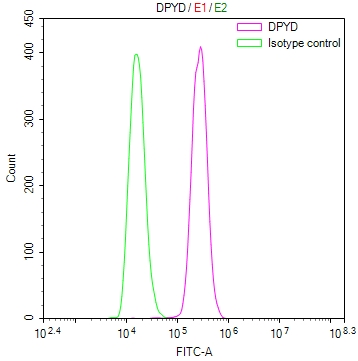
Validation across multiple techniques demonstrates this antibody's versatility in the laboratory. Western blot analysis confirms specific detection at the expected 111 kDa molecular weight in both U-251MG glioblastoma cells and rat liver tissue, supporting cross-species reactivity between human and rat samples. Immunohistochemical staining in paraffin-embedded human liver tissue reveals clear target localization, while flow cytometry analysis using BxPC-3 pancreatic cancer cells demonstrates suitability for single-cell protein expression studies with distinct signal separation from isotype controls.
The unconjugated format provides flexibility for researchers to pair this antibody with their preferred detection systems across ELISA, western blot, immunohistochemistry, and flow cytometry workflows. This DPYD antibody serves as a reliable tool for investigators exploring pyrimidine metabolism, chemotherapy response prediction, and hepatic enzyme expression in both basic research and translational oncology contexts.
There are currently no reviews for this product.





