
Call us
301-363-4651 (Available 9 a.m. to 5 p.m. CST from Monday to Friday)

| Code | CSB-RA965999A0HU |
| Size | US$210 |
| Order now | |
| Image |
|
| Have Questions? | Leave a Message or Start an on-line Chat |
| Application | Recommended Dilution |
|---|---|
| IF | 1:50-1:200 |
| FC | 1:50-1:200 |
EIF4A3 serves as a critical ATP-dependent RNA helicase and core component of the exon junction complex, playing essential roles in nonsense-mediated mRNA decay, mRNA splicing, and translation regulation. This DEAD-box protein has emerged as a significant focus in cancer research, where its dysregulation has been linked to tumor progression and therapeutic resistance, making it a valuable target for investigators studying RNA metabolism and disease mechanisms.
This recombinant monoclonal antibody, clone 6E9, offers researchers the reproducibility advantages inherent to recombinant technology. Generated against a synthetic peptide derived from human EIF4A3 and produced in rabbit, the antibody provides sequence-defined consistency between lots, eliminating the variability concerns that can complicate long-term studies or multi-site collaborations. Affinity chromatography purification ensures high specificity for your target.
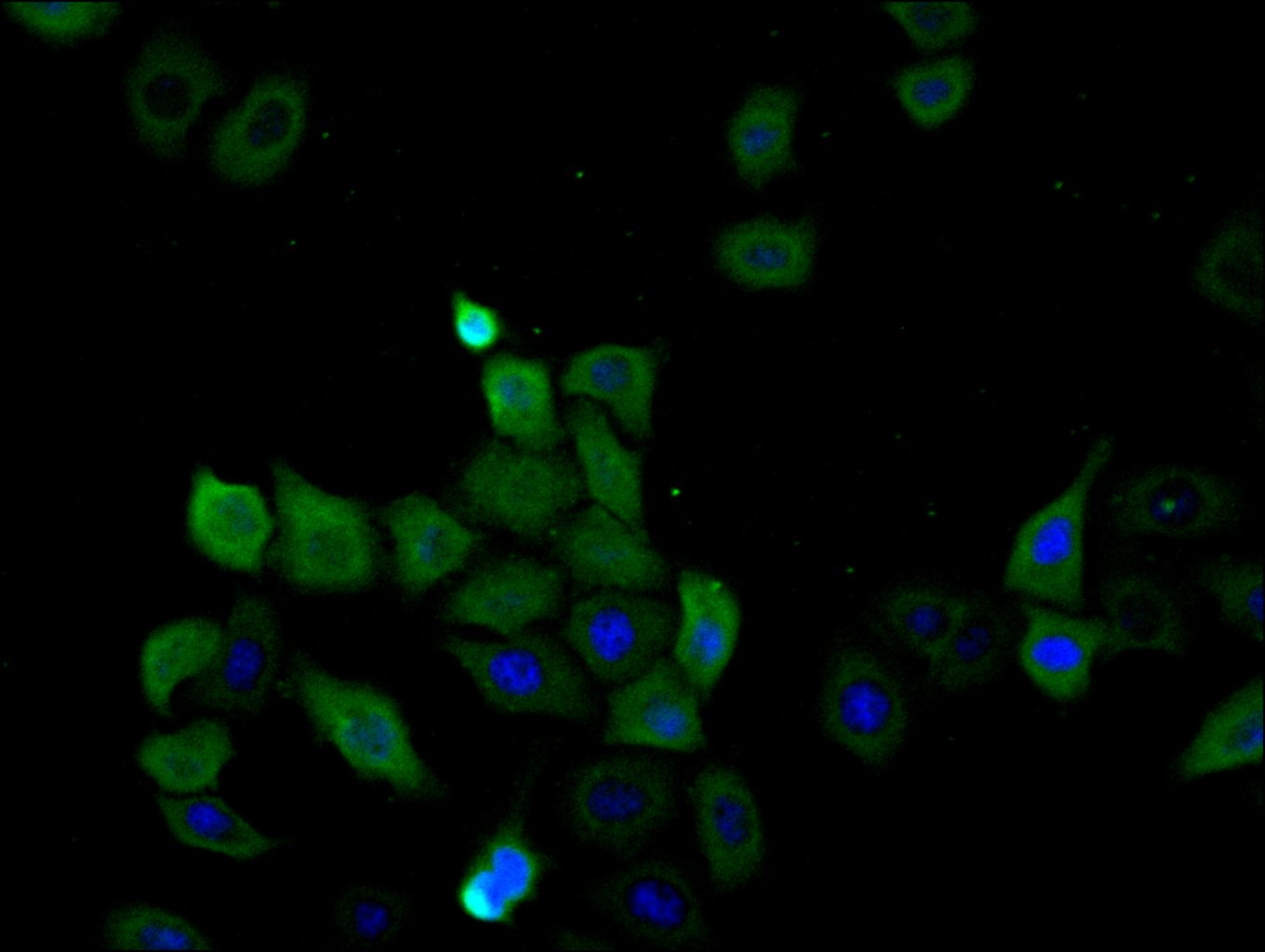
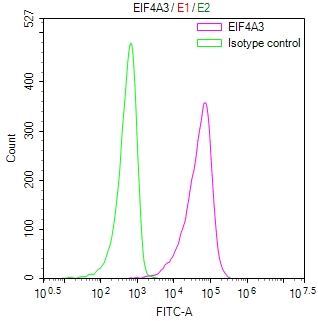
Validation studies demonstrate reliable performance across multiple experimental platforms. Immunofluorescence analysis in HeLa cells reveals clear nuclear localization patterns consistent with EIF4A3's known role in mRNA processing, with recommended dilutions of 1:50-1:200 providing flexibility to optimize signal intensity for your specific imaging setup. Flow cytometry validation using Jurkat cells confirms the antibody's utility for quantitative single-cell analysis, showing distinct positive population shifts compared to isotype controls at 1:50-1:200 dilutions. The antibody is also validated for ELISA applications.
For researchers investigating RNA surveillance pathways, splicing regulation, or the emerging connections between EIF4A3 and oncogenic processes, this antibody provides a dependable tool for characterizing protein expression and localization in human cell models. Its compatibility with both imaging and flow-based approaches supports diverse experimental strategies within a single research program.
There are currently no reviews for this product.





