
Call us
301-363-4651 (Available 9 a.m. to 5 p.m. CST from Monday to Friday)

| Code | CSB-RA272525A0HU |
| Size | US$210 |
| Order now | |
| Image |
|
| Have Questions? | Leave a Message or Start an on-line Chat |
| Application | Recommended Dilution |
|---|---|
| IHC | 1:50-1:200 |
| FC | 1:50-1:200 |
ERP27, also known as protein disulfide isomerase family A member 8 (PDIA8), is an endoplasmic reticulum-resident protein that plays a role in the protein folding machinery of the secretory pathway. As a member of the PDI family, ERP27 contributes to the complex network of chaperones and oxidoreductases that ensure proper protein maturation, making it a relevant target for researchers investigating ER stress responses, protein quality control mechanisms, and secretory pathway biology.
This recombinant rabbit monoclonal antibody, clone 13C8, offers the consistency and reproducibility that demanding experimental workflows require. Generated against a synthetic peptide derived from human ERP27, the antibody is produced using recombinant technology, ensuring sequence-defined specificity and eliminating the lot-to-lot variability that can complicate long-term studies or multi-site collaborations. Affinity chromatography purification further enhances performance by removing non-specific immunoglobulins.
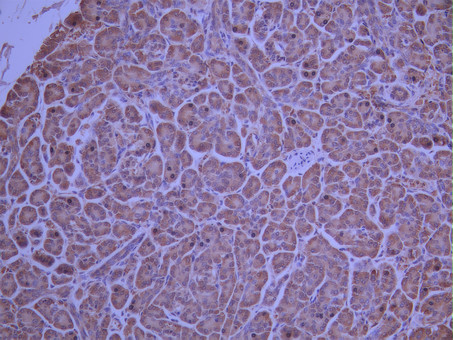
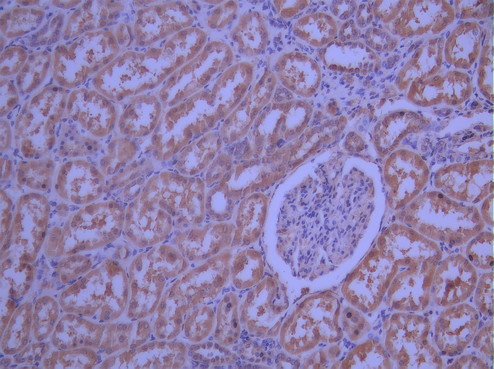
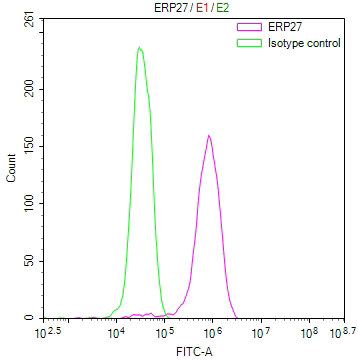
Validation studies demonstrate reliable detection across multiple experimental platforms. Immunohistochemistry performed on paraffin-embedded human tissues reveals clear staining in both pancreatic and kidney sections at 1:100 dilution using citrate buffer antigen retrieval, providing researchers with optimized starting conditions for tissue-based investigations. Flow cytometry analysis using fixed and permeabilized MCF-7 cells shows a distinct positive shift compared to isotype control, confirming the antibody's utility for intracellular detection of ERP27 in breast cancer cell models.
The unconjugated format allows flexibility in secondary antibody selection and detection system optimization. Whether you are examining ER protein expression patterns in tissue sections or quantifying ERP27 levels in cell populations, this antibody provides a dependable tool for signal transduction research and studies exploring endoplasmic reticulum biology.
There are currently no reviews for this product.





