
Call us
301-363-4651 (Available 9 a.m. to 5 p.m. CST from Monday to Friday)

| Code | CSB-RA207775A0HU |
| Size | US$210 |
| Order now | |
| Image |
|
| Have Questions? | Leave a Message or Start an on-line Chat |
| Application | Recommended Dilution |
|---|---|
| WB | 1:500-1:5000 |
FLI1 (Friend leukemia integration 1) is an ETS family transcription factor that plays a central role in vascular development, hematopoiesis, and oncogenesis. As a proto-oncogene, FLI1 is particularly significant in Ewing sarcoma research, where the characteristic EWS-FLI1 fusion protein drives tumorigenesis. Beyond cancer biology, FLI1 serves as a valuable marker in studies of megakaryocyte differentiation and endothelial cell function, making it a target of interest across multiple research disciplines including epigenetics, nuclear signaling, and metabolism.
This recombinant monoclonal antibody, clone 4E5, offers the reproducibility and consistency that demanding experimental workflows require. Because recombinant antibodies are produced from defined genetic sequences rather than hybridoma supernatants, researchers can expect reliable performance across experiments and between lots, eliminating a common source of variability in long-term studies. The rabbit IgG format provides excellent sensitivity while the affinity-chromatography purification ensures minimal background in detection applications.
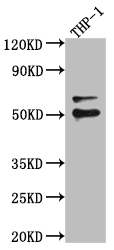
Validation by western blot demonstrates robust detection of FLI1 in human cell lysates, with clear signal observed at the predicted 51 kDa molecular weight. Testing across A549 lung carcinoma, U-251 glioblastoma, and HeLa cervical carcinoma cell lines confirms reliable performance in diverse cellular contexts, giving researchers flexibility when selecting their experimental models. The recommended working dilution range of 1:500 to 1:5000 for western blot applications allows optimization based on sample abundance and detection system sensitivity.
For investigators studying transcriptional regulation in cancer, stem cell differentiation, or vascular biology, this antibody provides a dependable tool for characterizing FLI1 expression and exploring its functional roles in both normal physiology and disease states.
There are currently no reviews for this product.





