FXR1 Recombinant Monoclonal Antibody

Code CSB-RA162896A0HU
Size US$210
Order now
Image
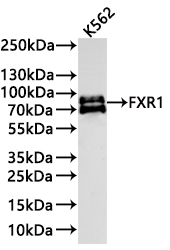
  • Western Blot
    Positive WB detected in: K562 whole cell lysate(30µg)
    All lanes: FXR1 antibody at 1:1000
    Secondary
    Goat polyclonal to rabbit IgG at 1/40000 dilution
    Predicted band size: 70 kDa
    Observed band size: 70-85 kDa
    Exposure time:1min
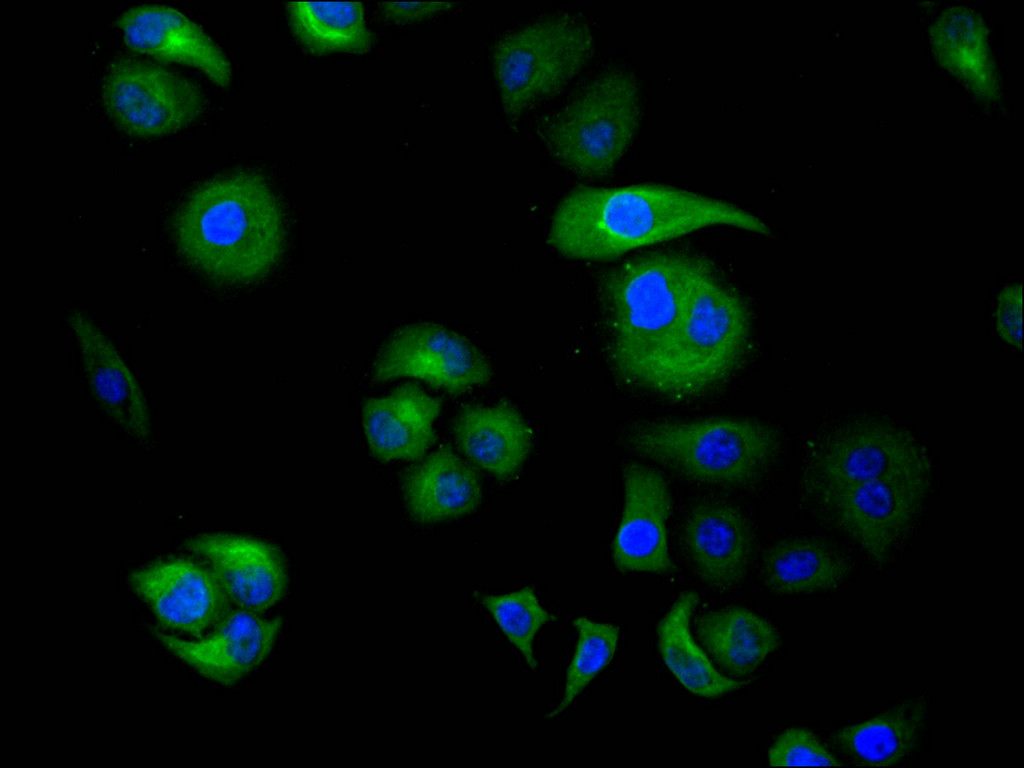
  • Immunofluorescence staining of Hela cell with CSB-RA162896A0HU at 1:50, counter-stained with DAPI. The cells were fixed in 4% formaldehyde, permeabilized using 0.2% Triton X-100 and blocked in 10% normal Goat Serum. The cells were then incubated with the antibody overnight at 4°C. The secondary antibody was Alexa Fluor 488-congugated AffiniPure Goat Anti-Rabbit IgG(H+L).
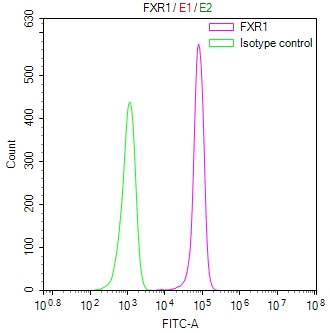
  • Overlay Peak curve showing A431 cells stained with CSB-RA162896A0HU (red line) at 1:100. The cells were fixed in 4% formaldehyde and permeated by 0.2% TritonX-100 for 10min. Then 10% normal goat serum to block non-specific protein-protein interactions followed by the antibody (1ug/1*106cells) for 45min at 4℃. The secondary antibody used was FITC-conjugated goat anti-rabbit IgG (H+L) at 1/200 dilution for 35min at 4℃.Control antibody (green line) was Rabbit IgG (1ug/1*106cells) used under the same conditions. Acquisition of >10,000 events was performed.
Have Questions? Leave a Message or Start an on-line Chat

Product Details

Uniprot No.
Target Names
Alternative Names
Fragile X mental retardation syndrome-related protein 1 (hFXR1p), FXR1
Species Reactivity
Human
Immunogen
A synthesized peptide from human FXR1 protein
Immunogen Species
Homo sapiens (Human)
Conjugate
Non-conjugated
Clonality
Monoclonal
Isotype
Rabbit IgG
Clone No.
9H11
Purification Method
Affinity-chromatography
Concentration
It differs from different batches. Please contact us to confirm it.
Buffer
Rabbit IgG in 10mM phosphate buffered saline , pH 7.4, 150mM sodium chloride, 0.05% BSA, 0.02% sodium azide and 50% glycerol.
Form
Liquid
Tested Applications
ELISA, WB, IF, FC
Recommended Dilution
Application Recommended Dilution
WB 1:500-1:2000
IF 1:50-1:200
FC 1:50-1:200
Troubleshooting and FAQs
Storage
Upon receipt, store at -20°C or -80°C. Avoid repeated freeze.
Lead Time
Basically, we can dispatch the products out in 1-3 working days after receiving your orders. Delivery time maybe differs from different purchasing way or location, please kindly consult your local distributors for specific delivery time.
Description

FXR1, or Fragile X mental retardation syndrome-related protein 1, belongs to a family of RNA-binding proteins that play essential roles in mRNA transport, localization, and translational regulation. As a paralog of FMRP, the protein implicated in Fragile X syndrome, FXR1 has garnered significant research interest for its involvement in muscle development, cardiac function, and neuronal processes. Dysregulation of FXR1 has been linked to various pathological conditions, making it a compelling target for researchers investigating RNA metabolism and developmental biology.

This recombinant monoclonal antibody, generated in rabbit against a synthetic peptide derived from human FXR1, offers the reproducibility and consistency that demanding experimental workflows require. Because recombinant antibodies are produced from defined sequences, researchers can expect uniform performance across lots, eliminating the variability that can compromise longitudinal studies or multi-site collaborations.

Validation across multiple platforms demonstrates this antibody's versatility in your experimental toolkit. Western blot analysis in K562 whole cell lysate reveals detection at 70-85 kDa, with the observed size range above the 70 kDa predicted molecular weight likely reflecting post-translational modifications such as phosphorylation or glycosylation that are characteristic of this protein. Immunofluorescence staining in HeLa cells confirms utility for subcellular localization studies, while flow cytometry analysis in A431 cells with clear separation from isotype control demonstrates suitability for quantitative single-cell applications.

Whether you are investigating FXR1's role in muscle differentiation, exploring its contributions to cancer biology, or examining RNA granule dynamics, this antibody provides a reliable detection tool validated across complementary techniques for comprehensive target characterization.

Usage
For Research Use Only. Not for use in diagnostic or therapeutic procedures.

Customer Reviews and Q&A

 Customer Reviews

There are currently no reviews for this product.

Submit a Review here

Target Background

Function
RNA-binding protein required for embryonic and postnatal development of muscle tissue. May regulate intracellular transport and local translation of certain mRNAs.
Gene References into Functions
  1. in head and neck squamous cell carcinoma, fragile X mental retardation syndrome related protein 1 (Fxr1) overexpression correlates with reduced F-box protein 4 (Fbxo4) levels. PMID: 29142209
  2. Inhibition of the remaining family member FXR1 selectively blocks cell proliferation in human cancer cells containing homozygous deletion of both TP53 and FXR2 in a collateral lethality manner. PMID: 28767039
  3. Our findings support our a priori hypothesis of a possible interaction between GSK3B (rs12630592 T allele) and FXR1 (rs496250 A allele) in mood disorder patients. PMID: 28242499
  4. human microbiota was able to reduce the levels of tauro-beta-muricholic acid and induce expression of FXR target genes Fgf15 and Shp in ileum after long-term colonization. We show that a human microbiota can change BA composition and induce FXR signaling in colonized mice, but the levels of secondary BAs produced are lower than in mice colonized with a mouse microbiota PMID: 27956475
  5. These data reveal a new role of FXR1 in controlling induction of monocyte migration. PMID: 27229378
  6. FXR1 binds and destabilizes p21 mRNA, binds and stabilizes TERC RNA and suppresses the cellular senescence in oral cancer cells. PMID: 27606879
  7. FXR1P interacts with CMAS, and that FXR1P may enhance the activation of sialic acid via interaction with CMAS, and increase GM1 levels to affect the development of the nervous system, thus providing evidence for further research into the pathogenesis of FXS. PMID: 27357083
  8. P97 interacts with 3' UTR-binding FXR1a-associated microRNPs and with PARN, which binds mRNA 5' caps, forming a specialized complex to translate recruited mRNAs in these altered canonical translation conditions. PMID: 26942679
  9. An accumulation of 8 SNPs in the fragile gene family (FMR1, FXR1 and FXR2)were found associated with autistic traits in a sample of male patients. PMID: 26612855
  10. FXR1P is a GSK3beta substrate with a role in regulating mood and emotion processing PMID: 26240334
  11. The mechanisms by which FXR1 executes its regulatory function by forming a novel complex with two other oncogenes, protein kinase C, iota and epithelial cell transforming 2, located in the same amplicon via distinct binding mechanisms, were identified. PMID: 25733852
  12. binding of PKP1/3 to FXR1 was RNA independent, and both PKP3 and FXR1 stabilized PKP2 mRNA. PMID: 25225333
  13. Deregulation of Fragile X-related protein 1 by the lipodystrophic lamin A p.R482W mutation elicits a myogenic gene expression program in preadipocytes. PMID: 24108105
  14. findings showed that FXR1P interacts with BTF in vivo and proved that FXR1P and BTF can co-localize mainly in the cytoplasm around the nucleus PMID: 24389646
  15. FXR1 and UPF1 may have a functional role in prostate cancer progression and metastasis. PMID: 23881279
  16. Our study describes a novel role of FXR1P that has crucial implications for the understanding of its role during myogenesis and muscle development PMID: 23555284
  17. Data show that the nuclear localization signals of the FXR1 and FXR2 comprise tandem Tudor domain architectures. PMID: 21072162
  18. These results indicate that FMR1 gene function is evolutionarily conserved in neural mechanisms and cannot be compensated by either FXR1 or FXR2, but that all three proteins can substitute for each other in non-neuronal requirements. PMID: 20442204
  19. Fxr1p shows a more tissue-specific expression particularly during late embryonic development. PMID: 15968590
  20. Results show that three genes, namely FXR1, CLAPM1 and EIF4G, are most frequently overexpressed in the center of the amplified domain in squamous cell carcinomas. PMID: 17290396
  21. A crosslinking-coupled affinity purification method was used to isolate TNF-alpha AU-rich element-associated proteins: two microRNP-related proteins, FXR1 and AGO2 were found that associate during translation activation. PMID: 17382880
  22. FXR1 mRNA splicing pattern is altered in facioscapulohumeral muscular dystrophy myoblasts. PMID: 18628314
  23. FXR1P and FXR2P KH2 domains bind G-quadruplex and kissing complex RNA with the same affinity as the FMRP KH2 domain. PMID: 19487368

Show More

Hide All

Subcellular Location
Cytoplasm, cytosol.
Protein Families
FMR1 family
Tissue Specificity
Expressed in all tissues examined including heart, brain, kidney and testis.
Database Links

HGNC: 4023

OMIM: 600819

KEGG: hsa:8087

STRING: 9606.ENSP00000350170

UniGene: Hs.478407

icon of phone
Call us
301-363-4651 (Available 9 a.m. to 5 p.m. CST from Monday to Friday)

icon of address
Address
No. 269, Shendun 5th Road, Donghu Hi-Tech Development Area, Hubei Province, 430206, P.R.China
icon of social media
Join us with

Subscribe newsletter

Leave a message

* To protect against spam, please pass the CAPTCHA test below.
CAPTCHA verification
© 2007-2026 CUSABIO TECHNOLOGY LLC All rights reserved. 鄂ICP备15011166号-1
Place an order now

I. Product details

*
*
*
*

II. Contact details

*
*

III. Ship To

*
*
*
*
*
*
*

IV. Bill To

*
*
*
*
*
*
*
*


