H1-0 Recombinant Monoclonal Antibody

Code CSB-RA598755A0HU
Size US$210
Order now
Image
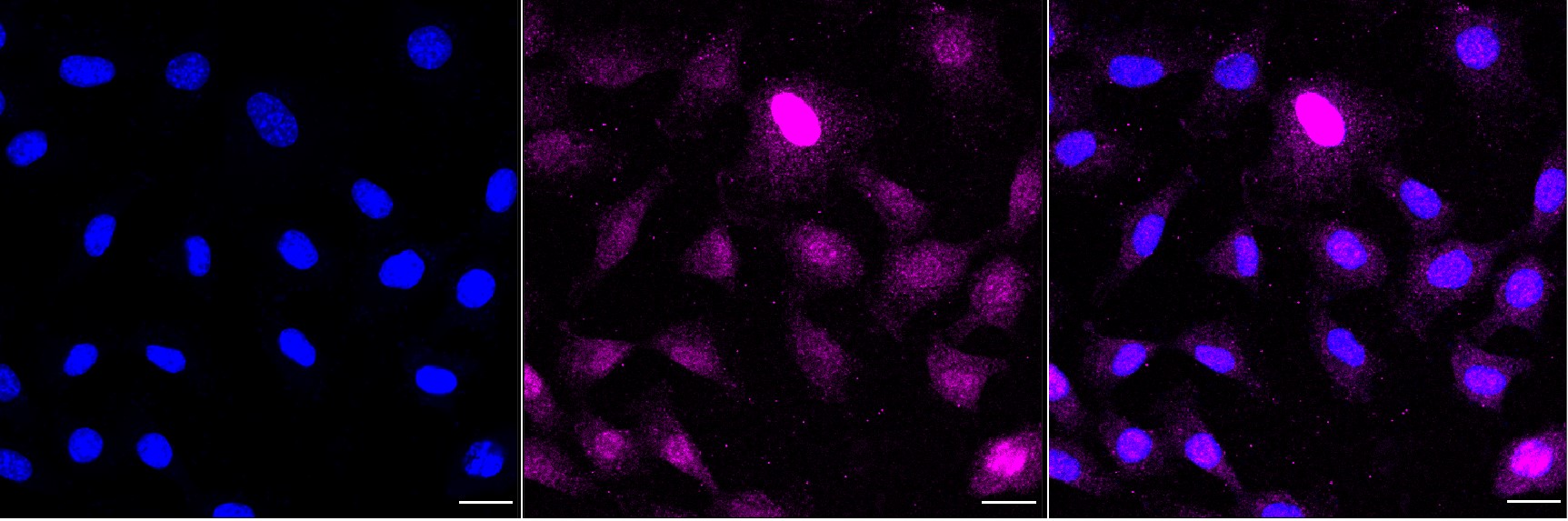
  • Immunocytochemical staining of C2C12 cells with Histone H1.0 antibody. Nuclei were stained blue with DAPI; Histone H1.0 was stained magenta with Alexa Fluor® 647. Images were taken using Leica stellaris 5. Protein abundance based on laser Intensity and smart gain: Medium. Scale bar, 20 μm.
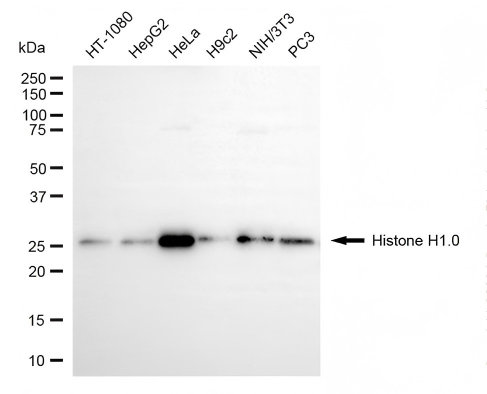
  • Western blotting analysis using histone H1.0 antibody. Total cell lysates (30 μg) from various cell lines were loaded and separated by SDS-PAGE. The blot was incubated with histone H1.0 antibody and HRP-conjugated goat anti-rabbit secondary antibody respectively.
Have Questions? Leave a Message or Start an on-line Chat

Product Details

Uniprot No.
Target Names
H1-0
Alternative Names
H1-0; H1.0 Linker Histone; H1.0; H1F0; H1FV; H1 Histone Family Member 0; H1.0, H1(0), H1-0; Histone H1(0); Histone H1.0; Histone H1'; H1 Histone Family, Member 0; H10
Species Reactivity
Human, Mouse, Rat
Immunogen
Recombinant Human H1-0 protein
Immunogen Species
Homo sapiens (Human)
Conjugate
Non-conjugated
Clonality
Monoclonal
Isotype
Rabbit IgG
Clone No.
12E1
Purification Method
Affinity-chromatography
Concentration
It differs from different batches. Please contact us to confirm it.
Buffer
Rabbit IgG in PBS (pH 7.4) containing 50% glycerol, and 0.02% sodium azide.
Form
Liquid
Tested Applications
ELISA, WB, ICC
Recommended Dilution
Application Recommended Dilution
WB 1:1000-1:5000
ICC 1:100-1:1000
Troubleshooting and FAQs
Storage
Upon receipt, store at -20°C or -80°C. Avoid repeated freeze.
Lead Time
Basically, we can dispatch the products out in 1-3 working days after receiving your orders. Delivery time maybe differs from different purchasing way or location, please kindly consult your local distributors for specific delivery time.
Usage
For Research Use Only. Not for use in diagnostic or therapeutic procedures.
Customer Reviews and Q&A

 Customer Reviews

There are currently no reviews for this product.

Submit a Review here

Target Background

Function
Histones H1 are necessary for the condensation of nucleosome chains into higher-order structures. The histones H1.0 are found in cells that are in terminal stages of differentiation or that have low rates of cell division.
Gene References into Functions
  1. H1.X moves more rapidly than other linker histones in vivo Domain swapping between H1.0 and H1.X suggests that the globular domain (GD) and C-terminal domain (CTD) of H1.X independently contribute to the dynamic behavior of H1.X. PMID: 27528617
  2. this study shows that dynamic epigenetic states defined by the linker histone H1.0 determine which cells within a tumor can sustain the long-term cancer growth. PMID: 27708074
  3. The N-terminal domain contributes toward the differential chromatin binding affinity, whereas the C-terminal domain contributes toward distinct nucleosomal interface of isotypes H10 and H1c. PMID: 22334665
  4. nuclear transport of H1 histones requires a heterodimeric nuclear import receptor PMID: 12080050
  5. H1(0)histone may be an important factor in normal DC differentiation. Tumor-derived factors may inhibit DC differentiation by affecting H1(0) expression. PMID: 12149419

Show More

Hide All

Subcellular Location
Nucleus. Chromosome. Note=The RNA edited version has been localized to nuclear speckles. During mitosis, it appears in the vicinity of condensed chromosomes.
Protein Families
Histone H1/H5 family
Database Links

HGNC: 4714

OMIM: 142708

KEGG: hsa:3005

STRING: 9606.ENSP00000344504

UniGene: Hs.745024

icon of phone
Call us
301-363-4651 (Available 9 a.m. to 5 p.m. CST from Monday to Friday)
icon of address
Address
7505 Fannin St., Ste 610, Room 7 (CUBIO Innovation Center), Houston, TX 77054, USA
icon of social media
Join us with

Subscribe newsletter

Leave a message

* To protect against spam, please pass the CAPTCHA test below.
CAPTCHA verification
© 2007-2025 CUSABIO TECHNOLOGY LLC All rights reserved. 鄂ICP备15011166号-1
×
Place an order now

I. Product details

*
*
*
*

II. Contact details

*
*

III. Ship To

*
*
*
*
*
*
*

IV. Bill To

*
*
*
*
*
*
*
*