
Call us
301-363-4651 (Available 9 a.m. to 5 p.m. CST from Monday to Friday)

| Code | CSB-RA901541A0HU |
| Size | US$210 |
| Order now | |
| Image |
|
| Have Questions? | Leave a Message or Start an on-line Chat |
| Application | Recommended Dilution |
|---|---|
| WB | 1:500-1:2000 |
| IHC | 1:50-1:200 |
| IF | 1:50-1:200 |
| FC | 1:50-1:200 |
Heterogeneous nuclear ribonucleoprotein M (hnRNP M) plays a central role in pre-mRNA processing, alternative splicing regulation, and mRNA metabolism. As a member of the hnRNP family, this RNA-binding protein influences gene expression at the post-transcriptional level and has been implicated in cancer progression, making it a valuable target for researchers investigating splicing mechanisms, RNA biology, and oncogenic pathways.
This recombinant monoclonal antibody against HNRNPM offers the reproducibility and consistency that demanding experimental workflows require. Generated using recombinant technology with a defined sequence, clone 14D3 eliminates the lot-to-lot variability that can compromise longitudinal studies and multi-site collaborations. The rabbit IgG format, raised against a synthetic peptide derived from human HNRNPM, provides reliable detection across human and mouse samples.
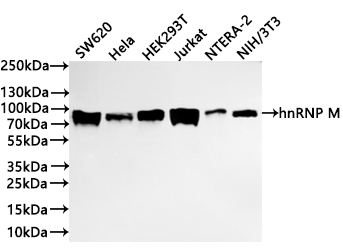
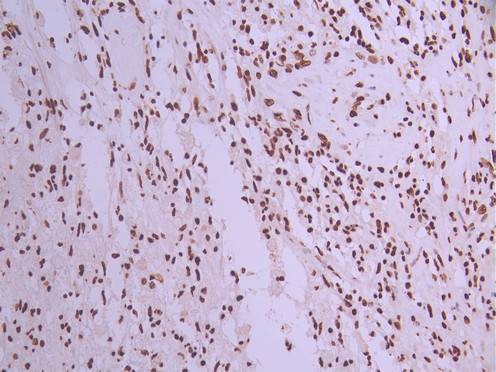
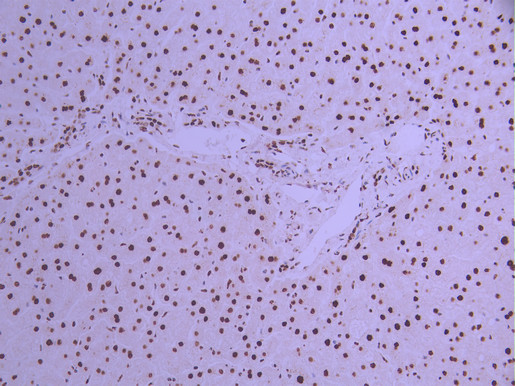
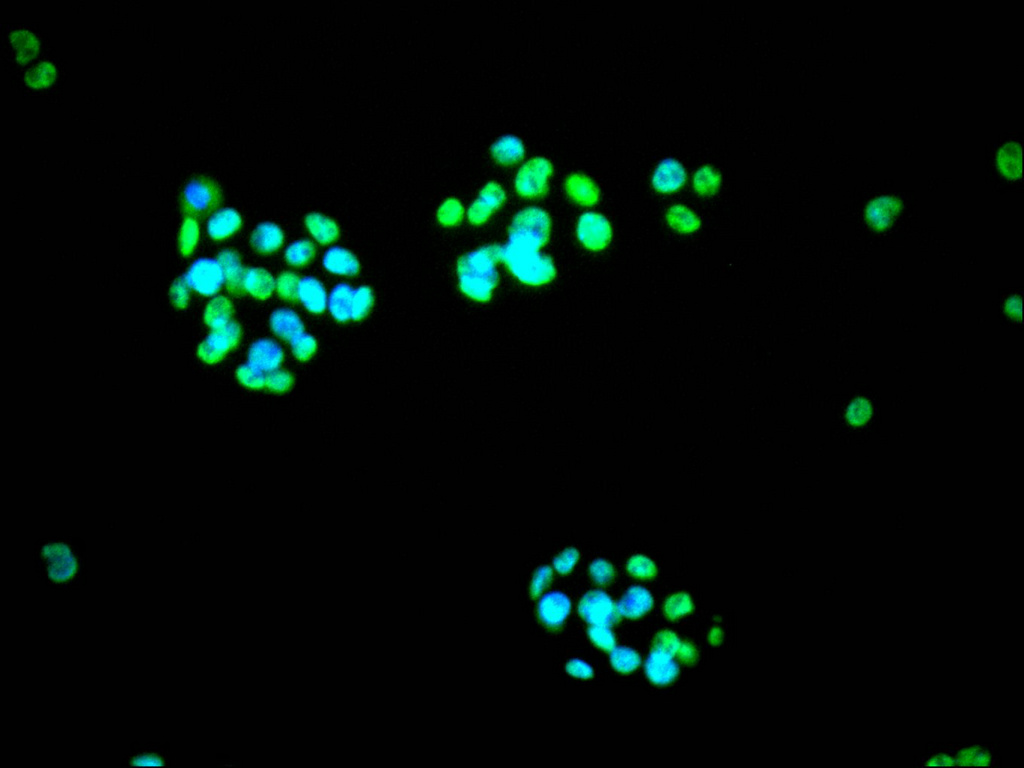
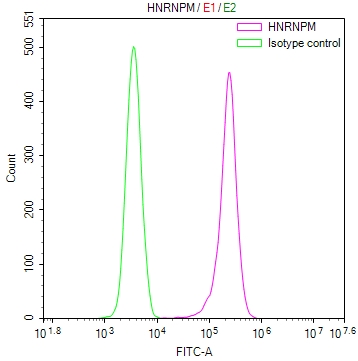
Validation data demonstrates robust performance across multiple applications. Western blot analysis detects a clean band at the predicted 78 kDa molecular weight across diverse human cell lines including SW620, HeLa, HEK293T, Jurkat, and NTERA-2, as well as mouse NIH/3T3 cells, confirming cross-species reactivity and consistent target recognition. Immunohistochemistry staining has been validated in paraffin-embedded human glioma and liver tissues, supporting studies in both cancer and normal tissue contexts. Immunofluorescence analysis in HepG2 cells reveals the expected nuclear localization pattern characteristic of hnRNP family members, while flow cytometry validation in Jurkat cells demonstrates clear signal separation from isotype controls.
This versatility across Western blot, immunohistochemistry, immunofluorescence, and flow cytometry applications makes this antibody well-suited for researchers studying RNA processing mechanisms, splicing regulation in disease models, or hnRNP M's emerging roles in tumor biology.
There are currently no reviews for this product.





