
Call us
301-363-4651 (Available 9 a.m. to 5 p.m. CST from Monday to Friday)

| Code | CSB-RA062796A0HU |
| Size | US$210 |
| Order now | |
| Image |
|
| Have Questions? | Leave a Message or Start an on-line Chat |
| Application | Recommended Dilution |
|---|---|
| WB | 1:500-1:2000 |
| IF | 1:50-1:200 |
| FC | 1:50-1:200 |
HSPA4, also known as APG-2 or HSP70RY, belongs to the heat shock protein 70 family and plays essential roles in cellular stress responses, protein folding, and proteostasis maintenance. This molecular chaperone has garnered significant research interest for its involvement in cytoprotective mechanisms and its potential implications in cancer biology and neurodegenerative disease models.
This recombinant monoclonal antibody, clone 9B11, offers the reproducibility and consistency that demanding research applications require. Generated through recombinant technology with a defined sequence, it eliminates the lot-to-lot variability that can compromise longitudinal studies and multi-site collaborations. The rabbit IgG format, raised against a synthesized peptide from human HSPA4, has been affinity-purified to ensure high specificity for your target.
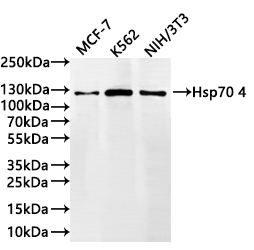
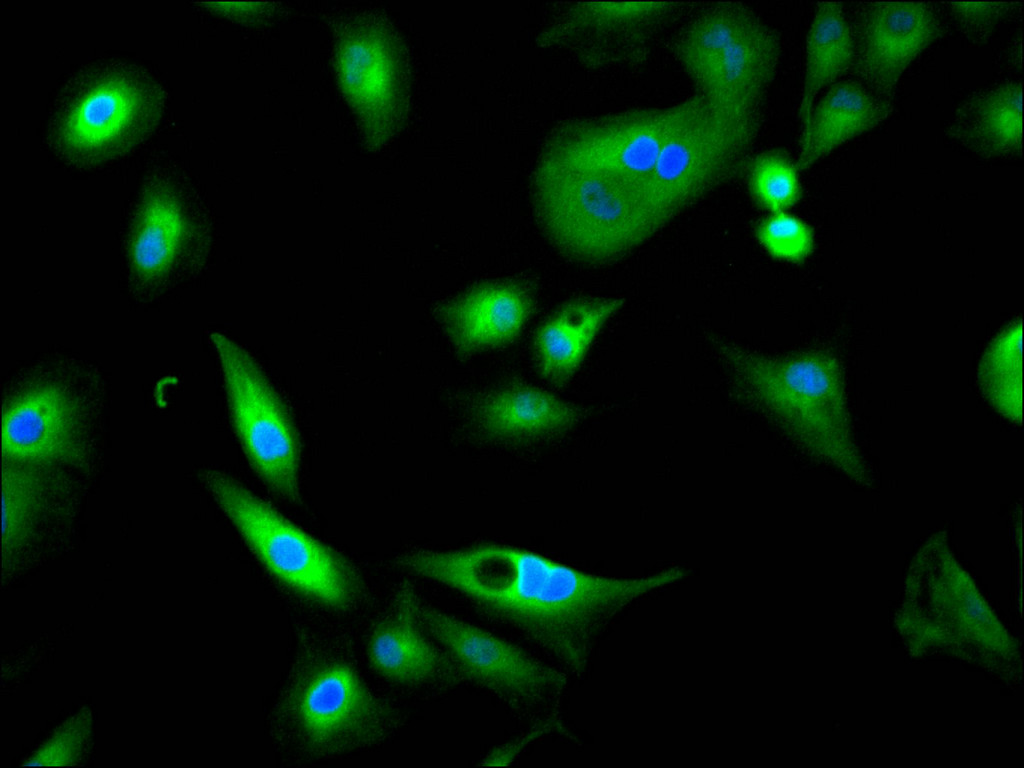
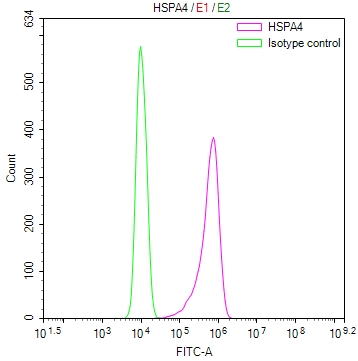
Validation across multiple platforms demonstrates this antibody's experimental versatility. Western blot analysis successfully detects HSPA4 in MCF-7 and K562 human cell lysates as well as NIH/3T3 mouse cells, confirming cross-species reactivity between human and mouse samples. The observed band at approximately 120 kDa, rather than the predicted 94 kDa molecular weight, likely reflects post-translational modifications such as glycosylation that are characteristic of this protein in cellular contexts. Immunofluorescence staining in A549 cells reveals clear cytoplasmic localization patterns, while flow cytometry analysis in A431 cells demonstrates robust signal separation from isotype controls, enabling quantitative single-cell studies.
Whether investigating heat shock responses, protein quality control mechanisms, or stress-related pathways in cancer research, this antibody provides the flexibility to move seamlessly between detection methods while maintaining confidence in your results across experimental systems.
There are currently no reviews for this product.





