
Call us
301-363-4651 (Available 9 a.m. to 5 p.m. CST from Monday to Friday)

| Code | CSB-RA151954A0HU |
| Size | US$210 |
| Order now | |
| Image |
|
| Have Questions? | Leave a Message or Start an on-line Chat |
| Application | Recommended Dilution |
|---|---|
| IHC | 1:50-1:200 |
KCNJ2 encodes the inward rectifier potassium channel Kir2.1, a critical regulator of cardiac and neuronal membrane excitability. This channel establishes and maintains the resting membrane potential in cardiomyocytes and contributes to the final phase of action potential repolarization. Mutations in KCNJ2 are associated with Andersen-Tawil syndrome and both long QT syndrome type 7 and short QT syndrome type 3, making it an important target for researchers investigating cardiac arrhythmias, channelopathies, and fundamental electrophysiology.
This recombinant monoclonal antibody, clone 16B6, offers the reproducibility and consistency that demanding experimental workflows require. Because the antibody sequence is defined and produced recombinantly in rabbit host cells, researchers can expect uniform performance across lots, eliminating the variability that can compromise longitudinal studies or multi-site collaborations. The antibody is raised against a synthetic peptide derived from human KCNJ2 and has been validated for human sample reactivity.
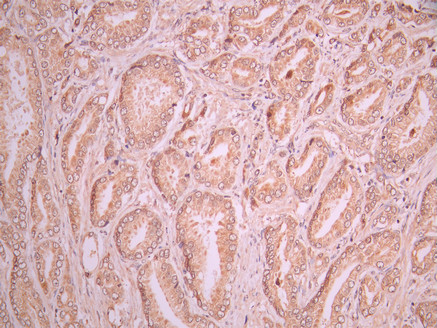
Validation testing demonstrates reliable performance in immunohistochemistry applications. Staining of paraffin-embedded human prostate cancer tissue using a 1:100 dilution on a Leica Bond system, with citrate buffer antigen retrieval and HRP-conjugated secondary detection, confirms the antibody's suitability for FFPE tissue analysis. Recommended working dilutions for IHC range from 1:50 to 1:200, providing flexibility to optimize signal intensity based on tissue type and fixation conditions. The antibody is also validated for ELISA applications.
Supplied in a stabilized liquid format with glycerol for convenient long-term storage at -20°C or -80°C, this affinity-purified antibody serves neuroscience and cardiovascular researchers investigating ion channel expression, cardiac electrophysiology, and channelopathy-related disease mechanisms.
There are currently no reviews for this product.





