
Call us
301-363-4651 (Available 9 a.m. to 5 p.m. CST from Monday to Friday)

| Code | CSB-RA057545A0HU |
| Size | US$210 |
| Order now | |
| Image |
|
| Have Questions? | Leave a Message or Start an on-line Chat |
| Application | Recommended Dilution |
|---|---|
| WB | 1:500-1:5000 |
| IHC | 1:50-1:200 |
| FC | 1:50-1:200 |
KIFC1, also known as HSET, is a minus-end-directed kinesin motor protein that plays a critical role in spindle assembly and chromosome segregation during cell division. Its involvement in centrosome clustering makes it particularly significant in cancer research, as tumor cells with supernumerary centrosomes depend on KIFC1 activity to achieve bipolar division and avoid mitotic catastrophe. This dependency has positioned KIFC1 as both a prognostic marker and a potential therapeutic target across multiple cancer types.
This recombinant monoclonal antibody, clone 1F9, offers the consistency and reproducibility that demanding research applications require. Produced using recombinant technology with a defined sequence, it eliminates the lot-to-lot variability inherent in traditional hybridoma-derived antibodies, ensuring your experimental results remain comparable across extended studies.
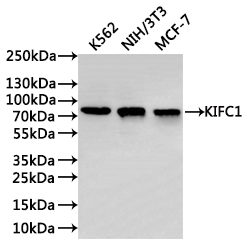
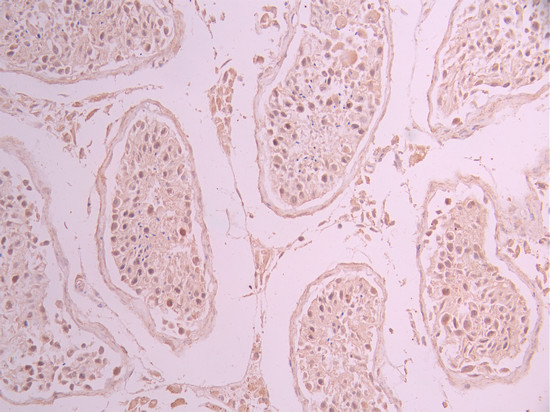
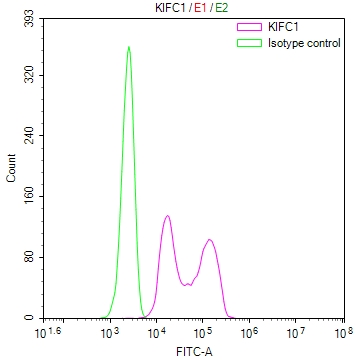
Validation testing demonstrates reliable performance across multiple platforms. Western blot analysis detects KIFC1 at the expected 74 kDa molecular weight in human K562 leukemia cells and MCF-7 breast cancer cells, as well as mouse NIH/3T3 fibroblasts, confirming specificity for the target protein. Immunohistochemistry staining in paraffin-embedded human testis tissue reveals clear localization patterns at 1:100 dilution using standard citrate buffer antigen retrieval. Flow cytometry analysis in Jurkat cells shows distinct positive signal separation from isotype controls, enabling quantitative assessment of KIFC1 expression at the single-cell level.
The flexibility to move between tissue sections, cell lysates, and suspension cell analysis makes this antibody well-suited for researchers investigating mitotic regulation, centrosome biology, or cancer cell vulnerabilities. Whether characterizing KIFC1 expression in tumor samples or validating functional studies, this reagent provides the technical foundation for reproducible results.
There are currently no reviews for this product.





