
Call us
301-363-4651 (Available 9 a.m. to 5 p.m. CST from Monday to Friday)

| Code | CSB-RA176322A0HU |
| Size | US$210 |
| Order now | |
| Image |
|
| Have Questions? | Leave a Message or Start an on-line Chat |
| Application | Recommended Dilution |
|---|---|
| IHC | 1:50-1:200 |
| FC | 1:50-1:200 |
Keratin 20 serves as a highly specific marker of intestinal and gastric epithelial differentiation, making it an invaluable tool for researchers investigating gastrointestinal biology and cancer pathology. Unlike other cytokeratins with broader tissue distribution, KRT20 expression is remarkably restricted to mature enterocytes, goblet cells, and Merkel cells, providing exceptional specificity when characterizing tissue origin or tracking epithelial differentiation states. This restricted expression pattern has established KRT20 as a cornerstone marker in colorectal cancer research and metastatic tumor identification.
This recombinant monoclonal antibody, generated against a synthetic peptide derived from human KRT20, offers the reproducibility that demanding research protocols require. Because the antibody sequence is defined and production occurs in controlled recombinant systems, you can expect consistent performance across experiments and between lot numbers, eliminating the variability that can complicate long-term studies or multi-site collaborations.
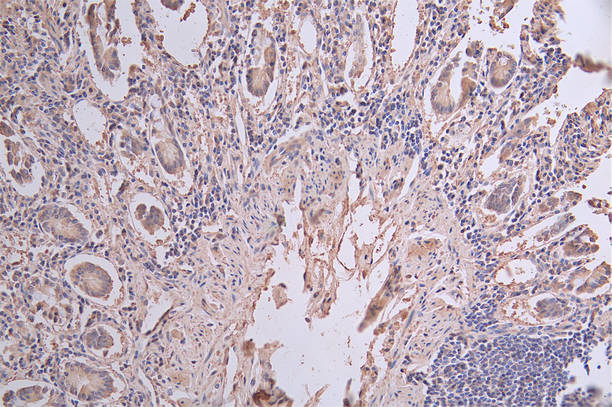
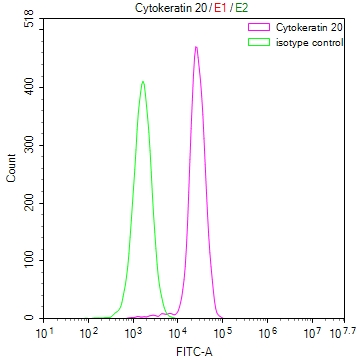
Validation studies demonstrate reliable performance across complementary detection platforms. Immunohistochemical staining of paraffin-embedded human small intestine tissue at dilutions between 1:50 and 1:200 reveals the expected epithelial localization pattern, with antigen retrieval performed using citrate buffer under high pressure conditions. Flow cytometry analysis using permeabilized MCF-7 cells confirms intracellular detection capability, showing clear signal separation from isotype control when used at 1:50 dilution. This application flexibility allows you to move between tissue-based and cell-based analyses using a single, well-characterized reagent.
Whether you are investigating colorectal carcinoma differentiation, mapping epithelial lineage commitment, or exploring signal transduction pathways in gastrointestinal contexts, this antibody provides the specificity and consistency your research demands.
There are currently no reviews for this product.





