
Call us
301-363-4651 (Available 9 a.m. to 5 p.m. CST from Monday to Friday)

| Code | CSB-RA557526A0HU |
| Size | US$210 |
| Order now | |
| Image |
|
| Have Questions? | Leave a Message or Start an on-line Chat |
| Application | Recommended Dilution |
|---|---|
| WB | 1:500-1:5000 |
| IHC | 1:50-1:200 |
| FC | 1:50-1:200 |
Keratin 5 serves as a fundamental structural protein in the cytoskeleton of basal epithelial cells, where it partners with Keratin 14 to form intermediate filaments essential for maintaining tissue integrity. This type II cytokeratin has garnered significant research attention due to its association with epidermolysis bullosa simplex, a group of inherited skin fragility disorders, making it a valuable marker for studying epithelial biology, skin diseases, and cellular architecture.
This recombinant monoclonal antibody, clone 9A9, offers the reproducibility advantages that come with sequence-defined production. Unlike traditional hybridoma-derived antibodies, recombinant technology ensures consistent performance across lots, allowing you to establish protocols with confidence that results will remain comparable throughout long-term studies.
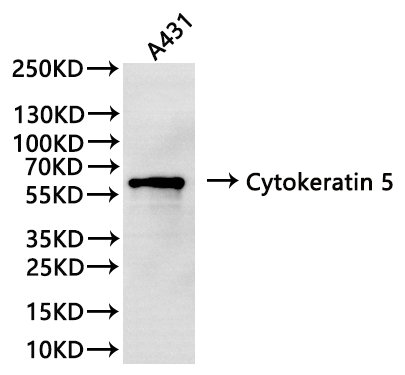
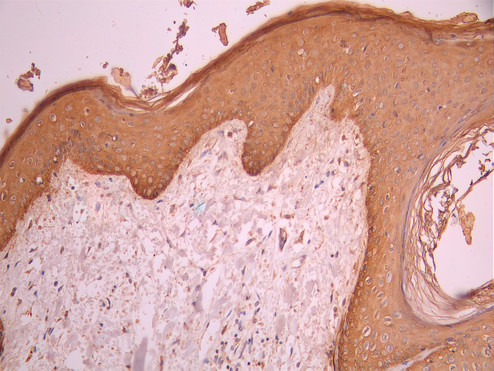
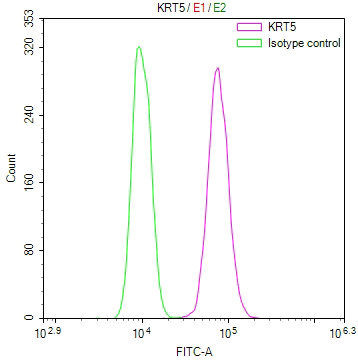
Validation across multiple techniques demonstrates this antibody's versatility in your experimental workflow. Western blot analysis of A431 whole cell lysate reveals a clean band at the predicted 62 kDa molecular weight, confirming specific target recognition in this epidermoid carcinoma line known for robust keratin expression. Immunohistochemistry on paraffin-embedded human skin tissue shows effective staining of basal keratinocytes, the expected localization for KRT5. Flow cytometry analysis using HeLa cells further confirms intracellular detection capability, with clear separation from isotype control, providing quantitative assessment options for your research.
With confirmed reactivity in human samples and documented cross-species reactivity with rat, this antibody supports comparative studies across model systems. The flexible dilution ranges accommodate optimization for your specific sample types, whether you're investigating epithelial differentiation, characterizing skin pathologies, or exploring signal transduction pathways involving cytoskeletal components.
There are currently no reviews for this product.





