KRT9 Recombinant Monoclonal Antibody

Code CSB-RA182472A0HU
Size US$210
Order now
Image
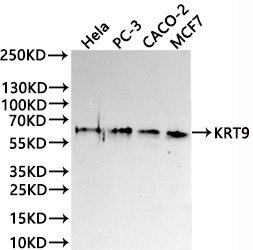
  • Western Blot
    Positive WB detected in: Hela whole cell lysate(30µg), PC-3 whole cell lysate(30µg), CACO-2 whole cell lysate(30µg), MCF7 whole cell lysate(30µg)
    All lanes: KRT9 antibody at 1:1000
    Secondary
    Goat polyclonal to rabbit IgG at 1/40000 dilution
    Predicted band size: 62 kDa
    Observed band size: 62 kDa
    Exposure time:2min
Have Questions? Leave a Message or Start an on-line Chat

Product Details

Uniprot No.
Target Names
Alternative Names
Keratin, type I cytoskeletal 9 (Cytokeratin-9) (CK-9) (Keratin-9) (K9), KRT9
Species Reactivity
Human
Immunogen
A synthesized peptide derived from Human KRT9 protein
Immunogen Species
Homo sapiens (Human)
Conjugate
Non-conjugated
Clonality
Monoclonal
Isotype
Rabbit IgG
Clone No.
6G7
Purification Method
Affinity-chromatography
Concentration
It differs from different batches. Please contact us to confirm it.
Buffer
Rabbit IgG in 10mM phosphate buffered saline , pH 7.4, 150mM sodium chloride, 0.05% BSA, 0.02% sodium azide and 50% glycerol.
Form
Liquid
Tested Applications
ELISA, WB
Recommended Dilution
Application Recommended Dilution
WB 1:500-1:5000
Troubleshooting and FAQs
Storage
Upon receipt, store at -20°C or -80°C. Avoid repeated freeze.
Lead Time
Basically, we can dispatch the products out in 1-3 working days after receiving your orders. Delivery time maybe differs from different purchasing way or location, please kindly consult your local distributors for specific delivery time.
Usage
For Research Use Only. Not for use in diagnostic or therapeutic procedures.
Customer Reviews and Q&A

 Customer Reviews

There are currently no reviews for this product.

Submit a Review here

Target Background

Function
May serve an important special function either in the mature palmar and plantar skin tissue or in the morphogenetic program of the formation of these tissues. Plays a role in keratin filament assembly.
Gene References into Functions
  1. A novel heterozygous c.1369C>T transition (p.Leu457Phe) in exon 6 of the KRT9 gene was identified in four patients in a Chinese Family with Epidermolytic Palmoplantar Keratoderma. PMID: 29719290
  2. During analyzing the sequences of KRT9 gene of a epidermolytic palmoplantar keratoderma (EPPK) pedigree, we found a new heterozygous missense mutation (488G>T) of exon 1 of KRT9 gene, which has not been reported before and does not exist in healthy individuals of the family and 100 unrelated individuals. PMID: 27726289
  3. Results identified the missense mutation KRT9 c.487C>T, as a potential causative mutation in the large Uygur family with epidermolytic palmoplantar keratoderma. PMID: 27864007
  4. KRT9 expression is significantly downregulated in human masticatory mucosa during wound healing PMID: 28005267
  5. Findings suggest that dysregulated Keratin 9 expression is a consequence of Alzheimer's disease (AD). PMID: 26973255
  6. Mutational analysis revealed a T to G transition in the coding DNA sequence, designated as c.470T>G (p.Met157Arg), a missense mutation in exon 1 of KRT9 in the proband and her brother, but not in unrelated healthy controls. PMID: 24899405
  7. KRT9 gene mutation as a reliable indicator in the prenatal molecular diagnosis of epidermolytic palmoplantar keratoderma. PMID: 24862219
  8. A heterozygous missense mutation c.482A to G in the KRT9 gene. PMID: 24510562
  9. Our findings indicate that knuckle pads can be associated with epidermolytic palmoplantar keratoderma and the R163W mutation in a family with a genetic background different from that described here. PMID: 23278372
  10. We identified a novel Eidermolytic Palmoplantar Keratoderma-causing mutation located in a region of the KRT9 gene, encoding a poorly conserved region of the protein that is not routinely screened for diagnostic purposes. PMID: 23397986
  11. Data indicate that the node tumour burden could be accurately quantified based on the cytokeratin 19 (CK19) mRNA copy number. PMID: 23265708
  12. A heterozygous transversional mutation, 488G-->A, was identified in exon 1 of KRT9 gene in all patients. PMID: 22678789
  13. A substitution in arginine alters the charge and shape of KRT9 rod domain, disrupting the function of the helix initiation motif of keratins and compromising the integrity of filaments and weakening their stability in the epidermis of palms and soles. PMID: 22262370
  14. KRT9 may play a complicated role in the genesis of epidermolytic palmoplantar keratoderma with knuckle pads and camptodactyly. PMID: 21715251
  15. Study provides evidence that epidermolytic palmoplantar keratoderma in a large Chinese family may result from a novel duplication mutation (c.495_503dupCTCTTACTT) in the 1A rod domain of KRT9. PMID: 21489919
  16. identified mRNA transcripts from three genes CDSN, LOR and KRT9, showing strong over-expression in skin samples relative to samples from forensic body fluids, making them suitable markers for skin identification PMID: 21221983
  17. A c.T1206C substitution in the 2B domain of KRT 9 was identified. PMID: 20964665
  18. The affected members of all five families possess mutations in the KRT9 gene that severely affect heterodimer formation with the type II keratin partner. PMID: 19874353
  19. Genetic studies have revealed that K9 gene mutations are responsible for epodermolytic palmoplantar keratoderma. PMID: 12532041
  20. Keratin 9 is mutated in epidermolytic palmoplantar keratoderma PMID: 14675368
  21. Keratin 9 gene mutation is associated with diffuse palmoplantar keratoderma. PMID: 16043929
  22. A heterozygous nucleotide T-->C transition at position 500 in exon 1 of KRT9 was detected, which resulted in a leucine to serine (L167S) change. PMID: 17362238
  23. A missense mutation in keratin 9 -- Met157Arg in the 1A domain -- was found in a Chinese family with EPPK PMID: 18477167
  24. the first family from Northeast China affected by epidermolytic palmoplantar keratoderma (EPPK) in which we confirmed the presence of the N161S mutation as the result of a 548A>G transition in exon1 of the keratin 9 gene. PMID: 18573708
  25. We show that in a family affected by EPPK and knuckle pad keratosis, carrying the R163W substitution, wild type (wt) and mutated K9 are strongly expressed in knuckle pads. This suggests that the knuckle pad phenotype is due to ectopical expression of K9. PMID: 19106041
  26. The genomic DNA from the patient's peripheral blood showed an R162W mutation in the keratin 9 gene. We therefore diagnosed the patient with Vorner type EPPK. PMID: 19451521
  27. Prenatal diagnosis of epidermolytic palmoplantar keratoderma caused by c.T470C (p.M157T) of the keratin 9 gene. PMID: 19548225

Show More

Hide All

Involvement in disease
Keratoderma, palmoplantar, epidermolytic (EPPK)
Protein Families
Intermediate filament family
Tissue Specificity
Expressed in the terminally differentiated epidermis of palms and soles.
Database Links

HGNC: 6447

OMIM: 144200

KEGG: hsa:3857

STRING: 9606.ENSP00000246662

UniGene: Hs.654569

icon of phone
Call us
301-363-4651 (Available 9 a.m. to 5 p.m. CST from Monday to Friday)
icon of address
Address
7505 Fannin St., Ste 610, Room 7 (CUBIO Innovation Center), Houston, TX 77054, USA
icon of social media
Join us with

Subscribe newsletter

Leave a message

* To protect against spam, please pass the CAPTCHA test below.
CAPTCHA verification
© 2007-2026 CUSABIO TECHNOLOGY LLC All rights reserved. 鄂ICP备15011166号-1
Place an order now

I. Product details

*
*
*
*

II. Contact details

*
*

III. Ship To

*
*
*
*
*
*
*

IV. Bill To

*
*
*
*
*
*
*
*



