
Call us
301-363-4651 (Available 9 a.m. to 5 p.m. CST from Monday to Friday)

| Code | CSB-RA163614A0HU |
| Size | US$210 |
| Order now | |
| Image |
|
| Have Questions? | Leave a Message or Start an on-line Chat |
| Application | Recommended Dilution |
|---|---|
| WB | 1:500-1:5000 |
| IHC | 1:50-1:200 |
| FC | 1:50-1:200 |
DNA ligase IV plays an essential role in the non-homologous end joining pathway, the primary mechanism by which mammalian cells repair double-strand DNA breaks. This enzyme works in concert with XRCC4 to rejoin broken DNA ends, making it a critical factor in maintaining genomic stability, V(D)J recombination during immune cell development, and cellular responses to genotoxic stress. Mutations in LIG4 are associated with LIG4 syndrome and increased sensitivity to ionizing radiation, underscoring its importance in DNA damage research and cancer biology.
This recombinant monoclonal antibody, generated from clone 6E2 in rabbit host, offers the reproducibility and consistency that demanding experimental workflows require. Because the antibody sequence is defined and production occurs in controlled recombinant systems, researchers can expect reliable performance across experiments and over time, eliminating the lot-to-lot variability that can complicate long-term studies.
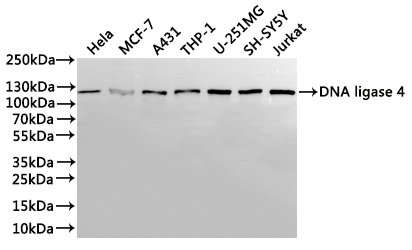
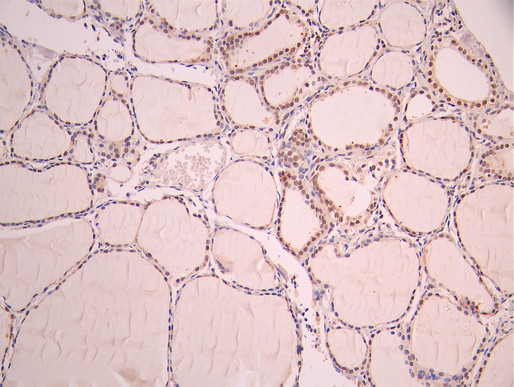
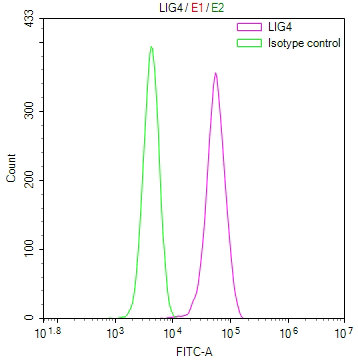
Validation across multiple platforms demonstrates the versatility of this antibody. Western blot analysis detects a band at the predicted molecular weight of 104 kDa across a diverse panel of human cell lines, including HeLa, MCF-7, A431, THP-1, U-251MG, SH-SY5Y, and Jurkat cells, confirming robust detection in epithelial, monocytic, glioblastoma, and lymphocyte models. Immunohistochemistry staining in paraffin-embedded human thyroid tissue reveals clear target localization, while flow cytometry analysis in Jurkat cells demonstrates suitability for single-cell quantification studies.
Whether investigating DNA repair mechanisms, characterizing responses to DNA-damaging agents, or exploring epigenetic and nuclear signaling pathways, this antibody provides a dependable tool for researchers studying genomic integrity and its implications in disease.
There are currently no reviews for this product.





