
Call us
301-363-4651 (Available 9 a.m. to 5 p.m. CST from Monday to Friday)

| Code | CSB-RA229992A0HU |
| Size | US$210 |
| Order now | |
| Image |
|
| Have Questions? | Leave a Message or Start an on-line Chat |
| Application | Recommended Dilution |
|---|---|
| WB | 1:500-1:5000 |
| IHC | 1:50-1:200 |
Leucine-rich alpha-2-glycoprotein 1 (LRG1) has emerged as a compelling target in both immunology and signal transduction research, particularly for its roles in angiogenesis, inflammatory responses, and disease progression. Originally identified as a serum protein, LRG1 has gained attention for its involvement in TGF-β signaling pathways and its potential as a biomarker in various pathological conditions, including cancer and autoimmune disorders.
This recombinant rabbit monoclonal antibody, clone 7A1, offers the reproducibility and consistency that demanding research protocols require. Because the antibody sequence is defined and produced recombinantly, you can expect uniform performance across experiments and over time, eliminating the lot-to-lot variability that can complicate long-term studies or multi-site collaborations. Affinity chromatography purification ensures high specificity for your target.
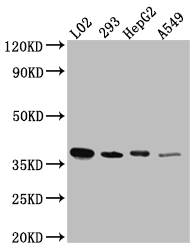
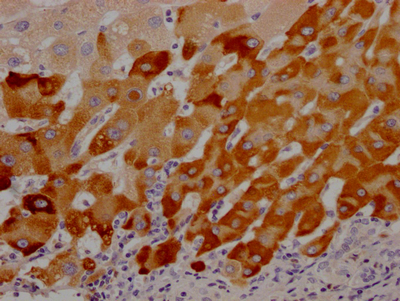
The antibody has been validated across multiple applications, giving you flexibility in your experimental approach. Western blot analysis demonstrates clean detection at the expected 39 kDa molecular weight across several human cell lines, including L02, HEK293, HepG2, and A549 whole cell lysates, confirming reliable performance in both hepatic and pulmonary cell models. For tissue-based studies, immunohistochemistry validation in paraffin-embedded human liver cancer tissue shows specific staining, supporting applications in oncology research and biomarker studies.
Whether you are investigating LRG1's role in tumor microenvironment signaling, exploring its function in inflammatory cascades, or evaluating its utility as a disease marker, this antibody provides a dependable tool for human sample analysis. The validated dilution ranges offer a practical starting point for optimizing detection in your specific experimental system.
There are currently no reviews for this product.





