
Call us
301-363-4651 (Available 9 a.m. to 5 p.m. CST from Monday to Friday)

| Code | CSB-RA104843A0HU |
| Size | US$210 |
| Order now | |
| Image |
|
| Have Questions? | Leave a Message or Start an on-line Chat |
| Application | Recommended Dilution |
|---|---|
| WB | 1:500-1:5000 |
| IHC | 1:50-1:200 |
| FC | 1:50-1:200 |
NDUFA13, also known as GRIM-19 (Gene associated with Retinoic and Interferon-induced Mortality 19), serves a dual role in cellular biology as both a structural component of mitochondrial Complex I and a regulator of cell death pathways. This protein is essential for proper electron transport chain function and has garnered significant research interest for its involvement in apoptotic signaling and its documented interactions with STAT3, making it relevant to studies of mitochondrial dysfunction, cancer biology, and metabolic disorders.
This recombinant rabbit monoclonal antibody (clone 4B1) offers the reproducibility and consistency that demanding experimental workflows require. Generated against a synthetic peptide derived from human NDUFA13, the antibody undergoes affinity chromatography purification to ensure high specificity. Because recombinant production yields a sequence-defined reagent, researchers can expect uniform performance across experiments and between lot numbers, eliminating a common source of variability in long-term studies.
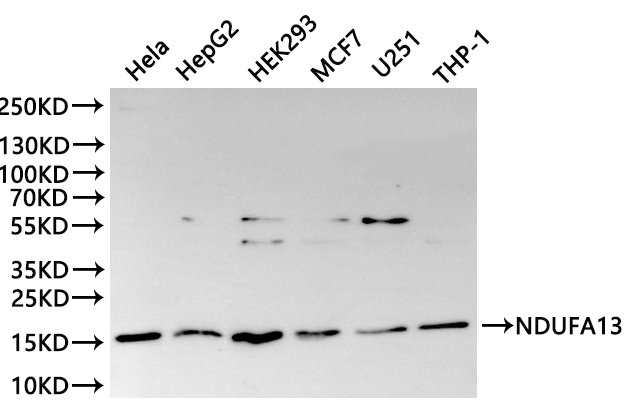
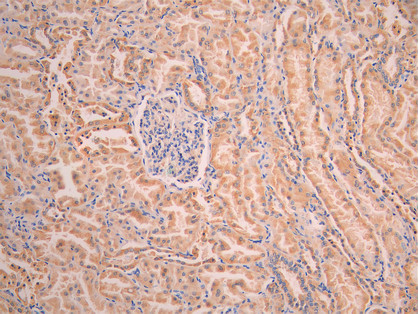
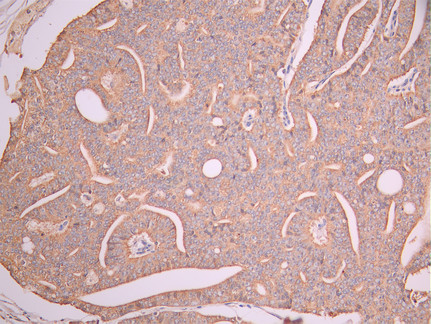
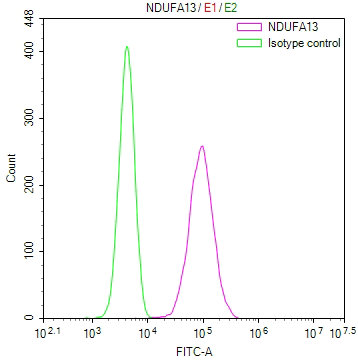
Validation data demonstrates reliable performance across multiple applications. Western blot analysis detects a clean band at the predicted 17 kDa molecular weight across diverse human cell lines including HeLa, HepG2, HEK293, MCF7, U251, and THP-1, confirming consistent detection regardless of cellular origin. Immunohistochemistry staining has been successfully performed on paraffin-embedded human kidney tissue and prostate cancer specimens, while flow cytometry validation in Jurkat cells shows clear positive signal separation from isotype controls.
This antibody supports researchers investigating mitochondrial biology, cellular metabolism, and apoptotic regulation, providing a dependable tool for characterizing NDUFA13 expression across experimental platforms from protein quantification to tissue localization and single-cell analysis.
There are currently no reviews for this product.





