
Call us
301-363-4651 (Available 9 a.m. to 5 p.m. CST from Monday to Friday)

| Code | CSB-RA942071A0HU |
| Size | US$210 |
| Order now | |
| Image |
|
| Have Questions? | Leave a Message or Start an on-line Chat |
| Application | Recommended Dilution |
|---|---|
| WB | 1:500-1:2000 |
| IF | 1:50-1:200 |
NFE2, also known as the transcription factor NF-E2 45 kDa subunit, plays a critical role in erythroid and megakaryocytic differentiation by regulating genes essential for hemoglobin synthesis and platelet production. As a basic leucine zipper transcription factor, NFE2 forms heterodimers with small Maf proteins to activate target gene expression, making it a key focus in hematological research, stem cell biology, and studies of blood cell development disorders.
This recombinant monoclonal antibody offers the consistency and reliability that demanding research applications require. Produced using recombinant technology with a defined sequence, this clone (1H11) eliminates the lot-to-lot variability inherent in traditional hybridoma-derived antibodies, ensuring reproducible results across long-term studies and multi-site collaborations. The rabbit IgG format provides excellent signal-to-noise characteristics while affinity purification delivers a clean reagent suitable for sensitive detection methods.
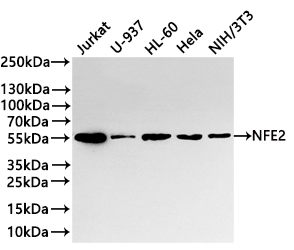
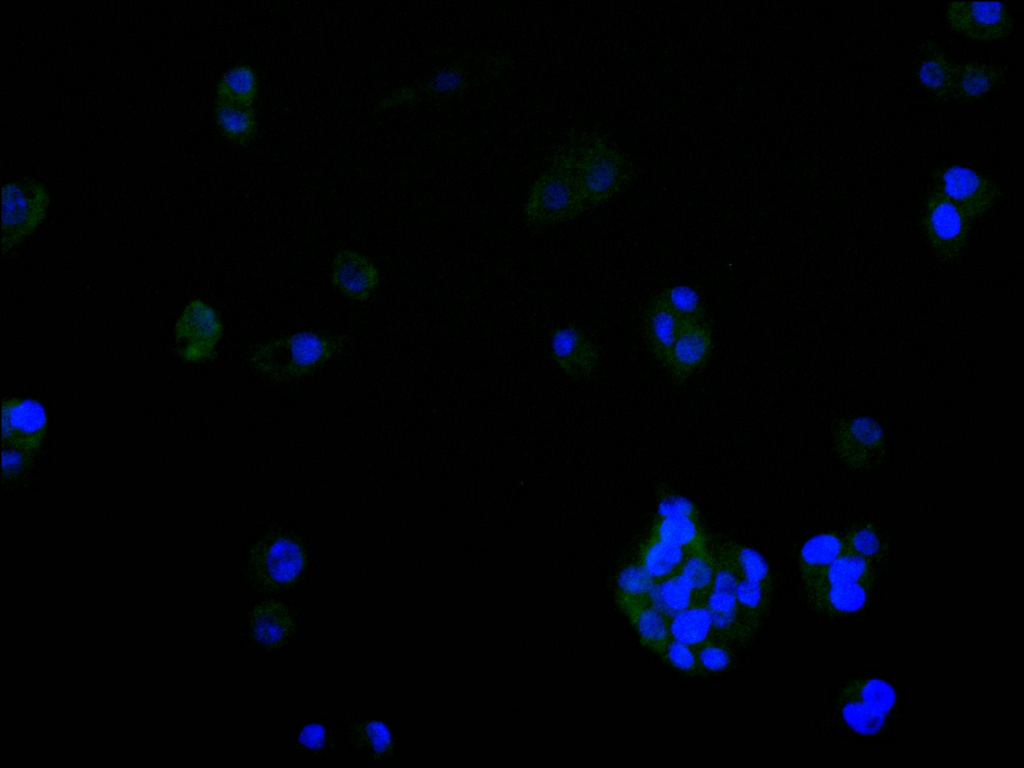
Validation studies demonstrate robust performance across multiple experimental platforms. Western blot analysis successfully detects NFE2 in human cell lines including Jurkat, U-937, HL-60, and HeLa, as well as mouse NIH/3T3 cells, confirming cross-species reactivity between human and mouse samples. The observed band at approximately 50 kDa, slightly higher than the predicted 41 kDa molecular weight, likely reflects post-translational modifications such as glycosylation or phosphorylation that are characteristic of this transcription factor in its native cellular context. Immunofluorescence studies in HepG2 cells reveal clear nuclear localization, consistent with NFE2's function as a transcription factor.
This antibody serves researchers investigating erythropoiesis, megakaryopoiesis, oxidative stress responses, and hematopoietic malignancies, providing a dependable tool for characterizing NFE2 expression and localization across diverse experimental systems.
There are currently no reviews for this product.





