
Call us
301-363-4651 (Available 9 a.m. to 5 p.m. CST from Monday to Friday)

| Code | CSB-RA213346A0HU |
| Size | US$210 |
| Order now | |
| Image |
|
| Have Questions? | Leave a Message or Start an on-line Chat |
| Application | Recommended Dilution |
|---|---|
| IHC | 1:50-1:200 |
| FC | 1:50-1:200 |
PPM1G, also known as protein phosphatase 2C isoform gamma, is a serine/threonine phosphatase that plays essential roles in pre-mRNA splicing regulation and cellular stress responses. This phosphatase dephosphorylates key substrates involved in spliceosome assembly and has emerged as a significant player in understanding RNA processing mechanisms and their connections to disease states, including cancer biology.
This recombinant monoclonal antibody, clone 5E2, offers researchers the reproducibility advantages inherent to recombinant technology. Because the antibody sequence is defined and produced from a stable expression system, you can expect consistent performance across experiments and over time, eliminating the lot-to-lot variability that can complicate long-term studies or multi-site collaborations. The rabbit IgG format, purified by affinity chromatography, ensures high specificity for human PPM1G.
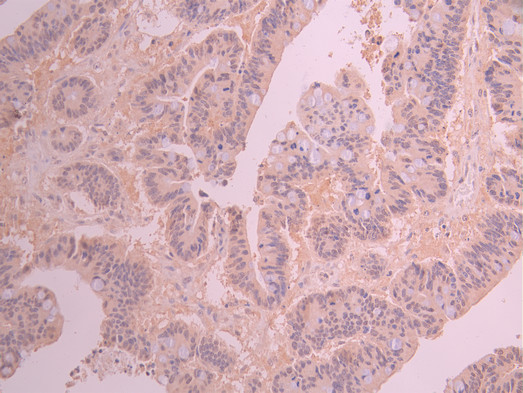
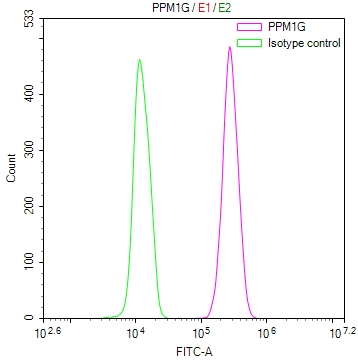
Validation studies demonstrate reliable performance across multiple experimental platforms. In immunohistochemistry applications, this antibody successfully detected PPM1G in paraffin-embedded human colorectal cancer tissue using a standard citrate buffer antigen retrieval protocol on an automated Leica Bond system, with recommended dilutions ranging from 1:50 to 1:200. Flow cytometry validation using HeLa cells confirmed intracellular detection capability, showing clear positive signal separation from isotype control when cells were fixed and permeabilized prior to staining. The antibody is also validated for ELISA applications, providing flexibility for quantitative studies.
This PPM1G antibody serves researchers investigating splicing regulation, phosphatase signaling networks, and cancer-related pathways where PPM1G dysregulation may contribute to disease progression. Its validated performance in both tissue sections and cell-based assays makes it suitable for studies spanning basic mechanistic research to translational investigations.
There are currently no reviews for this product.





