
Call us
301-363-4651 (Available 9 a.m. to 5 p.m. CST from Monday to Friday)

| Code | CSB-RA108247A0HU |
| Size | US$210 |
| Order now | |
| Image |
|
| Have Questions? | Leave a Message or Start an on-line Chat |
| Application | Recommended Dilution |
|---|---|
| FC | 1:50-1:200 |
Prion protein (PRNP), also designated CD230, occupies a unique position in neurobiology as the central molecule in transmissible spongiform encephalopathies and an increasingly recognized player in normal neuronal physiology. Understanding PRNP expression, localization, and conformational states remains essential for researchers investigating neurodegenerative mechanisms, protein misfolding disorders, and the physiological roles this glycoprotein plays in cellular signaling and copper metabolism.
This recombinant monoclonal antibody, clone 7C7, offers the reproducibility and molecular definition that prion research demands. Produced in rabbit host cells using recombinant technology, each lot delivers identical binding characteristics derived from a defined immunoglobulin sequence. This eliminates the variability inherent in traditional hybridoma-derived antibodies, providing confidence when comparing results across extended studies or between laboratories. The antibody targets a synthesized peptide from human PRNP and has been validated for human sample analysis.
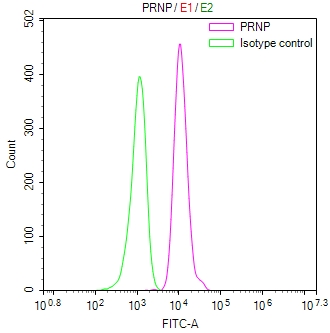
Flow cytometry validation demonstrates effective detection of PRNP in A431 cells, an epidermoid carcinoma line that provides a relevant model for examining prion protein expression in epithelial contexts. The validated protocol employed fixation with formaldehyde followed by permeabilization, enabling detection of both surface and intracellular PRNP populations. Clear separation from isotype control confirms specific target recognition, with recommended working dilutions ranging from 1:50 to 1:200 for flow cytometry applications. The antibody is also validated for ELISA, extending its utility across detection platforms.
Supplied in a glycerol-containing buffer optimized for long-term stability, this affinity-purified antibody serves researchers exploring prion disease pathogenesis, neurodegeneration mechanisms, and the emerging connections between PRNP and broader cellular processes including stem cell biology and immune function.
There are currently no reviews for this product.





