
Call us
301-363-4651 (Available 9 a.m. to 5 p.m. CST from Monday to Friday)

| Code | CSB-RA007523A51phHU |
| Size | US$210 |
| Order now | |
| Image |
|
| Have Questions? | Leave a Message or Start an on-line Chat |
| Application | Recommended Dilution |
|---|---|
| WB | 1:500-1:5000 |
| IHC | 1:50-1:200 |
| IF | 1:20-1:200 |
Phosphorylation of eukaryotic translation initiation factor 2 subunit alpha (EIF2S1) at serine 51 represents a critical regulatory checkpoint in cellular stress responses. This modification serves as a convergence point for the integrated stress response pathway, where kinases such as PERK, GCN2, PKR, and HRI phosphorylate this residue in response to diverse stressors including ER stress, amino acid deprivation, viral infection, and heme deficiency. The resulting attenuation of global protein synthesis, coupled with selective translation of stress-responsive mRNAs like ATF4, makes phospho-EIF2S1 (S51) an essential marker for investigating cellular adaptation mechanisms in contexts ranging from neurodegeneration to cancer biology.
This recombinant rabbit monoclonal antibody (clone 1C6) offers the reproducibility and consistency that phospho-specific detection demands. Generated against a synthetic phosphopeptide corresponding to the human EIF2S1 sequence surrounding serine 51, the antibody's sequence-defined nature ensures reliable performance across experiments and eliminates the lot-to-lot variability that can complicate longitudinal studies of stress signaling.
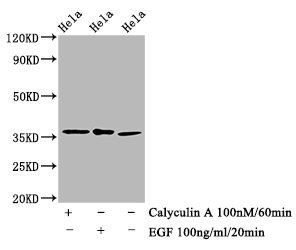
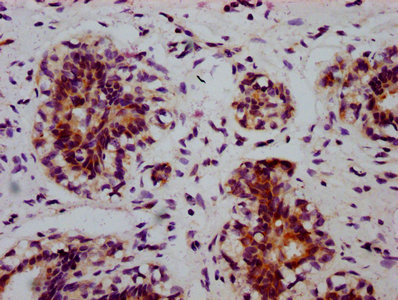
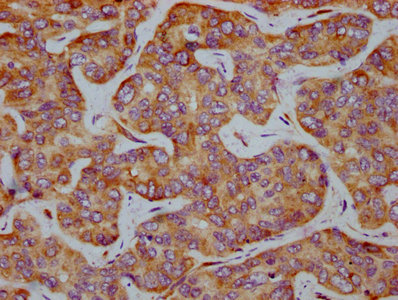
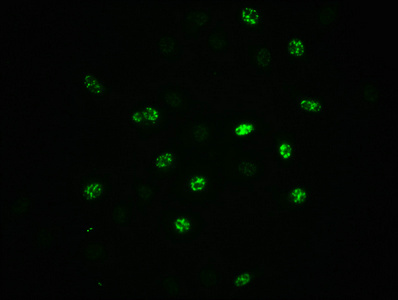
Validation data demonstrates robust performance across multiple applications. Western blot analysis of HeLa whole cell lysates treated with Calyculin A or EGF reveals specific detection at the predicted 36 kDa molecular weight, confirming accurate target recognition. The antibody performs effectively in immunohistochemistry, with validated staining in paraffin-embedded human breast cancer and liver cancer tissues, enabling investigation of stress pathway activation in clinical specimens. Immunofluorescence studies in EGF-stimulated A549 cells further demonstrate utility for subcellular localization studies of this phosphorylation event.
For researchers investigating epigenetics, nuclear signaling, and stress response pathways, this antibody provides a dependable tool for monitoring this pivotal translational control mechanism across biochemical, histological, and cell-based experimental platforms.
There are currently no reviews for this product.





