
Call us
301-363-4651 (Available 9 a.m. to 5 p.m. CST from Monday to Friday)

| Code | CSB-RA013466A183phHU |
| Size | US$210 |
| Order now | |
| Image |
|
| Have Questions? | Leave a Message or Start an on-line Chat |
| Application | Recommended Dilution |
|---|---|
| WB | 1:500-1:5000 |
| IHC | 1:50-1:200 |
The c-Jun N-terminal kinases (JNK1, JNK2, and JNK3, encoded by MAPK8, MAPK9, and MAPK10 respectively) serve as critical nodes in stress-activated signaling cascades, translating cellular stressors and inflammatory signals into transcriptional responses. Phosphorylation at their activation loop threonine residues (T183 for JNK1/JNK2, T221 for JNK3) marks the transition to catalytically active kinases capable of phosphorylating downstream targets including c-Jun, ATF2, and other transcription factors. Detecting this phosphorylation state provides researchers with a direct readout of pathway activation in contexts ranging from apoptosis and inflammation to neurodegeneration and metabolic disease.
This recombinant rabbit monoclonal antibody, clone 1A9, offers the reproducibility advantages inherent to sequence-defined production, ensuring consistent performance across experiments and eliminating the lot-to-lot variability that can complicate longitudinal studies. Raised against a synthetic phosphopeptide corresponding to the conserved activation site, the antibody recognizes all three JNK family members in their phosphorylated state.
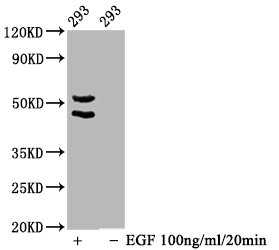
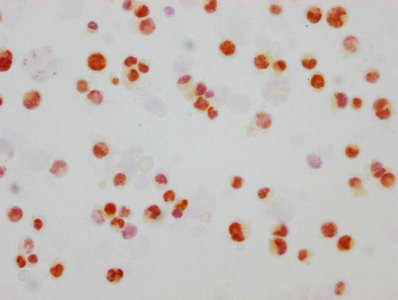
Validation in western blot applications demonstrates clear detection of the expected 46 kDa and 54 kDa bands in 293 cell lysates, with enhanced signal observed following EGF stimulation compared to untreated controls, confirming the antibody's ability to track dynamic changes in JNK phosphorylation status. Immunocytochemistry validation in HeLa cells treated with EGF further establishes utility for spatial localization studies of activated JNK within cellular compartments.
With validated performance in western blot, immunohistochemistry, and ELISA formats, this antibody supports diverse experimental workflows for researchers investigating stress-activated MAPK signaling, cellular stress responses, and signal transduction mechanisms in human samples.
There are currently no reviews for this product.





