
Call us
301-363-4651 (Available 9 a.m. to 5 p.m. CST from Monday to Friday)

| Code | CSB-RA020089A21phHU |
| Size | US$210 |
| Order now | |
| Image |
|
| Have Questions? | Leave a Message or Start an on-line Chat |
| Application | Recommended Dilution |
|---|---|
| IF | 1:20-1:200 |
Replication Protein A2 serves as an essential component of the heterotrimeric RPA complex, playing a central role in DNA replication, repair, and recombination. Phosphorylation at threonine 21 represents a critical regulatory modification that occurs in response to DNA damage and replication stress, making phospho-RPA2 (T21) a valuable marker for studying checkpoint signaling pathways and the cellular response to genotoxic stress. Researchers investigating DNA damage response mechanisms, cell cycle regulation, and genome stability rely on precise detection of this phosphorylation event to understand how cells coordinate repair processes.
This recombinant monoclonal antibody, clone 3B2, offers the reproducibility and consistency that phosphorylation studies demand. Because recombinant antibodies are produced from defined genetic sequences, researchers can expect uniform performance across experiments and over time, eliminating the lot-to-lot variability that can complicate longitudinal studies or multi-site collaborations. The rabbit IgG format, raised against a synthetic phosphopeptide corresponding to the human phospho-T21 site, provides high specificity for the phosphorylated epitope.
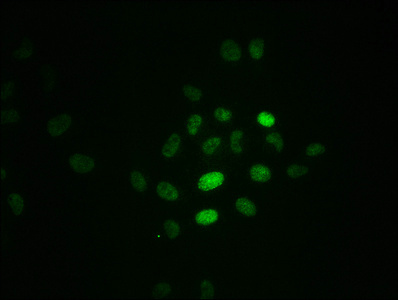
Validation in immunofluorescence applications demonstrates clear nuclear localization in HeLa cells, consistent with RPA2's known function in DNA metabolism. The recommended working dilution range of 1:20 to 1:200 for immunofluorescence provides flexibility for optimization across different experimental conditions and detection systems. The antibody has also been validated for ELISA applications, supporting quantitative approaches to phospho-RPA2 detection.
For researchers exploring epigenetics, nuclear signaling, and DNA damage response pathways, this antibody provides a reliable tool for monitoring RPA2 phosphorylation dynamics in human samples, supporting investigations into replication stress, checkpoint activation, and therapeutic responses to DNA-damaging agents.
There are currently no reviews for this product.





