
Call us
301-363-4651 (Available 9 a.m. to 5 p.m. CST from Monday to Friday)

| Code | CSB-RA889846A0HU |
| Size | US$210 |
| Order now | |
| Image |
|
| Have Questions? | Leave a Message or Start an on-line Chat |
| Application | Recommended Dilution |
|---|---|
| WB | 1:500-1:2000 |
| IHC | 1:50-1:200 |
| IF | 1:50-1:200 |
| FC | 1:50-1:200 |
RBFOX3, widely recognized as NeuN (Neuronal Nuclei antigen), serves as one of the most reliable markers for identifying mature post-mitotic neurons in neuroscience research. This RNA-binding protein plays essential roles in neuronal differentiation and alternative splicing regulation, making it indispensable for studies involving neuronal development, neurodegenerative disease, and brain tumor characterization.
This recombinant monoclonal antibody, generated from clone 19D2, offers the consistency and reproducibility that demanding neurological research requires. Because the antibody sequence is defined and produced recombinantly, you can expect reliable performance across experiments and between lots, eliminating the variability often encountered with traditional hybridoma-derived antibodies.
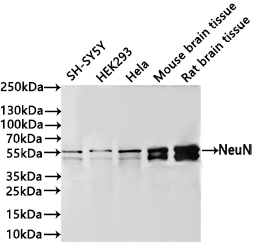
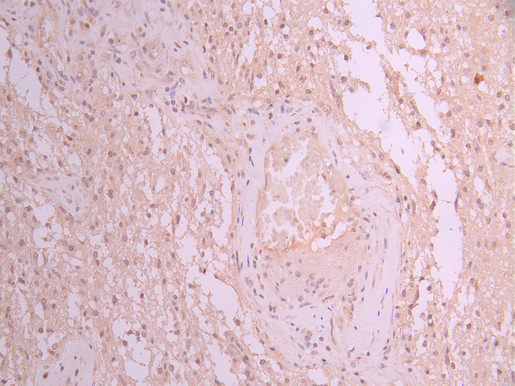
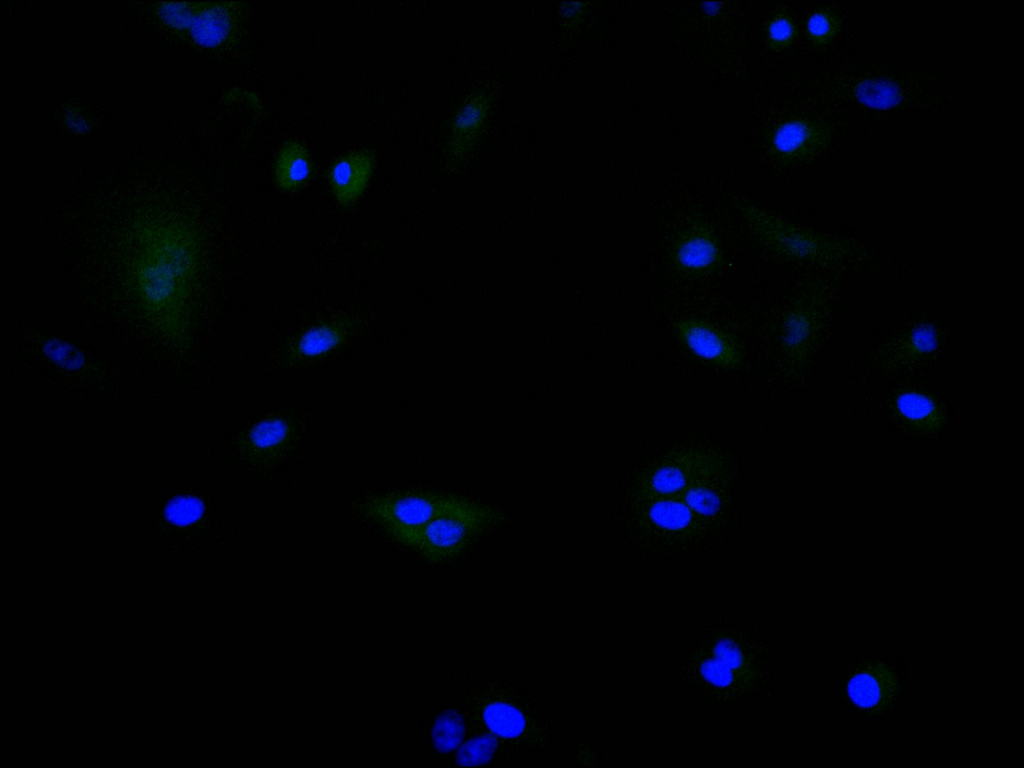
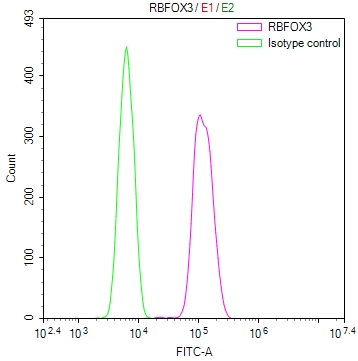
Extensive validation confirms this antibody's versatility across multiple experimental platforms. Western blot analysis demonstrates robust detection in human neuroblastoma SH-SY5Y cells, HEK293 cells, HeLa cells, as well as mouse and rat brain tissue lysates, confirming cross-species reactivity across human, mouse, and rat samples. The observed band size of 46-55 kDa exceeds the predicted 34 kDa molecular weight, which reflects the post-translational modifications, particularly glycosylation, characteristic of native RBFOX3 protein. Immunohistochemistry validation in paraffin-embedded human glioma tissue demonstrates clear nuclear staining patterns expected for this marker. Additional testing confirms performance in immunofluorescence applications using A549 cells and flow cytometry analysis with SH-SY5Y cells.
Whether you are mapping neuronal populations in tissue sections, characterizing neural differentiation in cell culture models, or investigating RBFOX3 expression changes in neurological disease contexts, this antibody provides the application flexibility and cross-species reactivity needed to advance your research.
There are currently no reviews for this product.





