

Call us
301-363-4651 (Available 9 a.m. to 5 p.m. CST from Monday to Friday)

| Code | CSB-RA130517A0HU |
| Size | US$210 |
| Order now | |
| Image |
|
| Have Questions? | Leave a Message or Start an on-line Chat |
| Application | Recommended Dilution |
|---|---|
| IF | 1:50-1:200 |
| FC | 1:50-1:200 |
RelB serves as a critical member of the NF-κB transcription factor family, playing a distinctive role in the non-canonical NF-κB signaling pathway. Unlike other NF-κB subunits, RelB specifically regulates genes involved in lymphoid organ development, dendritic cell maturation, and adaptive immune responses. Its dysregulation has been implicated in various malignancies and inflammatory conditions, making it a compelling target for researchers investigating cancer biology, immune signaling, and epigenetic regulation.
This recombinant monoclonal antibody, clone 9E4, offers the reproducibility and consistency that demanding experimental workflows require. Because recombinant antibodies are produced from defined genetic sequences rather than traditional hybridoma methods, researchers benefit from lot-to-lot uniformity that supports longitudinal studies and ensures comparable results across experiments. The rabbit IgG format provides high affinity binding, while affinity chromatography purification delivers a clean preparation suitable for sensitive detection methods.
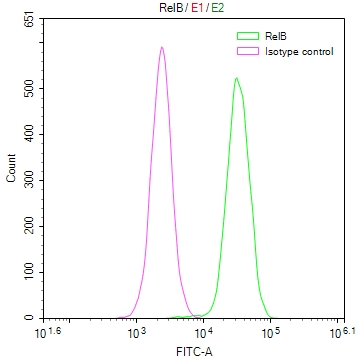
Validation studies demonstrate reliable performance in both immunofluorescence and flow cytometry applications using HeLa cells. Immunofluorescence staining reveals clear RelB detection with nuclear localization patterns consistent with its function as a transcription factor, while flow cytometry analysis shows distinct positive population shifts compared to isotype controls. These validated applications provide flexibility for researchers examining RelB expression and localization in fixed and permeabilized human cell preparations.
Whether investigating NF-κB pathway dynamics in cancer models, characterizing immune cell differentiation, or exploring epigenetic regulatory networks, this antibody delivers the specificity and consistency needed for meaningful experimental outcomes. The unconjugated format allows pairing with the secondary detection system best suited to your specific instrumentation and multiplexing requirements.
There are currently no reviews for this product.





