SGCA Recombinant Monoclonal Antibody

Code CSB-RA140135A0HU
Size US$210
Order now
Image
  • Western Blot
    Positive WB detected in: HEK293 whole cell lysate(30µg), A549 whole cell lysate(30µg)
    All lanes: SGCA antibody at 1:1000
    Secondary
    Goat polyclonal to rabbit IgG at 1/40000 dilution
    Predicted band size: 43 kDa
    Observed band size: 50 kDa
    Exposure time:3min
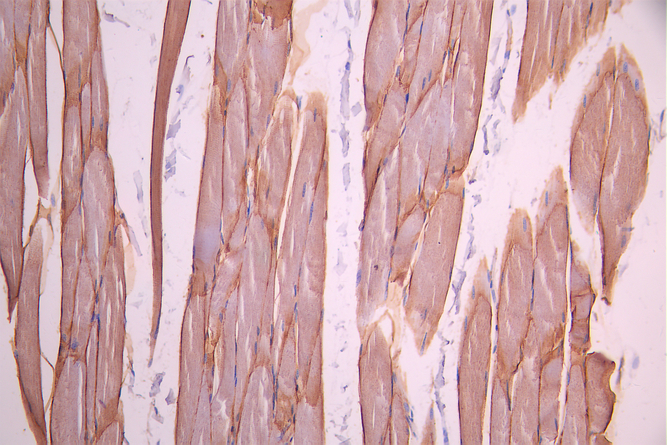
  • IHC image of CSB-RA140135A0HU diluted at 1:100 and staining in paraffin-embedded human skeletal muscle tissue performed on a Leica BondTM system. After dewaxing and hydration, antigen retrieval was mediated by high pressure in a citrate buffer (pH 6.0). Section was blocked with 10% normal goat serum 30min at RT. Then primary antibody (1% BSA) was incubated at 4°C overnight. The primary is detected by a Goat anti-rabbit polymer IgG labeled by HRP and visualized using 0.05% DAB.
Have Questions? Leave a Message or Start an on-line Chat

Product Details

Uniprot No.
Target Names
SGCA
Alternative Names
Alpha-sarcoglycan (Alpha-SG) (50 kDa dystrophin-associated glycoprotein) (50DAG) (Adhalin) (Dystroglycan-2), SGCA, ADL DAG2
Species Reactivity
Human
Immunogen
A synthesized peptide derived from Human SGCA protein
Immunogen Species
Homo sapiens (Human)
Conjugate
Non-conjugated
Clonality
Monoclonal
Isotype
Rabbit IgG
Clone No.
3A2
Purification Method
Affinity-chromatography
Concentration
It differs from different batches. Please contact us to confirm it.
Buffer
Rabbit IgG in 10mM phosphate buffered saline , pH 7.4, 150mM sodium chloride, 0.05% BSA, 0.02% sodium azide and 50% glycerol.
Form
Liquid
Tested Applications
ELISA, WB, IHC
Recommended Dilution
Application Recommended Dilution
WB 1:500-1:5000
IHC 1:50-1:200
Troubleshooting and FAQs
Storage
Upon receipt, store at -20°C or -80°C. Avoid repeated freeze.
Lead Time
Basically, we can dispatch the products out in 1-3 working days after receiving your orders. Delivery time maybe differs from different purchasing way or location, please kindly consult your local distributors for specific delivery time.
Usage
For Research Use Only. Not for use in diagnostic or therapeutic procedures.

Customer Reviews and Q&A

 Customer Reviews

There are currently no reviews for this product.

Submit a Review here

Target Background

Function
Component of the sarcoglycan complex, a subcomplex of the dystrophin-glycoprotein complex which forms a link between the F-actin cytoskeleton and the extracellular matrix.
Gene References into Functions
  1. Pathogenic mutations were found in SGCA from Egyptian families with limb-girdle muscular dystrophy. PMID: 26934379
  2. IN TMD patients, a locus near the sarcoglycan alpha ( SGCA), rs4794106, was suggestive in the discovery analysis ( P = 2.6 x 10(6)) and replicated (i.e., 1-tailed P = 0.016) in the Brazilian cohort. PMID: 28081371
  3. The results suggest that the carrier rate of c.101G>T in SGCA may be high in Taiwan, especially in the aboriginal population regardless of the tribes. PMID: 26944168
  4. B4GAT1 is involved in the initiation of the LARGE-dependent repeating disaccharide that is necessary for extracellular matrix protein binding to O-mannosylated alpha-dystroglycan. PMID: 25279697
  5. Results show that HRD1 and RFP2 contributes are required for the disposal of V247M alpha-sarcoglycan mutant. PMID: 24565866
  6. 2 members of a Spanish family with muscular dystrophy had a new missense mutation c409G>A, p.Glu137Lys in exon 5 of the alpha-sarcoglycan gene, as well as a paternal c739G>A, p.Val24Met mutation inexon 6. PMID: 23703062
  7. DNA analysis demonstrated homozygosity for a point mutation (574C>T) in the alpha-sarcoglycan gene. PMID: 22303798
  8. E-cadherin,alpha-dystroglycan and beta-dystroglycan levels were decreased in the oesophageal primary tumour samples, despite the presence of normal levels of dystroglycan mRNA. PMID: 21884196
  9. This study reported recessive founder LGMD2D for the Magdalen Islands, an archipelago settled in the XIXth century, largely by Acadian immigrants. PMID: 21856579
  10. Reduced expression of laminin-binding glycans on alpha-DG may contribute to formation of highly infiltrative behavior of prostate carcinoma cells. PMID: 21656825
  11. Peptide sequences in alpha-DG are substrates for protein-O-mannose N-acetylglucosaminyltransferase 1 (POMGnT1), demonstrated when a library of mannopeptides is generated which corresponds to sequences of the mucin-like stem region of alpha-DG. PMID: 21361872
  12. Long-term, sustainable gene expression of alpha-sarcoglycan was observed following gene transfer mediated by AAV. PMID: 21031578
  13. Absence of members of the dystrophin-associated glycoprotein complex constitutes a permissive environment for spontaneous development of embryonal rhabdomyosarcoma associated with mutation of p53 and mutation or altered splicing of Mdm2. PMID: 20019182
  14. Two adult brothers with a mild form of LGMD2D, compound heterozygous for two missense mutations of the SGCA gene (Arg77Cys, Val247Met), presented with respiratory insufficiency while they were still ambulatory. PMID: 15298081
  15. Biglycan is a ligand for two members of the sarcoglycan complex and regulates their expression at discrete developmental ages. PMID: 16883602
  16. identified a negative regulatory element in the alpha-SG distal promoter including two conserved E-boxes (E1 and E2), which interact with MyoD PMID: 18078839
  17. The limb-girdle muscular dystrophy patients with alpha-sarcoglycan deficient LGMD2D do not enable an accurate prediction of the genotype. PMID: 18996010

Show More

Hide All

Involvement in disease
Limb-girdle muscular dystrophy 2D (LGMD2D)
Subcellular Location
Cell membrane, sarcolemma; Single-pass type I membrane protein. Cytoplasm, cytoskeleton.
Protein Families
Sarcoglycan alpha/epsilon family
Tissue Specificity
Most strongly expressed in skeletal muscle. Also expressed in cardiac muscle and, at much lower levels, in lung. In the fetus, most abundant in cardiac muscle and, at lower levels, in lung. Also detected in liver and kidney. Not expressed in brain.
Database Links

HGNC: 10805

OMIM: 600119

KEGG: hsa:6442

STRING: 9606.ENSP00000262018

UniGene: Hs.463412

icon of phone
Call us
301-363-4651 (Available 9 a.m. to 5 p.m. CST from Monday to Friday)
icon of address
Address
7505 Fannin St., Ste 610, Room 7 (CUBIO Innovation Center), Houston, TX 77054, USA
icon of social media
Join us with

Subscribe newsletter

Leave a message

* To protect against spam, please pass the CAPTCHA test below.
CAPTCHA verification
© 2007-2026 CUSABIO TECHNOLOGY LLC All rights reserved. 鄂ICP备15011166号-1
Place an order now

I. Product details

*
*
*
*

II. Contact details

*
*

III. Ship To

*
*
*
*
*
*
*

IV. Bill To

*
*
*
*
*
*
*
*



