
Call us
301-363-4651 (Available 9 a.m. to 5 p.m. CST from Monday to Friday)

| Code | CSB-RA911986A0HU |
| Size | US$210 |
| Order now | |
| Image |
|
| Have Questions? | Leave a Message or Start an on-line Chat |
| Application | Recommended Dilution |
|---|---|
| WB | 1:500-1:2000 |
| FC | 1:50-1:200 |
Stathmin 1 (STMN1), also known as oncoprotein 18 or metablastin, serves as a critical regulator of microtubule dynamics by promoting depolymerization through tubulin sequestration and catastrophe enhancement. This phosphoprotein plays essential roles in cell cycle progression, mitotic spindle assembly, and cellular motility, making it a significant target in cancer research where its overexpression correlates with aggressive tumor phenotypes and poor prognosis across multiple malignancies. Understanding STMN1 regulation and expression patterns provides valuable insights into mechanisms of cell proliferation and potential therapeutic vulnerabilities.
This recombinant rabbit monoclonal antibody, clone 15E3, offers the reproducibility and consistency that demanding research applications require. Generated against a synthetic peptide derived from human STMN1 and produced through recombinant technology, this antibody delivers sequence-defined specificity with minimal lot-to-lot variation, ensuring your experimental results remain comparable across extended studies.
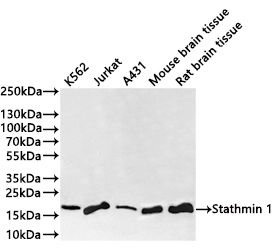
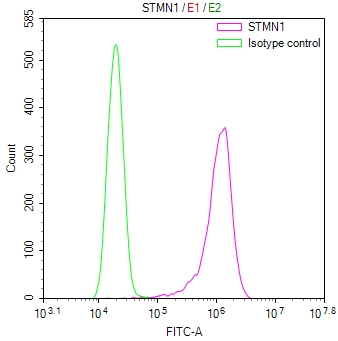
Validation data demonstrates robust performance across multiple platforms. Western blot analysis confirms detection of the expected 17 kDa band in human cell lines including K562, Jurkat, and A431, with cross-species reactivity verified in mouse and rat brain tissue lysates. This broad species compatibility supports translational research workflows spanning human cancer cell models and rodent tissue studies. Flow cytometry validation in A549 cells further extends the antibody's utility for single-cell analysis of intracellular STMN1 expression, with clear separation from isotype control demonstrating specific staining.
Whether investigating microtubule dynamics in cancer progression, examining STMN1 as a potential biomarker, or exploring its role in neuronal development, this antibody provides a reliable tool for researchers studying cell division, cytoskeletal regulation, and oncogenic signaling pathways.
There are currently no reviews for this product.





