
Call us
301-363-4651 (Available 9 a.m. to 5 p.m. CST from Monday to Friday)

| Code | CSB-RA147129A0HU |
| Size | US$210 |
| Order now | |
| Image |
|
| Have Questions? | Leave a Message or Start an on-line Chat |
| Application | Recommended Dilution |
|---|---|
| FC | 1:50-1:200 |
TCF4, also known as Transcription Factor 4 or Immunoglobulin Transcription Factor 2, is a class B basic helix-loop-helix transcription factor that plays fundamental roles in nervous system development, neuronal differentiation, and immune cell function. Mutations and dysregulation of TCF4 have been linked to Pitt-Hopkins syndrome, a severe neurodevelopmental disorder, as well as implicated in schizophrenia susceptibility and various malignancies, making it a compelling target for researchers investigating neurological disease mechanisms, developmental biology, and cancer pathogenesis.
This recombinant monoclonal antibody, clone 7C9, offers the reproducibility and consistency that demanding experimental workflows require. Generated against a synthetic peptide derived from human TCF4 protein, the recombinant format ensures sequence-defined specificity and eliminates the lot-to-lot variability that can compromise longitudinal studies or multi-site collaborations. Affinity chromatography purification delivers a high-purity reagent suitable for sensitive detection methods.
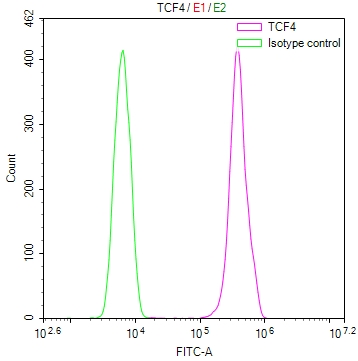
Validation in flow cytometry demonstrates reliable detection of TCF4 in SH-SY5Y cells, a human neuroblastoma line frequently employed in neuroscience research. The flow cytometry protocol utilized fixed and permeabilized cells with clear signal separation from isotype control, confirming specific intracellular detection at dilutions ranging from 1:50 to 1:200. This validated performance in a neuronal cell model provides confidence for researchers studying TCF4 expression in neural contexts.
The unconjugated format allows flexibility in secondary antibody selection and detection system optimization. Whether investigating TCF4's role in neural progenitor fate decisions, exploring its involvement in psychiatric disorder pathophysiology, or examining its function in B-cell development, this antibody provides a dependable tool for advancing your research objectives.
There are currently no reviews for this product.





