
Call us
301-363-4651 (Available 9 a.m. to 5 p.m. CST from Monday to Friday)

| Code | CSB-RA887971A0HU |
| Size | US$210 |
| Order now | |
| Image |
|
| Have Questions? | Leave a Message or Start an on-line Chat |
| Application | Recommended Dilution |
|---|---|
| WB | 1:500-1:5000 |
| IHC | 1:50-1:200 |
TP63 is a transcription factor belonging to the p53 family that plays essential roles in epithelial development, stem cell maintenance, and cellular differentiation. As a master regulator of keratinocyte biology, TP63 governs the balance between proliferation and differentiation in stratified epithelia, making it a critical marker in studies of skin development, squamous cell carcinomas, and epithelial stem cell biology. The protein exists as multiple isoforms, including the well-characterized p40 and p51 variants, which exhibit distinct and sometimes opposing functions in tissue homeostasis and tumorigenesis.
This recombinant rabbit monoclonal antibody, clone 4B3, offers the consistency and reproducibility that demanding research applications require. Generated against a synthetic peptide derived from human TP63 and produced using recombinant technology, this antibody provides sequence-defined specificity with minimal lot-to-lot variation, ensuring your experimental results remain comparable across studies and over time.
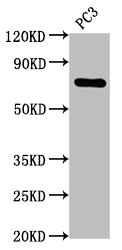
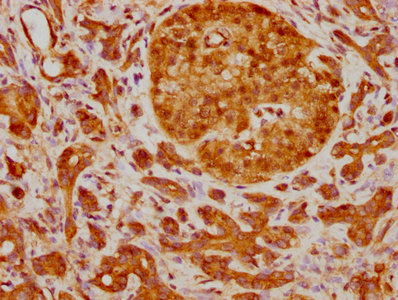
Validation studies demonstrate reliable performance across multiple platforms. In Western blot analysis of PC3 whole cell lysate, the antibody detects a band at 77 kDa, which corresponds to one of the larger TP63 isoforms and may reflect post-translational modifications such as glycosylation or phosphorylation that increase the apparent molecular weight beyond some predicted sizes. Immunohistochemistry validation in paraffin-embedded human pancreatic cancer tissue confirms robust nuclear staining patterns consistent with TP63's function as a transcription factor.
The antibody's compatibility with both Western blot and immunohistochemistry workflows provides flexibility for researchers investigating TP63 expression at the protein level in cell lysates or examining its localization and expression patterns in tissue sections, supporting diverse cell biology research applications.
There are currently no reviews for this product.





