
Call us
301-363-4651 (Available 9 a.m. to 5 p.m. CST from Monday to Friday)

| Code | CSB-RA993982A0HU |
| Size | US$210 |
| Order now | |
| Image |
|
| Have Questions? | Leave a Message or Start an on-line Chat |
| Application | Recommended Dilution |
|---|---|
| IF | 1:50-1:200 |
| FC | 1:50-1:200 |
USP10 is a deubiquitinating enzyme that plays essential roles in cellular homeostasis by removing ubiquitin chains from substrate proteins, thereby rescuing them from proteasomal degradation. This enzyme has garnered significant research attention for its involvement in p53 stabilization, DNA damage response pathways, and autophagy regulation, making it a compelling target for studies investigating tumor suppression mechanisms and stress response signaling.
This recombinant monoclonal antibody, clone 6A4, offers researchers the reproducibility advantages inherent to recombinant technology. Because the antibody sequence is defined and production occurs through controlled expression systems, you can expect consistent performance across experiments and between lot numbers, eliminating the variability concerns that can complicate long-term studies or multi-site collaborations.
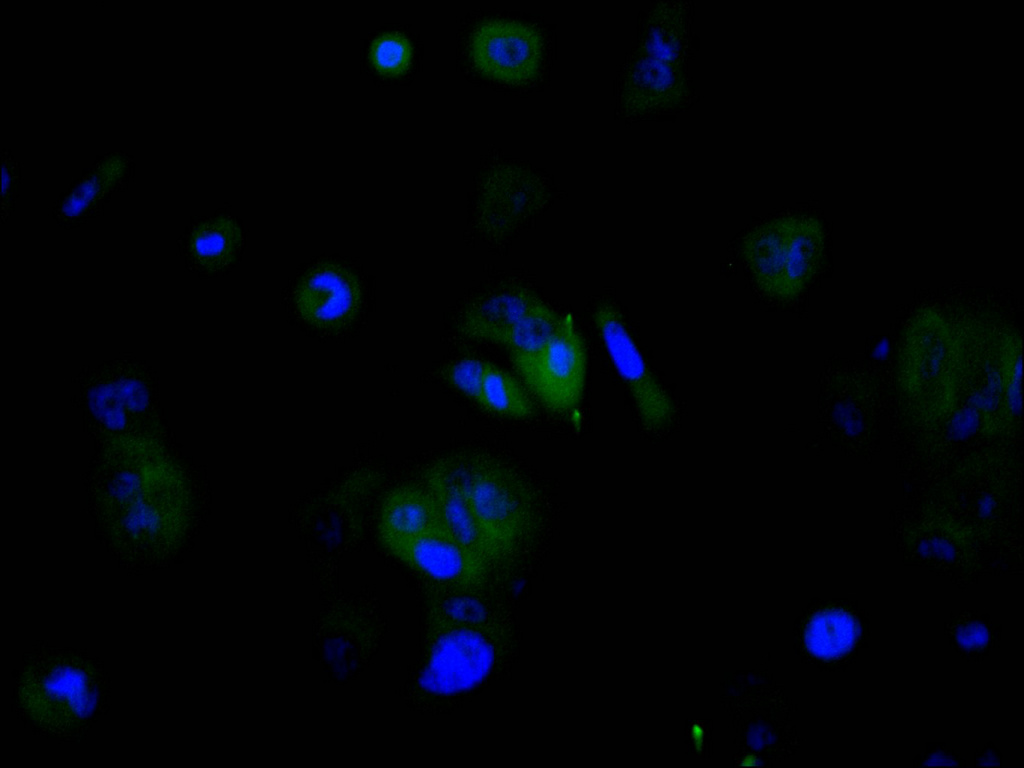
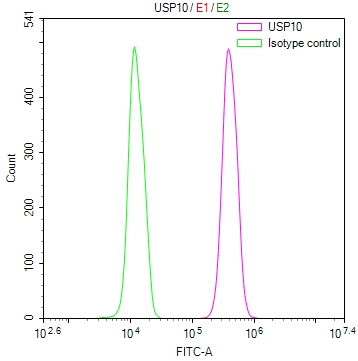
Validation studies demonstrate reliable performance in immunofluorescence and flow cytometry applications. Immunofluorescence analysis of MCF-7 breast cancer cells reveals clear cytoplasmic and nuclear staining patterns at dilutions of 1:50 to 1:200, consistent with the known shuttling behavior of USP10 between cellular compartments. Flow cytometry experiments using HeLa cells show distinct positive population shifts compared to isotype controls, confirming specific detection in fixed and permeabilized samples. These validated human cell lines provide a solid foundation for researchers working with similar experimental systems.
The unconjugated format allows flexibility in secondary antibody selection, accommodating various detection systems and multiplexing strategies. Supplied in a glycerol-containing buffer optimized for long-term storage stability, this antibody is well-suited for researchers investigating ubiquitin-proteasome system dynamics, p53 pathway regulation, or broader deubiquitinase biology in cancer and cellular stress contexts.
There are currently no reviews for this product.





