
Call us
301-363-4651 (Available 9 a.m. to 5 p.m. CST from Monday to Friday)

| Code | CSB-RA073613A0HU |
| Size | US$210 |
| Order now | |
| Image |
|
| Have Questions? | Leave a Message or Start an on-line Chat |
| Application | Recommended Dilution |
|---|---|
| WB | 1:500-1:5000 |
| FC | 1:50-1:200 |
USP39 plays a critical role in pre-mRNA splicing as a core component of the U4/U6.U5 tri-snRNP complex, making it essential for proper spliceosome assembly and function. Despite containing a ubiquitin-specific peptidase domain, USP39 lacks catalytic activity and instead functions as a scaffold protein in splicing machinery. This dual identity has positioned USP39 as an important target in research exploring splicing regulation, cell cycle progression, and cancer biology, where aberrant splicing patterns frequently contribute to disease mechanisms.
This recombinant monoclonal antibody, clone 25G11, offers the reproducibility and consistency that demanding splicing research requires. Developed using recombinant technology with a defined sequence, this rabbit IgG eliminates the lot-to-lot variability that can compromise longitudinal studies or multi-site collaborations. The antibody was raised against a synthetic peptide derived from human USP39, ensuring precise epitope targeting.
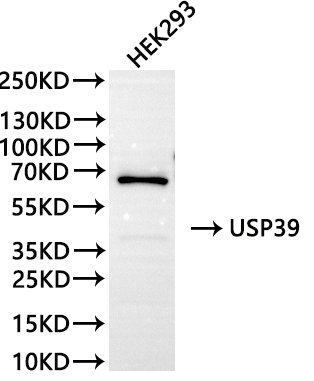
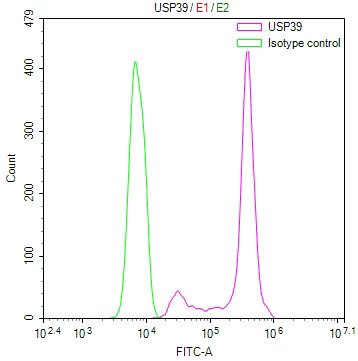
Validation studies confirm reliable performance across multiple experimental platforms. Western blot analysis in HEK293 whole cell lysates demonstrates specific detection of USP39 at the predicted molecular weight of 65 kDa, with recommended dilutions ranging from 1:500 to 1:5000 providing flexibility for optimization. Flow cytometry validation using HeLa cells shows clear separation between specific signal and isotype control, supporting intracellular detection applications at dilutions of 1:50 to 1:200. The antibody is also validated for ELISA applications.
Supplied in a stabilized liquid format with glycerol for convenient storage at -20°C or -80°C, this affinity-purified antibody is well-suited for researchers investigating spliceosome biology, RNA processing mechanisms, or the emerging connections between splicing dysregulation and oncogenesis.
There are currently no reviews for this product.





