
Call us
301-363-4651 (Available 9 a.m. to 5 p.m. CST from Monday to Friday)

| Code | CSB-RA079059A0HU |
| Size | US$210 |
| Order now | |
| Image |
|
| Have Questions? | Leave a Message or Start an on-line Chat |
| Application | Recommended Dilution |
|---|---|
| WB | 1:500-1:2000 |
| IF | 1:50-1:200 |
| FC | 1:50-1:200 |
WDR4 serves as an essential non-catalytic subunit of the tRNA methyltransferase complex responsible for N7-methylguanosine modification at position 46 of tRNAs. This post-transcriptional modification plays a critical role in tRNA stability and translational fidelity, making WDR4 a protein of significant interest in studies of epitranscriptomics, ribosome biology, and developmental disorders. Mutations in WDR4 have been linked to primordial dwarfism and microcephaly syndromes, underscoring its importance in cellular growth regulation and neurodevelopment.
This recombinant monoclonal antibody, clone 19E3, offers the reproducibility and consistency that demanding research applications require. Generated against a synthetic peptide derived from human WDR4, the antibody is produced using recombinant technology, ensuring sequence-defined specificity and eliminating the lot-to-lot variability that can compromise longitudinal studies or multi-site collaborations.
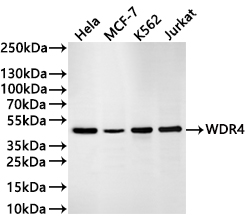
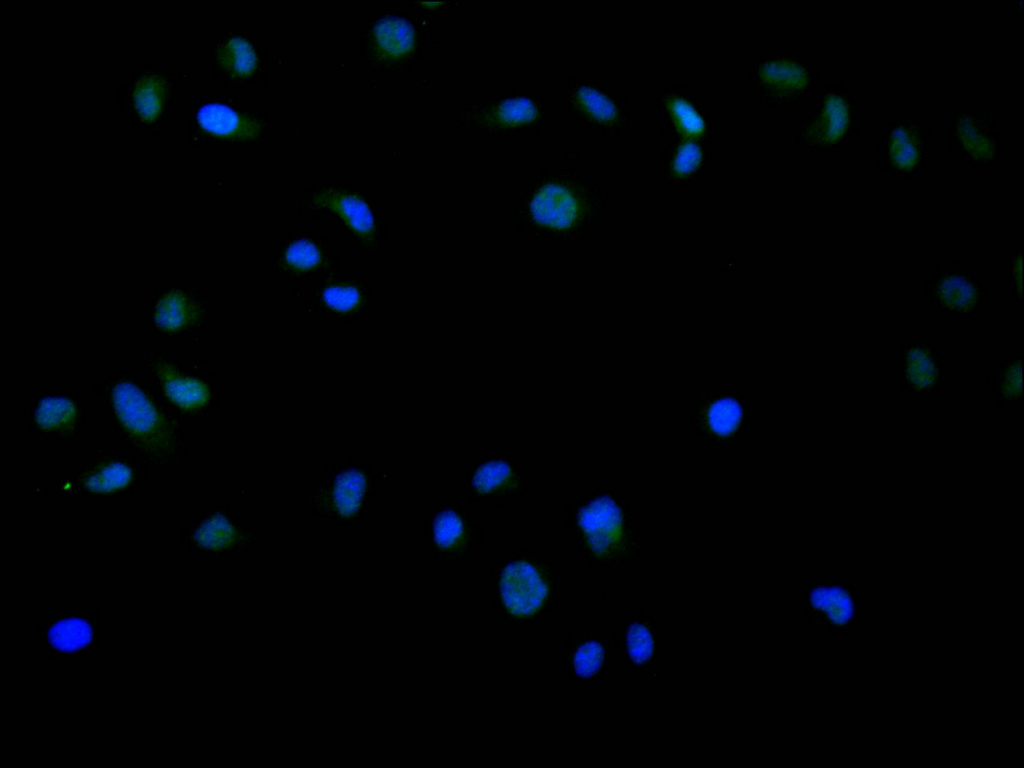
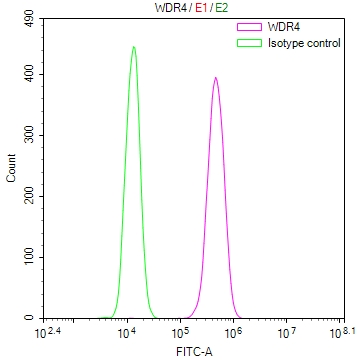
Validation across multiple experimental platforms demonstrates this antibody's versatility in your workflow. Western blot analysis confirms reliable detection of WDR4 at the expected 45 kDa molecular weight across diverse human cell lines including HeLa, MCF-7, K562, and Jurkat cells, providing confidence when working with different cellular models. Immunofluorescence staining in HeLa cells reveals clear subcellular localization patterns, while flow cytometry analysis in 786-O renal carcinoma cells shows distinct positive population shifts compared to isotype controls, enabling quantitative single-cell studies.
Whether investigating tRNA modification pathways, exploring translational regulation mechanisms, or studying the molecular basis of WDR4-associated developmental syndromes, this antibody provides a dependable tool for protein expression analysis, cellular localization studies, and population-level quantification across multiple validated applications.
There are currently no reviews for this product.





