
Call us
301-363-4651 (Available 9 a.m. to 5 p.m. CST from Monday to Friday)

| Code | CSB-RA248847A0HU |
| Size | US$210 |
| Order now | |
| Image |
|
| Have Questions? | Leave a Message or Start an on-line Chat |
| Application | Recommended Dilution |
|---|---|
| FC | 1:50-1:200 |
XRCC1 serves as a critical scaffold protein in the base excision repair pathway, coordinating the repair of DNA single-strand breaks and damaged bases that arise from oxidative stress, alkylation, and ionizing radiation. This protein's interactions with DNA ligase III, DNA polymerase beta, and poly(ADP-ribose) polymerase make it essential for maintaining genomic integrity, positioning XRCC1 as a key target for researchers investigating DNA damage response mechanisms, cancer biology, and cellular stress responses.
This recombinant monoclonal antibody, clone 4C7, offers the reproducibility and consistency that demanding experimental workflows require. Generated against a synthesized peptide derived from human XRCC1, the antibody is produced using recombinant technology, ensuring sequence-defined specificity and eliminating the lot-to-lot variability that can compromise longitudinal studies or multi-site collaborations. Affinity chromatography purification further enhances performance by removing non-specific immunoglobulins.
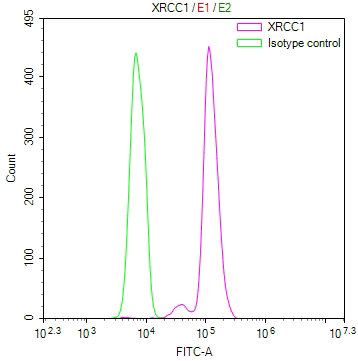
Validation studies confirm robust performance in flow cytometry applications, with recommended dilutions ranging from 1:50 to 1:200. Testing in HeLa cells demonstrated clear positive signal separation from isotype control, with cells fixed in formaldehyde and permeabilized with Triton X-100 to enable detection of this nuclear protein. The intracellular staining protocol successfully captured XRCC1 expression, providing researchers with a reliable tool for quantifying this repair factor at the single-cell level.
For investigators exploring epigenetics, nuclear signaling, or DNA repair pathways, this antibody supports studies examining XRCC1 expression dynamics following genotoxic stress, its role in replication-associated repair, or its potential as a biomarker in cancer research contexts where DNA damage response is therapeutically relevant.
There are currently no reviews for this product.





