Recombinant Mouse Phosphatidylcholine:ceramide cholinephosphotransferase 1 (Sgms1)

In Stock
Code CSB-CF848676MO
Abbreviation Recombinant Mouse Sgms1 protein
MSDS
Size $1620
Order now
Image
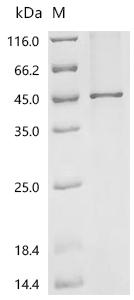
  • (Tris-Glycine gel) Discontinuous SDS-PAGE (reduced) with 5% enrichment gel and 15% separation gel.
Have Questions? Leave a Message or Start an on-line Chat

Product Details

Purity
Greater than 90% as determined by SDS-PAGE.
Activity
Not Test
Target Names
Sgms1
Uniprot No.
Research Area
Signal Transduction
Species
Mus musculus (Mouse)
Source
in vitro E.coli expression system
Expression Region
1-419aa
Target Protein Sequence
MLSARTMKEVVYWSPKKVADWLLENAMPEYCEPLEHFTGQDLINLTQEDFKKPPLYRVSSDNGQRLLDMIETLKMEHHMEAHKNGHANGHLSIGVDIPNPDGSFSIKTKPNGMPNGFRKEMIKIPMPEPERSQYPMEWGKTFLAFLYALSCFVLTTVMISVVHERVPPKEVQPPLPDTFFDHFNRVQWAFSICEINGMILVGLWLFQWLLLKYKSIISRRFFCIVGTLYLYRCITMYVTTLPVPGMHFNCSPKLFGDWEAQVRRIMKLIAGGGLSITGSHNMCGDYLYSGHTVMLTLTYLFIKEYSPRRLWWYHWICWLLSVVGIFCILLAHDHYTVDVVVAYYITTRLFWWYHTMANQQVLKEASQMNLLARVWWYRPFQYFEKNVQGIVPRSYHWPFPWPVVHLSRQVKYSRLVNDT
Note: The complete sequence may include tag sequence, target protein sequence, linker sequence and extra sequence that is translated with the protein sequence for the purpose(s) of secretion, stability, solubility, etc.
If the exact amino acid sequence of this recombinant protein is critical to your application, please explicitly request the full and complete sequence of this protein before ordering.
Mol. Weight
50.8 kDa
Protein Length
Full Length
Tag Info
N-terminal 10xHis-tagged
Form
Liquid or Lyophilized powder
Note: We will preferentially ship the format that we have in stock, however, if you have any special requirement for the format, please remark your requirement when placing the order, we will prepare according to your demand.
Buffer
If the delivery form is liquid, the default storage buffer is Tris/PBS-based buffer, 5%-50% glycerol. If the delivery form is lyophilized powder, the buffer before lyophilization is Tris/PBS-based buffer, 6% Trehalose, pH 8.0.
Reconstitution
We recommend that this vial be briefly centrifuged prior to opening to bring the contents to the bottom. Please reconstitute protein in deionized sterile water to a concentration of 0.1-1.0 mg/mL.We recommend to add 5-50% of glycerol (final concentration) and aliquot for long-term storage at -20°C/-80°C. Our default final concentration of glycerol is 50%. Customers could use it as reference.
Troubleshooting and FAQs
Storage Condition
Store at -20°C/-80°C upon receipt, aliquoting is necessary for mutiple use. Avoid repeated freeze-thaw cycles.
Shelf Life
The shelf life is related to many factors, storage state, buffer ingredients, storage temperature and the stability of the protein itself.
Generally, the shelf life of liquid form is 6 months at -20°C/-80°C. The shelf life of lyophilized form is 12 months at -20°C/-80°C.
Lead Time
3-7 business days
Notes
Repeated freezing and thawing is not recommended. Store working aliquots at 4°C for up to one week.
Datasheet & COA
Please contact us to get it.
Customer Reviews and Q&A

 Customer Reviews

There are currently no reviews for this product.

Submit a Review here

Target Background

Function
Major sphingomyelin synthase at the Golgi apparatus. Catalyzes the reversible transfer of phosphocholine moiety in sphingomyelin biosynthesis: in the forward reaction transfers phosphocholine head group of phosphatidylcholine (PC) on to ceramide (CER) to form ceramide phosphocholine (sphingomyelin, SM) and diacylglycerol (DAG) as by-product, and in the reverse reaction transfers phosphocholine from SM to DAG to form PC and CER. The direction of the reaction depends on the levels of CER and DAG in Golgi membranes. Does not use free phosphorylcholine or CDP-choline as donor. Regulates receptor-mediated signal transduction via mitogenic DAG and proapoptotic CER, as well as via SM, a structural component of membrane rafts that serve as platforms for signal transduction and protein sorting. Plays a role in secretory transport via regulation of DAG pool at the Golgi apparatus and its downstream effects on PRKD1.; (Microbial infection) Contributes to the brain SM production for Japanese encephalitis virus attachment and infection.
Gene References into Functions
  1. SMS1 contributed to sphingomyelin generation inducing Japanese encephalitis virus attachment and infection. PMID: 27892528
  2. Study has shown that sphingomyelin synthase 1 regulates ceramide levels in N2a cells and plays a potent protective role in this oxidative stress-induced apoptosis partly through the p38 pathway. PMID: 27391427
  3. SMS1 has a wider than anticipated role in testis polyunsaturated fatty acid homeostasis and for male fertility PMID: 27788151
  4. Sphingomyelin synthase 1 regulates Neuro-2a cell proliferation and cell cycle progression through modulation of p27 expression and Akt signaling PMID: 25084761
  5. that SMS1 is crucial to control oxidative stress in order to maintain white adipose tissue function. PMID: 23593476
  6. The deficiency of membrane sphingomyelin caused the CD4 T-cell dysfunction through impaired lipid raft function contributing to protection of ConA-induced liver injury, and suggesting that the membrane sphingomyelin is critical for full T-cell activation. PMID: 22345277
  7. Sms1 deficiency decreases sphingomyelin, but dramatically increases the levels of glycosphingolipids. Atherosclerosis in Sms1(-/-)-->Ldlr(-/-) mice is significantly decreased. PMID: 22580896
  8. SMS1-mediated SM synthesis directs Tf-TfR to undergo clathrin-dependent endocytosis and recycling, promoting the proliferation of lymphoma cells. PMID: 21856749
  9. sphingomyelin synthase has a role in controlling the antimicrobial activity of neutrophils against Cryptococcus neoformans PMID: 21203393
  10. SMS1 is important for controlling ROS generation, and SMS1 is required for normal mitochondrial function and insulin secretion in pancreatic beta-cells PMID: 21115496

Show More

Hide All

Subcellular Location
Golgi apparatus membrane; Multi-pass membrane protein.
Protein Families
Sphingomyelin synthase family
Tissue Specificity
Isoform 1 is widely expressed, isoform 2 shows a more narrow distribution and isoform 3 is detected only in testis and heart.
Database Links
icon of phone
Call us
301-363-4651 (Available 9 a.m. to 5 p.m. CST from Monday to Friday)
icon of address
Address
7505 Fannin St., Ste 610, Room 7 (CUBIO Innovation Center), Houston, TX 77054, USA
icon of social media
Join us with

Subscribe newsletter

Leave a message

* To protect against spam, please pass the CAPTCHA test below.
CAPTCHA verification
© 2007-2026 CUSABIO TECHNOLOGY LLC All rights reserved. 鄂ICP备15011166号-1
Place an order now

I. Product details

*
*
*
*

II. Contact details

*
*

III. Ship To

*
*
*
*
*
*
*

IV. Bill To

*
*
*
*
*
*
*
*



