
Call us
301-363-4651 (Available 9 a.m. to 5 p.m. CST from Monday to Friday)

| Code | CSB-ONH502BO-kit |
| Size | $825 |
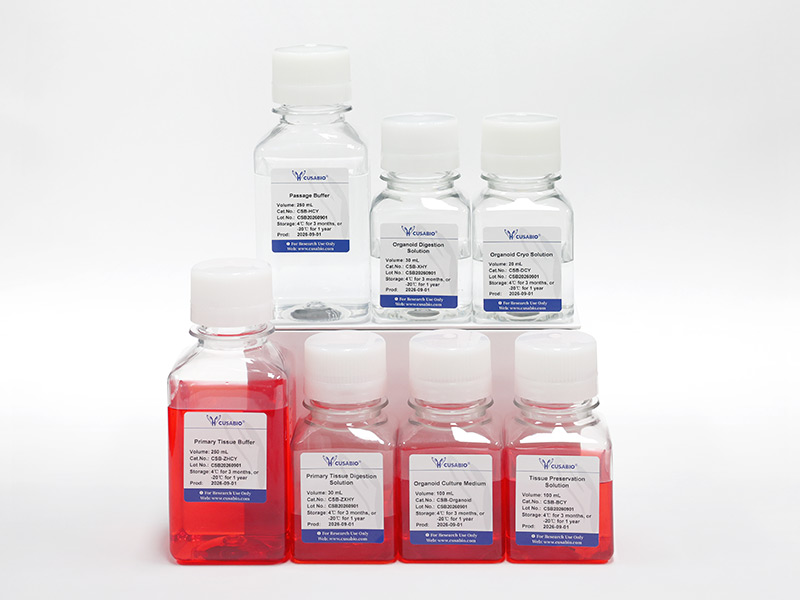
| Image |
|
| Have Questions? | Leave a Message or Start an on-line Chat |
| Contents | Size1 | Size2 | Storage | |
|---|---|---|---|---|
| 1 | Organoid Culture Medium | 100 mL | 500 mL | 4℃,3 months;-20℃,1 year |
| 2 | Primary Tissue Buffer | 250 mL | 1250 mL | 4℃,3 months;-20℃,1 year |
| 3 | Primary Tissue Digestion Solution | 30 mL | 200 mL | 4℃,3 months;-20℃,1 year |
| 4 | Organoid Digestion Solution | 30 mL | 200 mL | 4℃,3 months;-20℃,1 year |
| 5 | Tissue Preservation Solution | 100 mL | 500 mL | 4℃,3 months;-20℃,1 year |
| 6 | Organoid Cryo Solution | 20 mL | 100 mL | 4℃,3 months;-20℃,1 year |
| 7 | Passage Buffer | 250 mL | 1250 mL | 4℃,3 months;-20℃,1 year |
Note: Matrigel, cytokines and other products are not included in this kit.
There are currently no reviews for this product.
What common challenges occur during primary organoid establishment?
1.Pre-screening of tissue specimens: Cell viability of isolated tissue must reach ≥25% to proceed with organoid derivation.
2.Digestion time optimization: Digestion duration for tumor tissues ranges from 20–120 min, which should be adjusted according to tissue hardness and fibrosis degree.
3.Storage and transportation of ex vivo tissues: Total ex vivo storage time of isolated tissues should be controlled within 72 h to guarantee cellular activity.
Can dissociated primary cells from cryopreserved tissues be used for 3D organoid culture if fresh tissue is unavailable?
Literature has reported 2D and 3D culture using cryopreserved tissues, yet the overall establishment success rate remains low. Organoid culture demands high viability of starting stem cells, and cryopreservation causes irreversible damage to stem cell populations. Therefore, fresh ex vivo tissue specimens are strongly recommended over frozen tissues for organoid construction.
Is red blood cell removal mandatory after primary cell isolation?
Large quantities of red blood cells are commonly present in liver, lung and other tumor tissue samples. Most erythrocytes can be eliminated via repeated tissue washing; commercial red blood cell lysis buffer is an optional alternative. Red blood cell removal is not compulsory and can be decided based on specimen conditions.
How to minimize contamination risks in primary organoid culture?
Animal-derived specimens carry higher contamination risks than human samples, especially gastrointestinal and urogenital tissues. The culture system can be supplemented with 3–5% gentamicin, penicillin-streptomycin (P/S), and laboratory antifungal agents when necessary to build a multi-layer anti-contamination system.
What are the differences between tissue-derived organoids and iPSC-induced organoids?
Tissue-derived organoids:
iPSC-induced organoids:
How many passages can cryopreserved organoids sustain? Is specialized cryopreservation medium required?
Passage capacity depends on the stemness status of organoids; organoids with robust stem cell activity can be stably passaged over 20 times. Dedicated serum-free organoid cryopreservation medium is mandatory; general cell freezing medium is not suitable for organoid cryopreservation.
Why can organoids undergo multiple serial passages, whereas conventional primary tissue cells only sustain 3–5 passages?
Dissociated single primary cells activate replicative senescence pathways, leading to restricted proliferation. In contrast, organoid cultures retain self-renewing stem/progenitor cell populations, and specialized organoid culture medium maintains stem cell properties while suppressing excessive differentiation, enabling long-term serial passaging.




