
Call us
301-363-4651 (Available 9 a.m. to 5 p.m. CST from Monday to Friday)

| Code | CSB-MA000159 |
| Size | US$119 |
| Order now | |
| Image |
|
| Have Questions? | Leave a Message or Start an on-line Chat |
| Application | Recommended Dilution |
|---|---|
| WB | 1:500-1:5000 |
| IF | 1:50-1:200 |
| IP | 1:200-1:2000 |
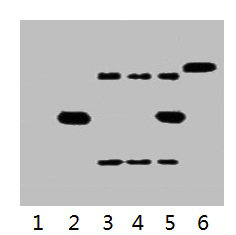
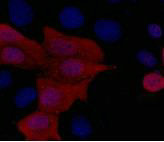
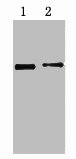
The His (histidine) tag is a widely utilized peptide marker for recombinant protein purification, detection, and quantification in biochemical and biotechnological studies. This His-Tag monoclonal antibody (CSB-MA000159) is generated in mouse with IgG isotype, raised against a synthetic peptide immunogen, and supplied as a non-conjugated liquid formulation for tag-specific protein analysis. Beyond rigorous production standards that deliver high purity, lot-to-lot stability, and minimal cross-reactivity, the antibody has been referenced in six published studies, providing researchers with literature-backed validation for recombinant protein applications. WB validation shows clear, specific bands against 2 μg of His fusion protein at dilutions of 1:5000 and 1:10000; immunofluorescence yields bright, well-defined signals in His-transfected 293 cells at 1:1000 dilution; immunoprecipitation demonstrates efficient target enrichment from transfected 293 cell lysates with minimal background in negative controls, consistent with the recommended application-specific dilution ranges. Fully validated for ELISA, WB, IF, and IP, this antibody serves as a dependable tool for His-tagged recombinant protein characterization, subcellular localization analysis, and affinity purification in protein engineering and biopharmaceutical research.
Applications : Pull-down assay
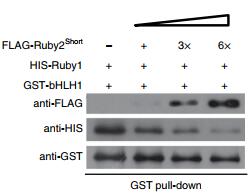
Review: Competitive binding assays of CgRuby1 and CgRuby2Short binding to CgbHLH1. The mixture of HIS-CgRuby1 and FLAG CgRuby2Short was added to immobilized GSTCgbHLH1. The precipitates were detected using western blot analysis with anti-HIS, anti-FLAG or anti-GST antibodies. The gradient indicates the increasing amount of FLAG-CgRuby2Short. These experiments were repeated independently twice with similar results.
By Anonymous
Applications : ELISA
Sample dilution: 1: 4000
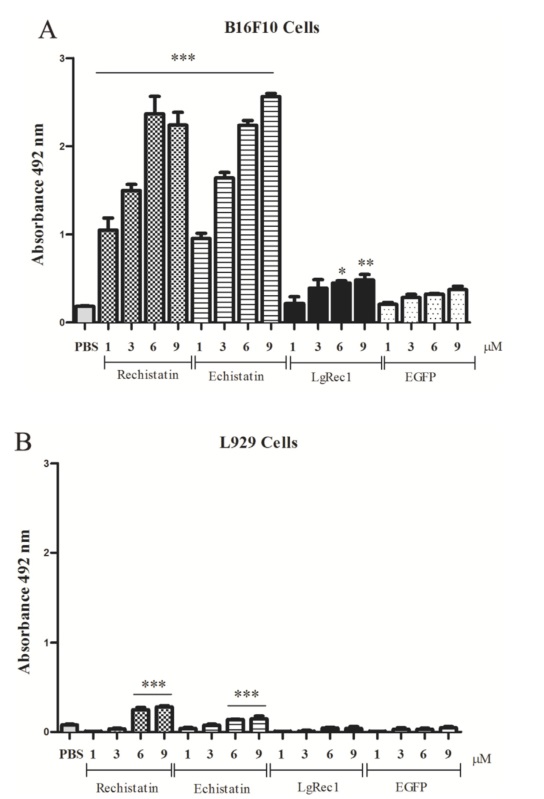
Review: Murine B16F10 and L929 cell lines (2× 10 5 ) were fixed on plates and then blocked with 2% BSA solution. After that, Rechistatin, Echistatin, LgRec1 or EGFP (1; 3; 6 and 9μM) were added to the plates followed by incubation for 2 h at 37°C. The binding of the recombinant proteins to the cells was assessed using anti-His (Cusabio®) mAb followed by anti-mouse IgG-peroxidase conjugate (Sigma® ). The reaction was measured by spectrophotometer at 492 nm, the higher the absorbance the grater the binding of the toxins to the cells. A) Binding of recombinant toxins on murine B16F10 melanoma cells; B) Binding of recombinant toxins on murine L929 cells. The results were expressed as mean ± SD (n = 3), ***p < 0.001; **p < 0.01 and *p < 0.05 comparing Rechistatin, Echistatin, LgRec1 and EGFP groups com- pared with PBS.
By Anonymous
Applications : GST pull-down
Sample dilution: 1:200
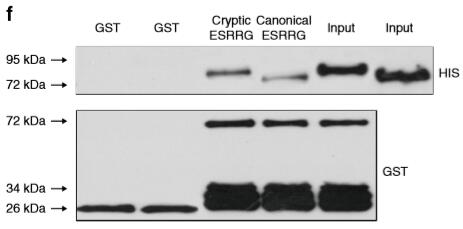
Review: We examined Pit-1 protein binding in relation to ESRRG alternative splicing status. Pit-1 protein fused to glutathione S-transferase (GST) pull-down HIS-tagged cryptic ESRRG, whereas it bound weakly to canonical ESRRG
By Anonymous
Applications : Western blot
Sample type: cells
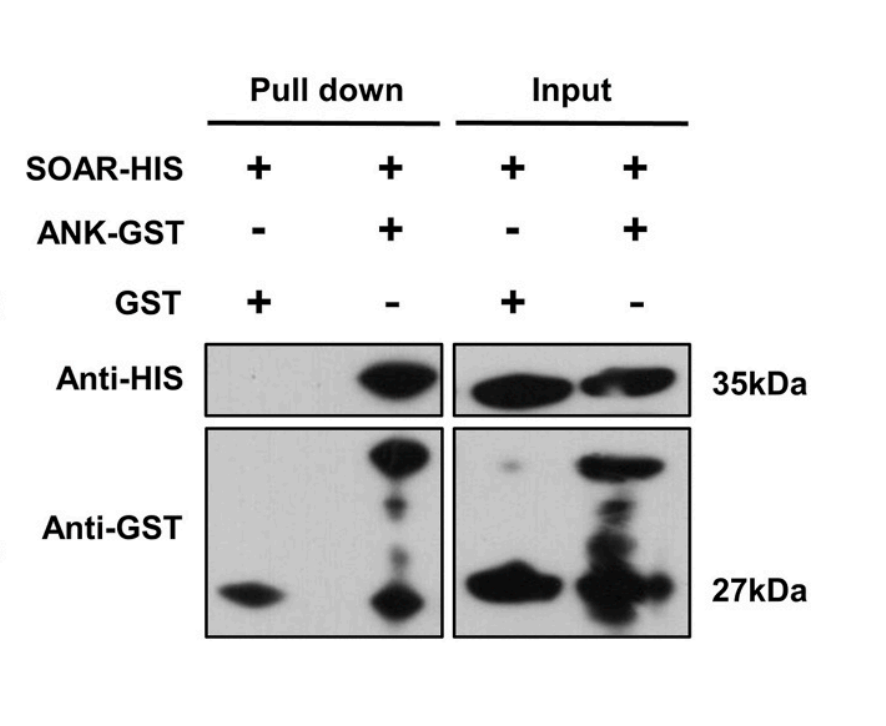
Review: GST pull-down assay revealed Shank3 directly bound with STIM1 (n = 3, t = 18.65, df = 4, P < 0.0001).
By Anonymous





