MOT1 Antibody

Code CSB-PA329158XA01SVG
Size US$299
Image
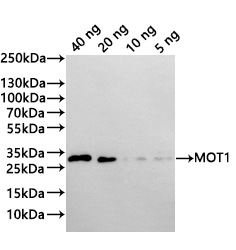
  • Western Blot
    Positive WB detected in: recombinant protein
    All lanes:MOT1 Antibody at 1:1000
    Secondary
    Goat polyclonal to rabbit IgG at 1/20000 dilution
    Predicted band size: 26.5 kDa
    Observed band size: 27 kDa
Have Questions? Leave a Message or Start an on-line Chat

Product Details

Full Product Name
Rabbit anti-Saccharomyces cerevisiae (strain ATCC 204508 / S288c) (Baker's yeast) MOT1 Polyclonal antibody
Uniprot No.
Target Names
MOT1
Alternative Names
TATA-binding protein-associated factor MOT1 (TBP-associated factor MOT1) (EC 3.6.4.-) (Modifier of transcription 1) MOT1 YPL082C LPF4C
Raised in
Rabbit
Species Reactivity
Saccharomyces cerevisiae (strain ATCC 204508 / S288c) (Baker's yeast)
Immunogen
Recombinant Saccharomyces cerevisiae (strain ATCC 204508 / S288c) (Baker's yeast) MOT1 protein (1284-1457aa)
Immunogen Species
Saccharomyces cerevisiae (strain ATCC 204508 / S288c) (Baker's yeast)
Conjugate
Non-conjugated
Clonality
Polyclonal
Isotype
IgG
Purification Method
Antigen Affinity Purified
Concentration
It differs from different batches. Please contact us to confirm it.
Buffer
Preservative: 0.03% Proclin 300
Constituents: 50% Glycerol, 0.01M PBS, pH 7.4
Form
Liquid
Tested Applications
ELISA, WB
Recommended Dilution
Application Recommended Dilution
WB 1:500-1:5000
Troubleshooting and FAQs
Storage
Upon receipt, store at -20°C or -80°C. Avoid repeated freeze.
Lead Time
Basically, we can dispatch the products out in 1-3 working days after receiving your orders. Delivery time maybe differs from different purchasing way or location, please kindly consult your local distributors for specific delivery time.
Usage
For Research Use Only. Not for use in diagnostic or therapeutic procedures.
Customer Reviews and Q&A

 Customer Reviews

There are currently no reviews for this product.

Submit a Review here

Target Background

Function
Regulates transcription in association with TATA binding protein (TBP). Removes TBP from the TATA box via its C-terminal ATPase activity. Both transcription activation and repression require its ATPase activity.
Gene References into Functions
  1. these results suggest that TBP-DNA affinity as well as other aspects of promoter sequence influence Mot1 function in vivo. PMID: 27255709
  2. The results stress the importance of the cooperation of Mot1p/NC2 with remodelers in maintaining a repressive environment for intragenic transcription. PMID: 24459134
  3. The action of Mot1 is required to clear TBP from intrinsically preferred (TATA-containing) binding sites, ensuring sufficient soluble TBP to bind intrinsically disfavored (TATA-less) sites. PMID: 24144978
  4. In the absence of ATP, ternary complex stability arises from both Mot1-DNA and Mot1-TBP interactions. PMID: 22298788
  5. findings suggest that the four conserved regions of Mot1 are essential for viability and required for proper regulation of most Mot1-regulated genes; loss of the ATPase domain, however, imparts some unexpected regulation on certain genes PMID: 21444714
  6. Mot1 plays a broad role in establishing the precision and efficiency of RNA synthesis. PMID: 20855454
  7. MOT1 might have a role in vivo as a transcriptional activator in the small ubiquitin-related modifier (SUMO) protein pathway. PMID: 16387868
  8. A novel ATP-independent TBPc displacement activity for Mot1 is reported PMID: 16541100
  9. These results support a model in which Mot1 affects the rate and efficiency of rRNA synthesis by both direct and indirect mechanisms, with resulting effects on transcription activation and the coupling of rRNA synthesis to processing. PMID: 17296733
  10. Mot1p interacts with a range of transcriptional co-regulators as well as proteins involved in chromatin remodeling. PMID: 18596064
  11. Mot1-mediated dissociation of TBP (or TBP-containing complexes) from chromatin can explain the Mot1 activation mechanism at some promoters. PMID: 19098311
  12. These results therefore demonstrate that Mot1 is an in vivo SUMO-targeted ubiquitin ligase target in yeast and suggest a role for SUMO-targeted degradation in protein quality control. PMID: 19139279

Show More

Hide All

Subcellular Location
Mitochondrion. Nucleus. Note=Localized on chromatin. Specifically localized to the promoters of the genes it regulates.
Protein Families
SNF2/RAD54 helicase family
Database Links

KEGG: sce:YPL082C

STRING: 4932.YPL082C

icon of phone
Call us
301-363-4651 (Available 9 a.m. to 5 p.m. CST from Monday to Friday)
icon of address
Address
7505 Fannin St., Ste 610, Room 7 (CUBIO Innovation Center), Houston, TX 77054, USA
icon of social media
Join us with

Subscribe newsletter

Leave a message

* To protect against spam, please pass the CAPTCHA test below.
CAPTCHA verification
© 2007-2026 CUSABIO TECHNOLOGY LLC All rights reserved. 鄂ICP备15011166号-1



