STE2 Antibody

Code CSB-PA517141XA01SVG
Size US$299
Image
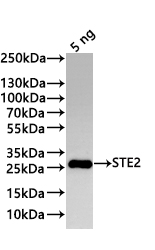
  • Western Blot
    Positive WB detected in: recombinant protein
    All lanes:STE2 Antibody at 1:1000
    Secondary
    Goat polyclonal to rabbit IgG at 1/20000 dilution
    Predicted band size: 22 kDa
    Observed band size: 27 kDa
Have Questions? Leave a Message or Start an on-line Chat

Product Details

Full Product Name
Rabbit anti-Saccharomyces cerevisiae (strain ATCC 204508 / S288c) (Baker's yeast) STE2 Polyclonal antibody
Uniprot No.
Target Names
STE2
Alternative Names
Pheromone alpha factor receptor STE2 YFL026W
Raised in
Rabbit
Species Reactivity
Saccharomyces cerevisiae (strain ATCC 204508 / S288c) (Baker's yeast)
Immunogen
Recombinant Saccharomyces cerevisiae (strain ATCC 204508 / S288c) (Baker's yeast) STE2 protein (300-431aa)
Immunogen Species
Saccharomyces cerevisiae (strain ATCC 204508 / S288c) (Baker's yeast)
Conjugate
Non-conjugated
Clonality
Polyclonal
Isotype
IgG
Purification Method
Antigen Affinity Purified
Concentration
It differs from different batches. Please contact us to confirm it.
Buffer
Preservative: 0.03% Proclin 300
Constituents: 50% Glycerol, 0.01M PBS, pH 7.4
Form
Liquid
Tested Applications
ELISA, WB
Recommended Dilution
Application Recommended Dilution
WB 1:500-1:5000
Troubleshooting and FAQs
Storage
Upon receipt, store at -20°C or -80°C. Avoid repeated freeze.
Lead Time
Basically, we can dispatch the products out in 1-3 working days after receiving your orders. Delivery time maybe differs from different purchasing way or location, please kindly consult your local distributors for specific delivery time.
Usage
For Research Use Only. Not for use in diagnostic or therapeutic procedures.
Customer Reviews and Q&A

 Customer Reviews

There are currently no reviews for this product.

Submit a Review here

Target Background

Function
Receptor for the peptide pheromone alpha factor, the mating factor of yeast.
Gene References into Functions
  1. Interaction between Ste2p and Gpa1p takes palce before ligand binding via the Ste2p C-terminal domain and the Gpa1p N-terminal domain. PMID: 28958779
  2. yeast pheromone receptor Ste2 forms predominantly tetramers at average expression levels of 2 to 25 molecules per pixel and a mixture of tetramers and octamers at expression levels of 25-100 molecules per pixel. Ste2 is a class D GPCR found in the yeast Saccharomyces cerevisiae of the mating type a, and binds the pheromone a-factor secreted secreted by cells of the mating type a PMID: 27993568
  3. The main difference between the Ste2 and Ste3 receptor observed in this work was that while hyperactive mutations were found for Ste3, no gain-of-function mutant for the Ste2 receptor was found. this fi nding is an outcome of the different strategies the two genes have adopted for their expression. PMID: 27150158
  4. Results suggest that the G-protein-coupled receptor, Ste2 binds the inhibitory G-protein signaling, Sst2 forming a complex with antagonistic functions. PMID: 28034910
  5. Variable Dependence of Signaling Output on Agonist Occupancy of Ste2p, a G Protein-coupled Receptor in Yeast PMID: 27646004
  6. results extend previous observations and quantify the contributions of Ste2p variants to mediating cell cycle arrest versus downstream mating functionalities. PMID: 26232403
  7. we propose that the N-terminus of Ste2p plays multiple regulatory roles in controlling receptor function. PMID: 26707753
  8. A strategy for the identification of stabilized variants of the yeast alpha-factor receptor Ste2p. PMID: 25647246
  9. Results show that Ste2 is downregulated by endocytosis, both constitutive and ligand induced and its internalization requires its phosphorylation and ubiquitinylation through the action of alpha arrestins. PMID: 24820415
  10. C-terminally trancated forms of Ste2p exert dominant-negative effects. PMID: 22923047
  11. structure determination of transmembrane segments of Y4 and the yeast Ste2p G-protein-coupled receptors PMID: 22947943
  12. the identification of disulfide bonds that stabilize the active state of the yeast alpha-mating pheromone receptor Ste2p PMID: 22387470
  13. C-terminus contains multiple functional domains with differential and interdependent roles in regulating Ste2p function. PMID: 22100461
  14. a cryptic polyadenylation site is present inside the coding region of the a-specific STE2 gene, encoding the receptor for the alpha-factor PMID: 21969566
  15. study provides new information about role of specific residues of STE2, a GPCR, in signal transduction and how peptide ligand binding activates the receptor PMID: 21728340
  16. These results suggest that receptor--agonist interactions, such as those involving Ste2p, involve at least two sites, of which only one is specific for the activated conformation of the receptor. PMID: 21477594
  17. Kinetic analysis suggests that alpha-factor associates with its receptor STE2 via a two-stage process consisting of an initial binding event followed by a rearrangement of the ligand-receptor complex. PMID: 15491163
  18. Thirty-five different STE2 suppressor mutations were identified by isolating second-site suppressor mutations that restored function to defective receptors carrying either an F204S or Y266C substitution. PMID: 15667221
  19. NMR analysis; findings suggest helical subdomains existed in both the transmembrane and cytosolic tail; as the tail participates in down-regulation of Ste2p, helical regions in the tail may play a role in protein-protein interactions in endocytosis PMID: 16128581
  20. there is an interaction between specific residues in an active state, but not the resting state, of Ste2p PMID: 16314417
  21. that G protein signaling and homologous desensitization are independent cellular processes PMID: 16325780
  22. TEDS site phosphorylation of the yeast myosins I is required for ligand-induced but not for constitutive endocytosis of Ste2p PMID: 16478726
  23. signal transduction by oligomeric Ste2p receptors appears to be a cooperative process requiring an interaction between functional monomers PMID: 16709573
  24. Amiono acid residues of Ste2 that are accessible to the cytoplasmic G-protein are defined and provide an important structural framework for the interpretation of the role of Ste2 residues that function in G-protein activation. PMID: 17176053
  25. an interaction between Ste2p and Ste3p has roles in yeast cellular mating PMID: 17369365
  26. presence of an alpha-helix in the segment encompassing residues 10-30, which is perturbed around the internal Pro-24 residue PMID: 17449670
  27. set the stage for the determination of the 3D structure of these large domains of a G protein-coupled receptor in micelles using high-resolution NMR PMID: 18260136
  28. alpha-Factor induced stabilization of the dimeric form and higher order oligomeric forms of the Ste2p receptor. PMID: 18996443
  29. Study is the first to report DOPA cross-linking of a peptide hormone to a GPCR and the first to identify a residue-to-residue cross-link between Ste2p and alpha-factor, thereby defining a specific contact point between the bound ligand and its receptor. PMID: 19152328
  30. high-resolution NMR study on an 80-residue fragment of Ste2p; data support stable fold for the TM parts of TM1-TM2; NMR structure is consistent with biochemical experiments that identified the ligand-binding site within this region of the receptor PMID: 19383463
  31. Results support the conclusion that G protein-coupled receptors, including Ste2, form oligomers and not just dimers, since TM1 and TM4 are too far apart in the class A GPCRs to form contacts in the same dimer moiety. PMID: 19588927
  32. The effect of ligand (alpha-factor) on dimer formation of STE2 suggests that dimers are formed in the resting state and the activated state of the receptor by different transmembrane interactions. PMID: 19839649

Show More

Hide All

Subcellular Location
Membrane; Multi-pass membrane protein.
Protein Families
G-protein coupled receptor 4 family
Database Links

KEGG: sce:YFL026W

STRING: 4932.YFL026W

icon of phone
Call us
301-363-4651 (Available 9 a.m. to 5 p.m. CST from Monday to Friday)
icon of address
Address
7505 Fannin St., Ste 610, Room 7 (CUBIO Innovation Center), Houston, TX 77054, USA
icon of social media
Join us with

Subscribe newsletter

Leave a message

* To protect against spam, please pass the CAPTCHA test below.
CAPTCHA verification
© 2007-2026 CUSABIO TECHNOLOGY LLC All rights reserved. 鄂ICP备15011166号-1



