
Call us
301-363-4651 (Available 9 a.m. to 5 p.m. CST from Monday to Friday)

| Code | CSB-EL022599HU-IS |
| Size | 96T,5×96T,10×96T |
| Price | Request a Quote |
| Promotion |

|
| Trial Size |
24T ELISA Kit Trial Size (Only USD$150/ kit) * Sample kit cost can be deducted as a $30 credit for each 96-assay kit of the same analyte and brand you subsequently purchase within six months until depleted. More details >> Interested in a trial size? Please leave a message below.
|
| Have Questions? | Leave a Message or Start an on-line Chat |
Intra-assay Precision (Precision within an assay): CV%<8% | ||||||
Three samples of known concentration were tested twenty times on one plate to assess. | ||||||
Inter-assay Precision (Precision between assays): CV%<10% | ||||||
Three samples of known concentration were tested in twenty assays to assess. | ||||||
To assess the linearity of the assay, samples were spiked with high concentrations of human SPON1 in various matrices and diluted with the Sample Diluent to produce samples with values within the dynamic range of the assay. | ||||||
| Sample | Serum(n=4) | ||||
1:1 | Average % | 93 | ||||
Range % | 88-99 | |||||
1:2 | Average % | 101 | ||||
Range % | 94-108 | |||||
1:4 | Average % | 98 | ||||
Range % | 91-105 | |||||
1:8 | Average % | 90 | ||||
Range % | 85-95 | |||||
The recovery of human SPON1 spiked to levels throughout the range of the assay in various matrices was evaluated. Samples were diluted prior to assay as directed in the Sample Preparation section. | ||||||
Sample Type | Average % Recovery | Range | ||||
Serum (n=5) | 96 | 89-103 | ||||
EDTA plasma (n=4) | 91 | 85-97 | ||||
These standard curves are provided for demonstration only. A standard curve should be generated for each set of samples assayed. | ||||||
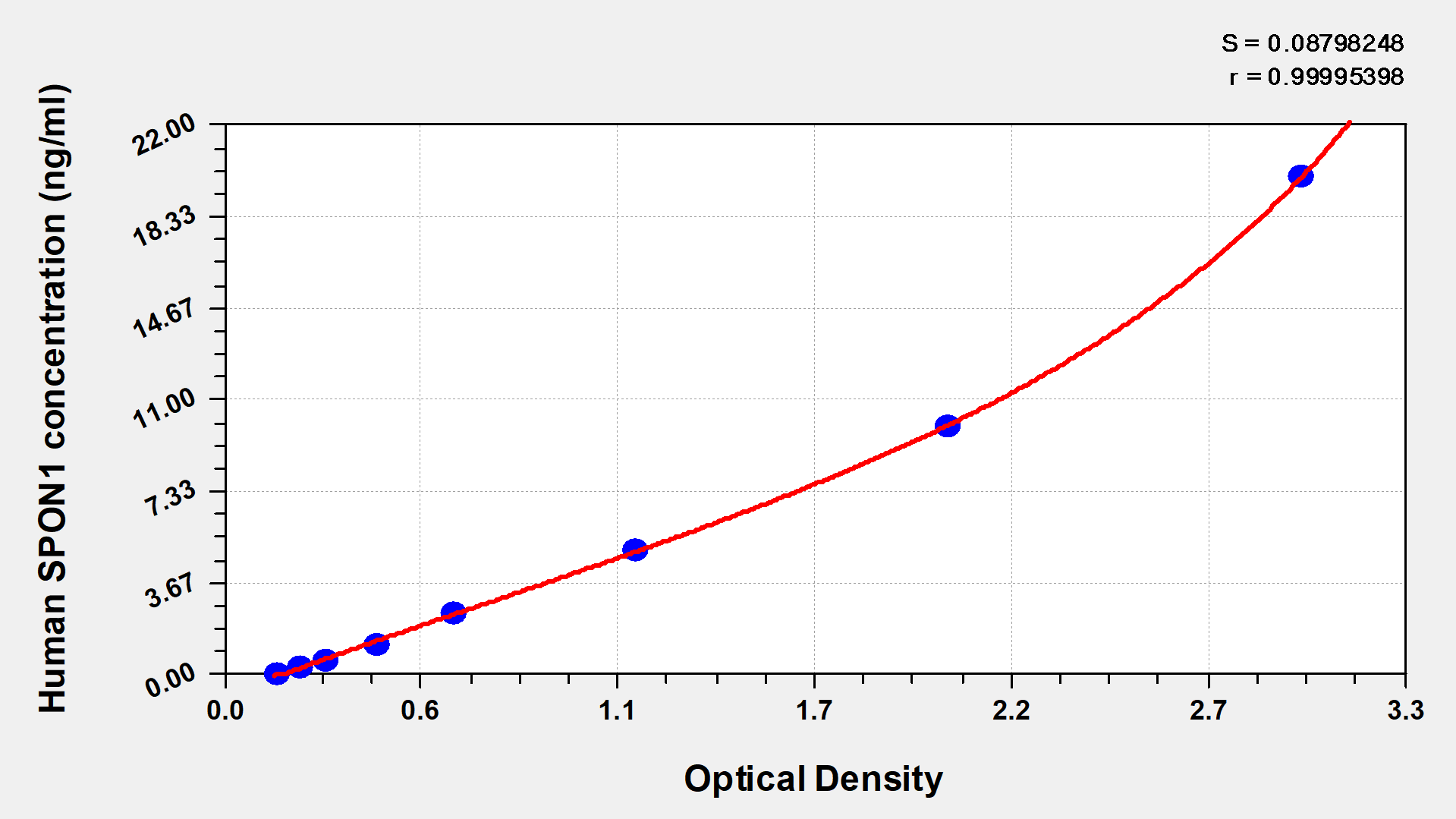 | ||||||
ng/ml | OD1 | OD2 | Average | Corrected | ||
20 | 3.068 | 2.934 | 3.001 | 2.840 | ||
10 | 2.078 | 1.967 | 2.022 | 1.862 | ||
5 | 1.183 | 1.128 | 1.155 | 0.995 | ||
2.5 | 0.666 | 0.641 | 0.654 | 0.493 | ||
1.25 | 0.449 | 0.431 | 0.440 | 0.280 | ||
0.625 | 0.305 | 0.293 | 0.299 | 0.138 | ||
0.312 | 0.228 | 0.217 | 0.223 | 0.062 | ||
0 | 0.164 | 0.157 | 0.161 |
| ||
This ELISA kit provides quantitative measurement of Spondin-1 (SPON1) in human samples, supporting neuroscience research into this extracellular matrix glycoprotein involved in axon guidance, neuronal development, and emerging roles in Alzheimer's disease pathology. Because SPON1 functions at the intersection of amyloid precursor protein processing and neurodevelopmental signaling, researchers need precise quantification across both circulating and tissue-level compartments.
Detection Range: The 0.312–20 ng/mL range aligns with reported SPON1 concentrations in human plasma and tissue lysates, covering both baseline physiological levels and the elevated expression observed in neurodegenerative contexts. Most serum and plasma samples can be assayed neat or with minimal dilution, simplifying workflow planning.
Sensitivity: At 0.156 ng/mL, the kit detects SPON1 in low-abundance conditions such as cerebrospinal fluid-adjacent fractions, conditioned media from primary neuronal cultures, or samples from early-stage neurodegeneration where subtle expression changes carry biological significance.
Sample Compatibility: Validation across serum, plasma, and tissue homogenates enables researchers to correlate circulating SPON1 levels with localized expression in brain tissue within the same study, bridging biomarker discovery and mechanistic investigation.
Assay Efficiency: The 1–5 hour protocol and 50–100 µL sample volume accommodate limited-volume specimens typical of paired CSF-plasma biobanking studies and primary neuron culture experiments.
This kit is directly applicable to Alzheimer's disease biomarker research, axon guidance pathway studies, and neurodevelopmental disorder investigations.
There are currently no reviews for this product.





