Recombinant Human G-protein coupled receptor 68 (GPR68), partial

In Stock
Code CSB-EP623012HU1
Abbreviation Recombinant Human GPR68 protein, partial
MSDS
Size $256
Order now
Image
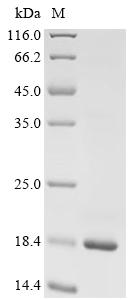
  • (Tris-Glycine gel) Discontinuous SDS-PAGE (reduced) with 5% enrichment gel and 15% separation gel.
Have Questions? Leave a Message or Start an on-line Chat

Product Details

Purity
≥85% as determined by SDS-PAGE.
Activity
Not Test
Target Names
Uniprot No.
Research Area
Signal Transduction
Alternative Names
G protein-coupled receptor 12A;Ovarian cancer G protein-coupled receptor 1
Species
Homo sapiens (Human)
Source
E.coli
Expression Region
290-365aa
Target Protein Sequence
SETTHRDLARLRGACLAFLTCSRTGRAREAYPLGAPEASGKSGAQGEEPELLTKLHPAFQTPNSPGSGGFPTGRLA
Note: The complete sequence may include tag sequence, target protein sequence, linker sequence and extra sequence that is translated with the protein sequence for the purpose(s) of secretion, stability, solubility, etc.
If the exact amino acid sequence of this recombinant protein is critical to your application, please explicitly request the full and complete sequence of this protein before ordering.
Mol. Weight
14.8 kDa
Protein Length
Partial
Tag Info
C-terminal 6xHis-tagged
Form
Liquid or Lyophilized powder
Note: We will preferentially ship the format that we have in stock, however, if you have any special requirement for the format, please remark your requirement when placing the order, we will prepare according to your demand.
Buffer
If the delivery form is liquid, the default storage buffer is Tris/PBS-based buffer, 5%-50% glycerol. If the delivery form is lyophilized powder, the buffer before lyophilization is Tris/PBS-based buffer, 6% Trehalose, pH 8.0.
Reconstitution
We recommend that this vial be briefly centrifuged prior to opening to bring the contents to the bottom. Please reconstitute protein in deionized sterile water to a concentration of 0.1-1.0 mg/mL.We recommend to add 5-50% of glycerol (final concentration) and aliquot for long-term storage at -20℃/-80℃. Our default final concentration of glycerol is 50%. Customers could use it as reference.
Troubleshooting and FAQs
Storage Condition
Store at -20°C/-80°C upon receipt, aliquoting is necessary for mutiple use. Avoid repeated freeze-thaw cycles.
Shelf Life
The shelf life is related to many factors, storage state, buffer ingredients, storage temperature and the stability of the protein itself.
Generally, the shelf life of liquid form is 6 months at -20°C/-80°C. The shelf life of lyophilized form is 12 months at -20°C/-80°C.
Lead Time
3-7 business days
Notes
Repeated freezing and thawing is not recommended. Store working aliquots at 4℃ for up to one week.
Datasheet & COA
Please contact us to get it.
Customer Reviews and Q&A

 Customer Reviews

There are currently no reviews for this product.

Submit a Review here

Target Background

Function
Proton-sensing receptor involved in pH homeostasis. May represents an osteoblastic pH sensor regulating cell-mediated responses to acidosis in bone. Mediates its action by association with G proteins that stimulates inositol phosphate (IP) production or Ca(2+) mobilization. The receptor is almost silent at pH 7.8 but fully activated at pH 6.8. Also functions as a metastasis suppressor gene in prostate cancer.
Gene References into Functions
  1. High GPR68 expression is associated with pancreatic ductal adenocarcinoma. PMID: 29092903
  2. different benzodiazepines exhibit a range of biases for OGR1, with sulazepam selectively activating the canonical Gs of the G protein signaling pathway, in heterologous expression systems, as well as in several primary cell types. PMID: 29042451
  3. Our results suggest that OGR1-dependent increases in TRPC4 expression may favour formation of highly Ca(2+) -permeable TRPC4-containing channels that promote transformed granule cell migration. Increased motility of cancer cells is a prerequisite for cancer invasion and metastasis, and our findings may point towards a key role for TRPC4 in progression of certain types of medullablastoma. PMID: 28627017
  4. Blocking of GPR68 or NF-small ka, CyrillicB activity severely attenuated acidification induced IL-8 production. PMID: 27166427
  5. These results suggest that zOGR1, but not GPR4, is also a metal-sensing G-protein-coupled receptor in addition to a proton-sensing G-protein-coupled receptor, although not all metals that activate hOGR1 activated zOGR1. PMID: 28270026
  6. data identify a role for GPR68 as a proton sensor that is required for proper enamel formation PMID: 27693231
  7. coexpression of OGR1- and G2A-enhanced proton sensitivity and proton-induced calcium signals. This alteration is attributed to oligomerization of OGR1 and G2A. The oligomeric potential locates receptors at a specific site, which leads to enhanced PMID: 27049592
  8. Proton-sensing GPCR-YAP Signalling Promotes Cancer-associated Fibroblast Activation of Mesenchymal Stem Cells PMID: 27019624
  9. The deconstruction of OGR1-dependent signaling may aid our understanding of mucosal inflammation mechanisms PMID: 26206859
  10. Provide evidence for the roles of OGR1 and ASIC1a in the regulation of intestinal passive Mg(2+) absorption. PMID: 24375028
  11. the expression of OGR1 in myeloid-derived cells, especially in double positive cells, was required for prostate tumor cell-induced immunosuppression. PMID: 23222714
  12. The involvement of ovarian cancer G-protein-coupled receptor 1 in acidic extracellular environment may be an underlying mechanism responsible for bone pain in osteoporosis or bone metastasis without clinically proved fractures. PMID: 22835475
  13. OGR1 activation increased intracellular calcium in transfected HEK293 cells. PMID: 22508039
  14. It indicated that OGR1 may be a tumor suppressor gene for ovarian cancer. PMID: 21740742
  15. extracellular acidification induces CTGF production through the OGR1/G(q/11) protein and inositol-1,4,5-trisphosphate-induced Ca(2+) mobilization in human airway smooth muscle cells. PMID: 21907704
  16. acidic pH-induced vascular actions of aortic smooth muscle cells can be dissected to OGR1-dependent and -independent pathways: COX-2 expression, PGI(2) production, and MKP-1 expression are mediated by OGR1, but PAI-1 expression is not. PMID: 20622109
  17. ovarian cancer G-protein-coupled receptor 1 (OGR1), previously described as a receptor for sphingosylphosphorylcholine, acts as a proton-sensing receptor stimulating inositol phosphate formation PMID: 12955148
  18. OGR1 was found to evoke strong pH-dependent responses as measured by inositol phosphate accumulation. PMID: 15665078
  19. cAMP accumulation may occur through OGR1-mediated stimulation of the phospholipase C/cyclooxygenase/PGI(2) pathway PMID: 16087674
  20. OGR1 is a novel metastasis suppressor gene for prostate cancer. OGR1's constitutive activity via G alpha(i) contributes to its inhibitory effect on cell migration in vitro. PMID: 17728215
  21. OGR1/G(q/11)/phospholipase C/protein kinase C pathway regulates osteoblastic COX-2 induction and subsequent PGE(2) production in response to acidic circumstances PMID: 18302504

Show More

Hide All

Involvement in disease
Amelogenesis imperfecta, hypomaturation type, 2A6 (AI2A6)
Subcellular Location
Cell membrane; Multi-pass membrane protein.
Protein Families
G-protein coupled receptor 1 family
Tissue Specificity
Found at low level in a wide range of tissues, but significantly expressed in lung, kidney, bone and nervous system.
Database Links

HGNC: 4519

OMIM: 601404

KEGG: hsa:8111

STRING: 9606.ENSP00000434045

UniGene: Hs.8882

icon of phone
Call us
301-363-4651 (Available 9 a.m. to 5 p.m. CST from Monday to Friday)
icon of address
Address
No. 269, Shendun 5th Road, Donghu Hi-Tech Development Area, Hubei Province, 430206, P.R.China
icon of social media
Join us with

Subscribe newsletter

Leave a message

* To protect against spam, please pass the CAPTCHA test below.
CAPTCHA verification
© 2007-2026 CUSABIO TECHNOLOGY LLC All rights reserved. 鄂ICP备15011166号-1
Place an order now

I. Product details

*
*
*
*

II. Contact details

*
*

III. Ship To

*
*
*
*
*
*
*

IV. Bill To

*
*
*
*
*
*
*
*



