Recombinant Pig Aldo-keto reductase family 1 member A1 (AKR1A1)

In Stock
Code CSB-EP001538PIa0
Abbreviation Recombinant Pig AKR1A1 protein
MSDS
Size $256
Order now
Image
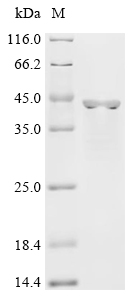
  • (Tris-Glycine gel) Discontinuous SDS-PAGE (reduced) with 5% enrichment gel and 15% separation gel.
Have Questions? Leave a Message or Start an on-line Chat

Product Details

Purity
Greater than 85% as determined by SDS-PAGE.
Activity
Not Test
Target Names
AKR1A1
Uniprot No.
Research Area
Cell Biology
Alternative Names
Alcohol dehydrogenase [NADP+;Aldehyde reductase;Glucuronate reductase;Glucuronolactone reductase
Species
Sus scrofa (Pig)
Source
E.coli
Expression Region
2-325aa
Target Protein Sequence
AASCVLLHTGQKMPLIGLGTWKSEPGQVKAAIKYALTVGYRHIDCAAIYGNELEIGEALQETVGPGKAVPREELFVTSKLWNTKHHPEDVEPALRKTLADLQLEYLDLYLMHWPYAFERGDNPFPKNADGTIRYDATHYKDTWKALEALVAKGLVRALGLSNFSSRQIDDVLSVASVRPAVLQVECHPYLAQNELIAHCQARGLEVTAYSPLGSSDRAWRDPNEPVLLEEPVVQALAEKYNRSPAQILLRWQVQRKVICIPKSVTPSRILQNIQVFDFTFSPEEMKQLDALNKNLRFIVPMLTVDGKRVPRDAGHPLYPFNDPY
Note: The complete sequence may include tag sequence, target protein sequence, linker sequence and extra sequence that is translated with the protein sequence for the purpose(s) of secretion, stability, solubility, etc.
If the exact amino acid sequence of this recombinant protein is critical to your application, please explicitly request the full and complete sequence of this protein before ordering.
Mol. Weight
42.4 kDa
Protein Length
Full Length of Mature Protein
Tag Info
N-terminal 6xHis-tagged
Form
Liquid or Lyophilized powder
Note: We will preferentially ship the format that we have in stock, however, if you have any special requirement for the format, please remark your requirement when placing the order, we will prepare according to your demand.
Buffer
If the delivery form is liquid, the default storage buffer is Tris/PBS-based buffer, 5%-50% glycerol. If the delivery form is lyophilized powder, the buffer before lyophilization is Tris/PBS-based buffer, 6% Trehalose, pH 8.0.
Reconstitution
We recommend that this vial be briefly centrifuged prior to opening to bring the contents to the bottom. Please reconstitute protein in deionized sterile water to a concentration of 0.1-1.0 mg/mL.We recommend to add 5-50% of glycerol (final concentration) and aliquot for long-term storage at -20°C/-80°C. Our default final concentration of glycerol is 50%. Customers could use it as reference.
Troubleshooting and FAQs
Storage Condition
Store at -20°C/-80°C upon receipt, aliquoting is necessary for mutiple use. Avoid repeated freeze-thaw cycles.
Shelf Life
The shelf life is related to many factors, storage state, buffer ingredients, storage temperature and the stability of the protein itself.
Generally, the shelf life of liquid form is 6 months at -20°C/-80°C. The shelf life of lyophilized form is 12 months at -20°C/-80°C.
Lead Time
3-7 business days
Notes
Repeated freezing and thawing is not recommended. Store working aliquots at 4°C for up to one week.
Datasheet & COA
Please contact us to get it.
Customer Reviews and Q&A

 Customer Reviews

There are currently no reviews for this product.

Submit a Review here

Target Background

Function
Catalyzes the NADPH-dependent reduction of a wide variety of carbonyl-containing compounds to their corresponding alcohols. Displays enzymatic activity towards endogenous metabolites such as aromatic and aliphatic aldehydes, ketones, monosaccharides and bile acids, with a preference for negatively charged substrates, such as glucuronate and succinic semialdehyde. Plays an important role in ascorbic acid biosynthesis by catalyzing the reduction of D-glucuronic acid and D-glucurono-gamma-lactone. Functions as a detoxifiying enzyme by reducing a range of toxic aldehydes. Reduces methylglyoxal and 3-deoxyglucosone, which are present at elevated levels under hyperglycemic conditions and are cytotoxic. Involved also in the detoxification of lipid-derived aldehydes like acrolein. Plays a role in the activation of procarcinogens, such as polycyclic aromatic hydrocarbon trans-dihydrodiols, and in the metabolism of various xenobiotics and drugs. Displays no reductase activity towards retinoids.
Gene References into Functions
  1. Structure of ALR1 in ternary complex with NADPH and 3,5-dichlorosalicylic acid is reported as well as the implications for inhibitor binding and selectivity. PMID: 18782556
Subcellular Location
Cytoplasm, cytosol. Apical cell membrane.
Protein Families
Aldo/keto reductase family
Database Links

KEGG: ssc:396924

UniGene: Ssc.14521

icon of phone
Call us
301-363-4651 (Available 9 a.m. to 5 p.m. CST from Monday to Friday)
icon of address
Address
7505 Fannin St., Ste 610, Room 7 (CUBIO Innovation Center), Houston, TX 77054, USA
icon of social media
Join us with

Subscribe newsletter

Leave a message

* To protect against spam, please pass the CAPTCHA test below.
CAPTCHA verification
© 2007-2026 CUSABIO TECHNOLOGY LLC All rights reserved. 鄂ICP备15011166号-1
Place an order now

I. Product details

*
*
*
*

II. Contact details

*
*

III. Ship To

*
*
*
*
*
*
*

IV. Bill To

*
*
*
*
*
*
*
*



