
Call us
301-363-4651 (Available 9 a.m. to 5 p.m. CST from Monday to Friday)

| Code | CSB-EP347478THA |
| Abbreviation | Recombinant Toxocara canis TES-26 protein |
| MSDS | |
| Size | US$388 |
| Order now | |
| Image |
|
| Have Questions? | Leave a Message or Start an on-line Chat |
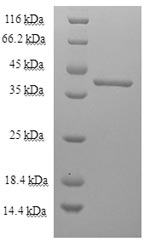
Recombinant Toxocara canis 26KDA secreted antigen (TES-26) is produced in E. coli and contains the full mature protein from amino acids 22 to 262. This protein carries an N-terminal 6xHis-SUMO tag, which appears to help with purification and detection. The product reaches a purity greater than 90% as verified by SDS-PAGE analysis, suggesting it meets high-quality standards for research applications.
TES-26 is a secreted antigen from Toxocara canis, the canine roundworm. In biological research, scientists study TES-26 for its potential role in host-parasite interactions, particularly in immune response mechanisms. As a secreted protein, it likely participates in modulating host immune systems, making it an interesting subject for parasitology and immunology studies.
Potential Applications
Note: The applications listed below are based on what we know about this protein's biological functions, published research, and experience from experts in the field. However, we haven't fully tested all of these applications ourselves yet. We'd recommend running some preliminary tests first to make sure they work for your specific research goals.
Based on the provided information, the recombinant Toxocara canis TES-26 antigen is expressed in E. coli, a prokaryotic system that is generally unsuitable for producing properly folded eukaryotic secretory proteins. TES-26 is a secreted antigen from a parasitic nematode that likely requires specific folding, disulfide bond formation, and potential glycosylation for its native structure and antigenic properties. While the protein is expressed as the mature form (22-262aa) with an N-terminal 6xHis-SUMO tag and >90% purity, E. coli lacks the eukaryotic chaperones and post-translational modification machinery necessary for correct folding of complex parasitic antigens. The SUMO tag may improve solubility, but cannot compensate for the lack of a proper eukaryotic folding environment. Since activity is unverified, the protein cannot be assumed to be correctly folded or to possess native antigenic properties without experimental validation.
1. Antibody Development and Validation Studies
The recombinant TES-26 can serve as an effective immunogen for generating antibodies that recognize linear epitopes, even if the protein is misfolded. The high purity and His-SUMO tag facilitate purification and screening. However, antibodies may not recognize conformational or glycosylation-dependent epitopes of native TES-26 from parasite secretions. Validation against native antigen from T. canis is recommended.
2. Protein-Protein Interaction Studies Using Tag-Assisted Pull-Down Assays
This application is high-risk without folding validation. While the tags enable technical feasibility for pull-down assays, if TES-26 is misfolded (as likely in E. coli), it will not interact physiologically with true host binding partners. Parasitic antigens require specific conformations for proper host protein interactions. Identified interactions could be non-physiological artifacts. This application should not be pursued without confirmation of proper folding.
3. Biochemical Characterization
Basic biochemical characterization is feasible with limitations. The TES-26 protein can be used for biophysical studies (size-exclusion chromatography, circular dichroism) to assess folding state. However, activity screening should be limited to validated functions of TES-26.
4. Immunological Response Studies in Animal Models
This application requires caution. If TES-26 is misfolded, it may not elicit immune responses representative of natural T. canis infection. The antigenic properties may differ significantly from the native TES-26 protein. This application should only be pursued after confirming proper folding and antigenic similarity to native TES-26.
Final Recommendation & Action Plan
Given the high probability of misfolding in E. coli for this eukaryotic parasitic antigen, recommend first performing comprehensive validation: 1) Biophysical characterization (circular dichroism for secondary structure, size-exclusion chromatography for oligomeric state); 2) Immunological validation comparing antibody reactivity with native TES-26 from T. canis secretions; 3) Structural validation if possible. Antibody development can proceed as the safest application. Avoid all functional studies (interactions, immunological models) until proper folding and antigenic properties are confirmed. For reliable TES-26 research, obtain native antigen from parasite sources or use eukaryotic expression systems for recombinant production.

Applications : Binding assay/Protein-protein interaction, ELISA standard and its raw materials
Review: We had a very good experience working with both Cusabio and this protein. The protein itself arrived very quickly after ordering (overnight) and upon our internal QC, the purity was appropriate for our assays (>85%). Beyond this, the customer service with Lili and Linda was exceptional. We reached out after receiving the protein to inquire about the full sequence including the tags, and they responded within 1 business day. We will definitely be reordering this protein when we run out and will continue to use Cusabio products following this experience.
By Anonymous





